
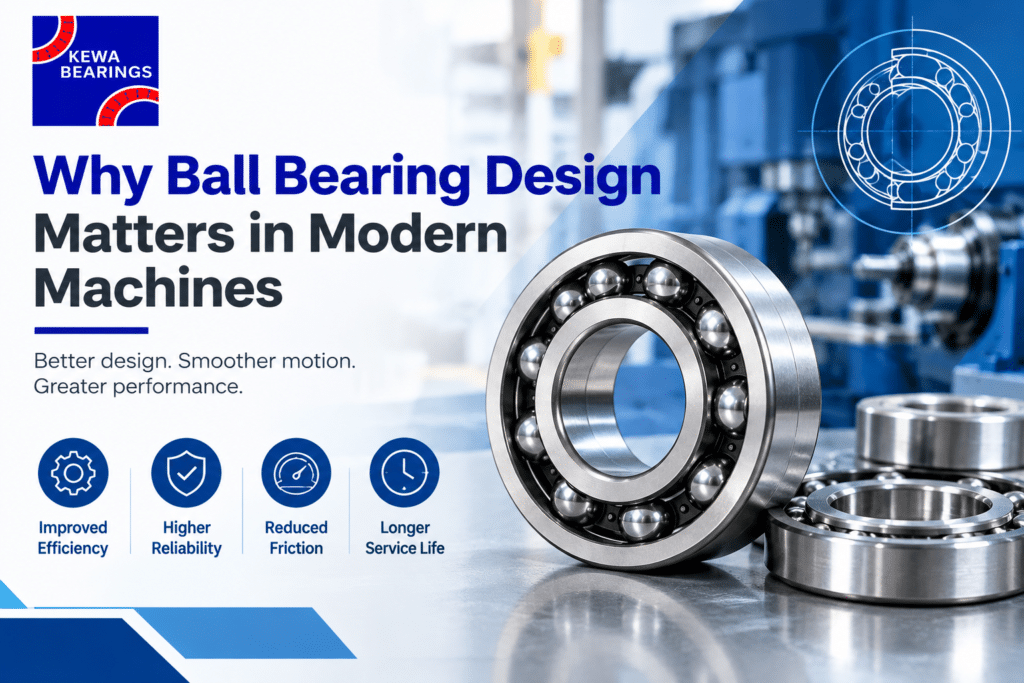
Modern machines run better when motion is steady and dependable. Ball bearings let parts carry loads and they help shafts spin with less drag. Even so, what matters is not just the size of the bearing. Good ball bearing design depends on several practical items, like the material choice, the load rating, the max speed, the way it is greased or oiled, and the conditions where it works.
A solid design can raise overall efficiency, slow down wear, help manage heat, and keep the machine running longer. A bad fit or wrong setup can lead to shaky motion, hot running, and early breakdown.
What Is Ball Bearing Design?
Ball bearing design is about how the bearing is built and made to fit certain operating needs. Usually a ball bearing has an inner ring, an outer ring, rolling balls, and a cage. Each part has a job. Together they help the motion stay smooth and steady.
The inner ring goes on the shaft. The outer ring sits in the machine housing. How the rolling elements are sized and placed matters. The raceway shape matters too. Internal clearance affects how the parts act during use. Material choice also changes how well the bearing lasts. Even the cage build has an effect.
Lubrication is not optional. It lowers friction and helps guard the inside parts against fast wear. A good ball bearing design supports the speed the system needs, the load it sees, the heat it runs at, and the environment it works in. When the design fits, the machine can run with less trouble and more dependable results.
Why Does Ball Bearing Design Matter?
Machines often operate under demanding conditions. Some equipment runs continuously for several hours, while others operate at very high speeds or carry heavy loads. A bearing must be capable of handling these conditions without excessive wear.
Good bearing design helps distribute loads across the rolling elements. It also reduces unnecessary friction between moving components. This can help the machine operate more smoothly and reduce the amount of energy lost through mechanical resistance.
The right ball bearing design can also support longer service intervals. When a bearing is correctly matched to its application, there is less risk of overheating, surface damage, excessive vibration, or premature failure.
For manufacturers and machine operators, this can translate into improved reliability and reduced maintenance requirements.
1. Reduces Friction
One of the main purposes of a ball bearing is to reduce friction between moving components. Without a bearing, direct contact between a rotating shaft and its housing could create considerable resistance and heat.
Ball bearings replace much of this sliding contact with rolling contact. The balls move along the raceways, allowing the shaft to rotate with less resistance.
The geometry of the bearing has a direct effect on this process. Properly designed raceways and rolling elements help maintain smooth movement and reduce unnecessary friction.
This is especially important in applications where machines operate continuously or at high rotational speeds.
2. Supports Different Types of Loads
Machines can experience different types of loads. Some applications mainly involve radial loads, while others may also experience axial or combined loads.
A suitable bearing needs to accommodate the load conditions of its application. The number and size of rolling elements, raceway geometry, internal clearance, and bearing dimensions can all influence load-handling capability.
A well-planned ball bearing design helps distribute the applied load effectively instead of concentrating excessive stress on a small area.
This is one reason engineers consider the operating load before selecting a bearing for a particular machine.
3. Helps Improve Machine Efficiency
Energy efficiency matters a lot in today’s industries. When machines run all day, even minor mechanical drag can add up to wasted energy.
The right bearing shape inside and the right lubricant can cut friction. When friction drops, motors and other drive parts often run with less wasted power.
A bearing is small next to the whole machine. Still, what it does can affect how well the entire setup performs.
That is why ball bearing design gets attention during the build of many modern mechanical systems.
4. Handles High-Speed Applications
Lots of today’s machines, like electric motors, pumps, turbines, and machine tools, run fast and need bearings that fit the job. When the RPM climbs, several things start to matter more: friction and heat, how well lubrication holds up, how the cage is built, and the internal clearance. So you should not pick a bearing only by its outer size. You also need to check what speed it can handle and what the operating conditions demand.
5. Controls Heat and Wear
Friction creates heat. That heat can change how well a lubricant works, and it may raise wear if nobody manages it. Heat control matters.
The shape of a bearing matters too. So does the choice of material. And using lubricant correctly helps keep temperatures in check and limits extra harm. A good ball bearing design also supports the rolling parts. Those rolling elements can take repeated loads. That can reduce the chance of early failure. If the selection is right and upkeep is done on time, bearings can stay dependable for longer.
6. Improves Reliability
Unexpected bearing failure can lead to expensive downtime and slow production. A bearing has to fit the load, the speed, the heat level, and the actual working conditions. Good ball bearing design also pays attention to tight dimensions, strong materials, smooth surface finish, and steady manufacturing. These factors support steadier operation and help the machine run better over time.
7. Reduces Noise and Vibration
Noise and vibration can affect machine accuracy and increase component wear. Proper bearing geometry, precision manufacturing, and correct cage design help maintain smooth rotation. When the right bearing is properly installed, it can support quieter operation and reduce unnecessary vibration.
8. Supports Different Industrial Applications
Ball bearings are widely used in electric motors, pumps, fans, conveyors, automobiles, agricultural machinery, and household appliances. However, each machine has different load, speed, and operating requirements. Understanding ball bearing design helps engineers select the right bearing based on actual application needs, not just its dimensions.
9. Material Selection Matters
Bearing materials affect strength, durability, wear resistance, and overall performance. Rings and rolling elements are commonly made from bearing steels, while cages may use steel, brass, or polymers depending on the application. A reliable ball bearing design combines suitable materials with precise manufacturing to handle the required load, speed, temperature, and operating conditions.
10. Proper Lubrication Is Essential
Proper lubrication is essential for reducing friction and wear in bearings. Grease or oil should be selected based on factors such as speed, temperature, load, and operating conditions. Too little or excessive lubrication can cause problems, so the right amount and type should be used for reliable bearing performance.
How to Choose the Right Ball Bearing?
Choosing a bearing starts with understanding the application. Engineers and maintenance professionals should consider the load type, load magnitude, shaft speed, temperature, available space, lubrication method, and expected operating life.
The bearing dimensions must also match the shaft and housing accurately. Installation conditions are equally important because incorrect fitting can damage the bearing even when the product itself is suitable.
Environmental factors should also be considered. Dust, moisture, chemicals, vibration, and extreme temperatures can influence bearing performance.
Working with a reliable bearing manufacturer or supplier can help businesses identify a suitable product for their specific machine requirements.
Why Quality Manufacturing Matters
Bearing performance depends on both design and manufacturing quality. Even small differences in dimensions, surface finish, roundness, or component alignment can affect how smoothly a bearing operates. Precision manufacturing and strict quality checks help ensure that each bearing delivers consistent performance during regular use.
High-quality bearings can reduce friction, vibration, and unnecessary wear, helping machines operate more efficiently. For industrial users, choosing bearings from a trusted manufacturer like Kewa Bearings can provide better reliability and application suitability. Selecting the correct bearing specification can also help extend service life, reduce maintenance requirements, and prevent avoidable machine downtime.
Conclusion
Ball bearings matter because they cut friction, carry loads, and help machines run smoothly. A good ball bearing design depends on things such as the load size, the operating speed, the material used, how it is lubricated, and the conditions where it works.
Pick the right bearing first, then keep up with maintenance. When that is done, machines tend to run with better efficiency, break less often, and usually last longer.
FAQs
1. What is ball bearing design?
It refers to the engineering and construction of a ball bearing, including its rings, balls, cage, internal clearance, materials, and geometry.
2. Why are ball bearings used in machines?
They reduce friction and allow shafts and other moving components to rotate smoothly.
3. Can ball bearings handle heavy loads?
Some ball bearings are designed for substantial loads, but the correct bearing must be selected according to the application’s load requirements.
4. Do ball bearings work at high speeds?
Yes. Certain ball bearings are specifically designed for high-speed applications.
5. How does lubrication affect bearing life?
Proper lubrication reduces friction and wear and helps protect the bearing’s contacting surfaces.
6. What causes ball bearing failure?
Common causes include incorrect installation, inadequate lubrication, contamination, overloading, excessive speed, and unsuitable bearing selection.
7. How can bearing noise be reduced?
Using the correct bearing, maintaining proper lubrication, ensuring accurate installation, and preventing contamination can help reduce unwanted noise.
8. Why is bearing material important?
Material affects strength, wear resistance, temperature capability, and overall durability.
9. Where are ball bearings commonly used?
They are widely used in motors, pumps, fans, conveyors, automobiles, agricultural equipment, appliances, and industrial machinery.
10. How do I select the right ball bearing?
Consider the load, speed, temperature, dimensions, lubrication, environment, and expected operating conditions before selecting a bearing.
Pingback: What Makes Bearing Material Strong and Long-Lasting? - KEWA BEARINGS