
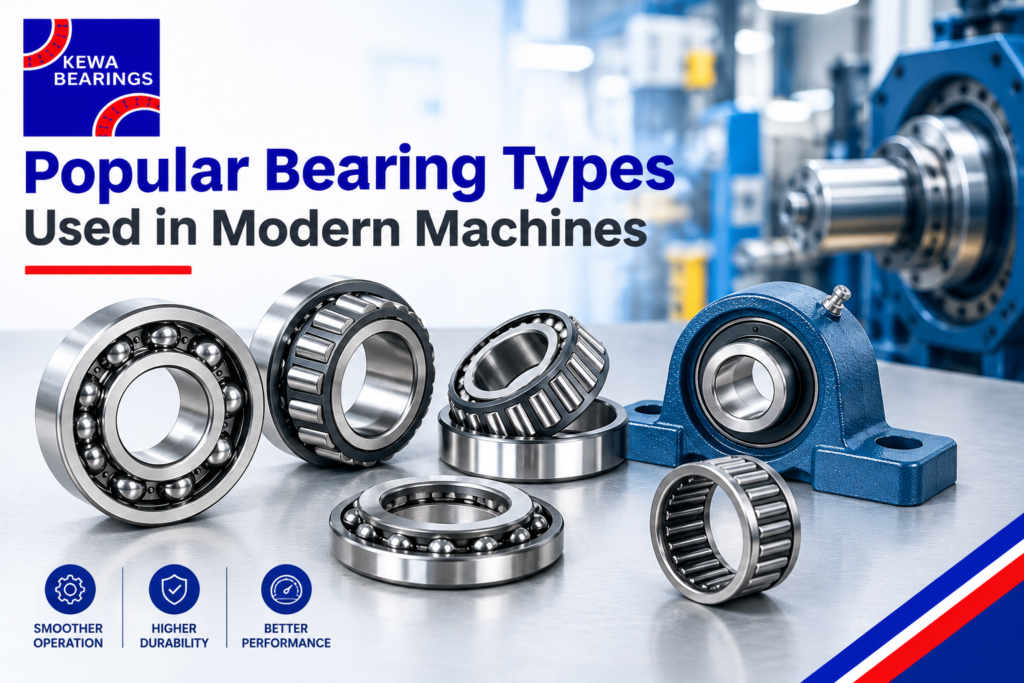
Modern machines may look very different from one another, but many of them depend on the same basic principle: parts need to move smoothly. From electric motors and pumps to cars, conveyors, construction equipment, and factory machines, rotating shafts are working almost everywhere. Bearings help these moving parts run with less friction and support the loads placed on them.
Choosing the right bearing is important because every machine has different working conditions. Some machines need to carry heavy radial loads, while others deal with axial forces, high speeds, vibration, or slight shaft misalignment. Understanding different bearings types makes it easier to see why one bearing may work well in a particular application while another may not.
What Is a Bearing?
A bearing is a mechanical component that supports a rotating or moving part and allows it to move with less friction. In many machines, a bearing sits around a shaft and helps the shaft rotate smoothly while carrying the load.
Most rolling bearings have an inner ring, an outer ring, rolling elements, and a cage. The rolling elements may be balls or rollers, depending on the bearing design. Some bearings are sealed or shielded to keep dust and other contaminants away from the internal parts.
Why Are Bearings Important in Machines?
A machine can have a powerful motor and strong components, but poor bearing performance can still affect the entire system. Too much friction creates heat, wastes energy, and increases wear. Over time, this can lead to noise, vibration, downtime, and unexpected maintenance.
The right bearing helps keep movement smooth and supports the shaft under its working load. This is particularly important in modern industrial equipment, where machines may run for long hours with very little stopping time.
Popular Bearing Types Used in Modern Machines
There are many bearings types available for different applications. The choice depends on factors such as load, speed, space, alignment, temperature, lubrication, and the environment in which the machine operates.
Deep Groove Ball Bearings
Deep groove ball bearings are probably the most familiar type of rolling bearing. They have balls between the inner and outer rings and can handle radial loads as well as moderate axial loads.
Because of their simple design and versatility, they are used in electric motors, fans, pumps, conveyors, household appliances, and many general-purpose machines. They are available in different sizes and configurations, including sealed and shielded versions.
Cylindrical Roller Bearings
Cylindrical roller bearings use cylindrical rollers instead of balls. The rollers provide a larger contact area, allowing these bearings to handle high radial loads.
They are often found in gearboxes, generators, electric motors, pumps, and other industrial equipment. Depending on the design, some versions can also accommodate axial movement. Good lubrication and correct installation are important for keeping them working reliably.
Tapered Roller Bearings
Tapered roller bearings have tapered rollers and raceways. This design allows them to handle both radial and axial loads, which makes them useful when a machine experiences combined forces.
These bearings are commonly used in vehicle wheel systems, gearboxes, industrial machinery, and other demanding applications. They are often installed in pairs so that axial loads can be supported in both directions.
Spherical Roller Bearings
Spherical roller bearings are made for applications where heavy loads and demanding operating conditions are common. One of their useful features is their ability to accommodate a certain amount of shaft or housing misalignment.
They are frequently used in mining equipment, crushers, conveyors, steel plants, cement machinery, and paper-making equipment. They can handle heavy radial loads and are suitable for applications where vibration or shock loads may occur.
Needle Roller Bearings
Needle roller bearings use long and thin rollers. Their compact design makes them useful when there is not much radial space available but the application still needs good load-carrying capacity.
They are commonly used in automotive components, transmissions, pumps, compressors, and other compact mechanisms. Their small cross-section can help engineers save space while maintaining the required bearing performance.
Thrust Ball Bearings
Thrust ball bearings are mainly designed to carry axial loads, meaning loads that act along the shaft. They are generally used where the axial position of a rotating component needs to be supported.
These bearings can be found in machine tools, automotive applications, and other mechanisms with relatively light radial loads. The correct bearing should be selected according to the load, speed, and operating conditions.
Thrust Roller Bearings
When axial loads are higher, thrust roller bearings may be considered. Instead of balls, these bearings use rollers to carry the load. Depending on the design, they may use cylindrical, tapered, or spherical rollers.
They are used in heavy machinery, gearboxes, industrial drives, and equipment where significant thrust forces are present. Proper lubrication and load selection are important for dependable performance.
Pillow Block Bearings
Pillow block bearings are supplied with a housing, making them convenient to mount on machine frames. They are commonly used when a rotating shaft needs support outside the main machine body.
You can find them in conveyor systems, agricultural machinery, fans, material-handling equipment, and processing machines. Their ready-to-mount design can make installation and replacement easier.
Self-Aligning Ball Bearings
Self-aligning ball bearings are designed to handle small amounts of misalignment between the shaft and housing. This can be helpful in applications where maintaining perfect alignment during operation is difficult.
They are used in conveyor systems, textile machinery, long shafts, and other equipment where alignment can change slightly during operation. However, they should not be treated as a solution for major alignment problems.
How to Choose the Right Bearing
Selecting between different bearings types is not simply a matter of choosing the biggest or most expensive option. The actual working conditions of the machine should guide the decision.
Start by checking the type and size of the load. Next, consider shaft speed, shaft diameter, available installation space, operating temperature, lubrication, vibration, contamination, and expected service life. Shaft alignment is another important factor, especially for equipment that may experience movement during operation.
For example, a high-speed electric motor may need a bearing designed for smooth operation at high rotational speeds. Heavy industrial equipment, on the other hand, may require a roller bearing that can handle substantial loads. A dusty working environment may also require suitable sealing or shielding.
Installation and Maintenance Matter Too
Buying a quality bearing is only part of the job. Installation has a direct effect on bearing performance and service life. Excessive force, incorrect fitting, contamination, or poor alignment can damage a bearing before the machine even starts operating.
Lubrication also needs attention. Too little lubricant can increase friction and heat, while the wrong lubricant or excessive lubrication can create other problems. Regular checks for unusual noise, vibration, temperature, or visible wear can help identify issues early.
Knowing bearings types helps teams choose confidently. Different bearings types suit different loads and applications. Comparing bearings types can reduce selection mistakes and help improve machine reliability. Choosing the right bearings types for specific operating conditions can also support longer service life.
Why Choose Quality Bearings?
A bearing may be a relatively small component, but its failure can stop an entire machine. For this reason, quality, correct sizing, and application suitability should all be considered before making a selection.
Kewa Bearings offers bearing solutions for different industrial and mechanical applications. Understanding the application first helps users choose a suitable product instead of simply selecting a bearing based on size or price.
Conclusion
Bearings play a key role in keeping modern machines moving smoothly. From deep groove ball bearings and cylindrical roller bearings to tapered, spherical, needle, and thrust designs, each type has its own purpose.
Understanding the main bearings types can make bearing selection much easier. Still, the final choice should be based on the machine’s actual load, speed, alignment, environment, lubrication needs, and available space. A suitable bearing, combined with correct installation and regular maintenance, can help reduce friction, limit wear, and support reliable machine performance.
FAQs
1. What does a bearing do?
A bearing supports moving parts and reduces friction between them.
2. Which bearing is commonly used in machines?
Deep groove ball bearings are widely used because they are versatile and easy to apply.
3. Which bearing is suitable for heavy radial loads?
Cylindrical and spherical roller bearings are commonly used for high radial loads.
4. What are tapered roller bearings used for?
They are used where both radial and axial loads need to be supported.
5. Where are needle roller bearings useful?
They are useful when installation space is limited but good load capacity is needed.
6. What are thrust bearings designed for?
Thrust bearings are mainly designed to support axial loads along the shaft.
7. Can bearings handle misalignment?
Some bearings, such as spherical roller and self-aligning ball bearings, can handle limited misalignment.
8. Why is bearing lubrication important?
Proper lubrication helps reduce friction, heat, and wear during operation.
9. What can cause bearing failure?
Poor lubrication, contamination, incorrect installation, overload, and misalignment can cause early failure.
10. How do I choose the right bearing?
Consider the load, speed, shaft size, space, temperature, alignment, lubrication, and working environment.
Pingback: Why Ball Bearing Design Matters in Modern Machines - KEWA BEARINGS