
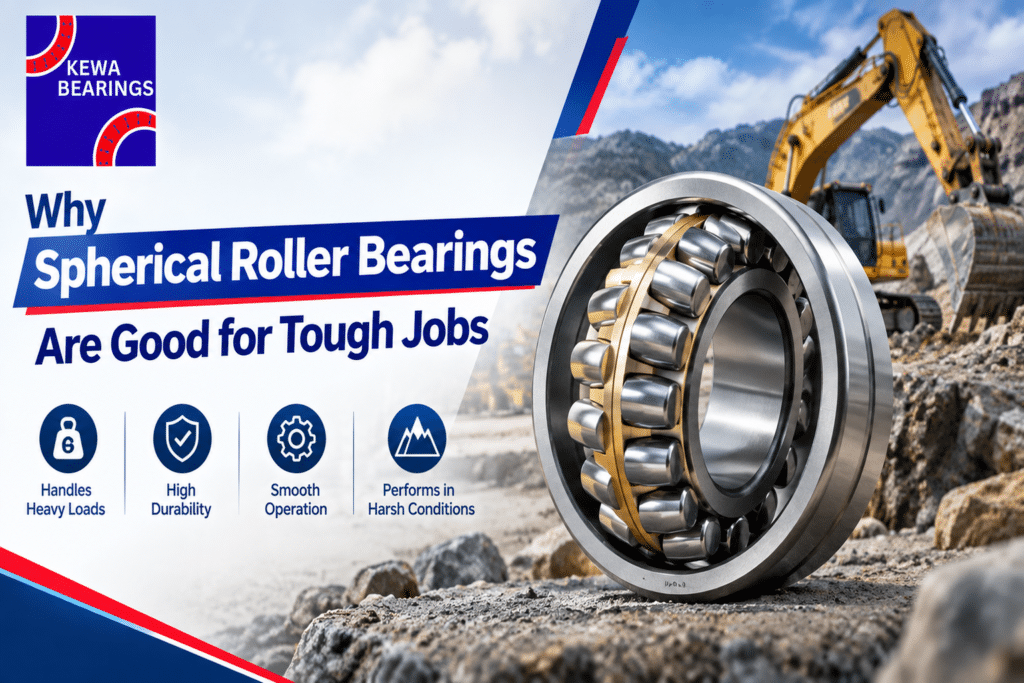
Industrial machinery often operates under heavy loads, vibration, shock, dust, temperature changes, and shaft misalignment. In such conditions, every component must provide reliable performance.
Bearings support rotating shafts, reduce friction, and ensure smooth machine movement. For demanding applications, spherical roller bearings are widely used because of their high load capacity, ability to handle misalignment, and strong construction. They are commonly found in mining, steel, cement, paper, construction, and material-handling equipment.
But what makes them suitable for tough industrial jobs? Let’s explore their key features and applications.
What Are Spherical Roller Bearings?
Spherical roller bearings are rolling-element bearings that use barrel-shaped rollers positioned between an inner ring and an outer ring. The outer ring has a spherical raceway, which allows the rollers to adjust their position during operation.
One of their most useful characteristics is their ability to accommodate a certain degree of misalignment between the shaft and housing. In industrial machinery, perfect alignment may not always be possible because of shaft deflection, mounting errors, housing deformation, or thermal expansion.
Instead of allowing these conditions to put excessive stress on the bearing, the spherical design provides flexibility during operation.
These bearings are available in different sizes and designs to suit various industrial requirements. The appropriate bearing should always be selected according to the machine’s load, speed, temperature, lubrication, and operating environment.
1. Excellent Load-Carrying Capacity
Heavy machinery often places significant loads on rotating shafts. If a bearing cannot handle these loads properly, it can experience excessive wear, overheating, or premature failure.
Spherical roller bearings are capable of handling high radial loads. Their multiple rollers distribute the load across a larger contact area, allowing them to support heavy rotating components.
This makes them suitable for applications such as crushers, conveyors, gearboxes, rolling mills, and heavy industrial equipment.
Their load-handling ability is particularly useful in machines that operate continuously or experience changing loads throughout the working cycle.
2. Ability to Accommodate Misalignment
Shaft and housing alignment is extremely important for bearing performance. However, industrial machinery can experience small alignment changes during operation.
Shaft bending, thermal expansion, mounting inaccuracies, and housing deformation can all contribute to misalignment. A bearing that cannot accommodate such movement may experience additional internal stress.
The spherical outer raceway of these bearings allows the bearing components to adjust to a certain degree of angular misalignment. This makes them useful for machines where operating conditions can affect alignment.
It is important to remember that this feature does not mean alignment can be ignored. Proper shaft and housing alignment is still essential for achieving good bearing performance.
3. Suitable for Heavy-Duty Machinery
Many industrial machines are expected to work for long hours with minimal interruption. Equipment used in mining, cement plants, steel production, and material handling may operate under demanding conditions every day.
The robust construction of spherical roller bearings makes them suitable for many heavy-duty applications.
They can support rotating shafts in machines exposed to high loads, vibration, and demanding operating cycles. When properly selected and maintained, they can contribute to stable machine operation and help reduce unnecessary maintenance interruptions.
4. Handles Shock and Vibration
Industrial machinery does not always operate under smooth and consistent conditions. Crushers, conveyors, construction equipment, and heavy processing machinery can experience sudden impacts and continuous vibration.
Excessive vibration can affect bearing performance and may contribute to wear if the bearing is not suitable for the application.
The strong design and multiple rolling elements of these bearings make them suitable for many applications where vibration and shock loads are present.
However, bearing selection should always consider the actual operating conditions. Load levels, speed, vibration, lubrication, mounting, and environmental factors can all influence performance.
5. Supports Combined Loads
In many machines, bearings are exposed to more than one type of force. A rotating shaft may experience both radial and axial loads during operation.
Spherical roller bearings can handle high radial loads and are also capable of accommodating axial loads within their design limits. This makes them useful for equipment where the direction and nature of the load can vary.
Understanding the load conditions of a machine is important when selecting a bearing. Using a bearing that is appropriately rated for the application’s load can help support reliable operation and reduce the possibility of premature damage.
6. Useful Across Multiple Industries
One of the reasons these bearings are widely used is their versatility. Different industries have different machinery requirements, but many of them face similar challenges involving heavy loads, vibration, and continuous operation.
Common applications include:
- Mining and quarrying machinery
- Cement plant equipment
- Steel and metal-processing machines
- Paper mill machinery
- Conveyor systems
- Crushers
- Gearboxes
- Industrial fans
- Material-handling equipment
- Construction machinery
- Power-generation equipment
The exact bearing type and specification should be chosen according to the machine’s operating requirements.
7. Can Support Continuous Industrial Operation
Production facilities often depend on machines that operate for extended periods. Unexpected bearing problems can result in equipment downtime and maintenance costs.
Using the correct bearing can help support consistent machine performance. Spherical roller bearings are designed for demanding applications where reliable shaft support is required.
However, bearing performance depends on more than the bearing itself. Correct installation, proper lubrication, suitable operating speed, adequate sealing, and regular inspection all play important roles.
A good maintenance program can also help identify early warning signs such as abnormal noise, overheating, unusual vibration, or lubricant contamination.
8. Importance of Proper Lubrication
Lubrication is an important part of bearing maintenance. It helps reduce friction between the rolling elements and raceways while also helping manage heat and wear.
Using the correct lubricant in the correct quantity is essential. Both insufficient and excessive lubrication can cause problems.
The appropriate lubrication method depends on the bearing design and operating conditions. Factors such as speed, temperature, load, environment, and operating cycle should be considered when developing a lubrication schedule.
Regular maintenance teams should also check for lubricant contamination or deterioration.
9. Correct Installation Matters
Even a high-quality bearing can experience problems if it is installed incorrectly. Excessive mounting force, improper tools, incorrect clearances, contamination, or poor alignment can affect bearing performance.
During installation, manufacturers’ recommendations should be followed carefully. The shaft, housing, seals, and related components should also be inspected to ensure they are in suitable condition.
Proper installation helps the bearing operate as intended and can reduce the risk of unnecessary damage during the early stages of service.
How to Choose the Right Bearing for Tough Jobs
Selecting a bearing should be based on the actual requirements of the machine rather than simply choosing the largest or strongest-looking option.
Important factors include:
Load: Determine the radial and axial forces acting on the bearing.
Speed: Check the required operating speed and ensure the bearing is suitable.
Temperature: Consider normal and maximum operating temperatures.
Misalignment: Understand whether the application may experience shaft or housing misalignment.
Lubrication: Select an appropriate lubrication method and maintenance schedule.
Environment: Consider dust, moisture, chemicals, heat, and other contaminants.
Installation: Make sure the bearing can be correctly installed and maintained.
A proper evaluation of these factors can help businesses select a bearing that matches their equipment and operating conditions.
Why Kewa Bearings?
For industrial machinery, bearing quality and correct application are both important. Kewa Bearings focuses on providing bearing solutions for a variety of industrial requirements.
From heavy machinery to material-handling systems, industrial equipment requires components that can perform reliably under demanding conditions. Kewa Bearings can help businesses identify suitable bearing solutions based on their application requirements.
The goal is not simply to choose a bearing but to select the right bearing for the specific load, speed, environment, and operating conditions of the machine.
Conclusion
Tough industrial jobs need components that can handle heavy loads, vibration, and demanding conditions. Spherical roller bearings are well suited for such machinery because they offer high radial load capacity and can accommodate certain misalignment.
They are widely used in mining, steel, cement, paper, construction, and material-handling industries. However, proper installation, lubrication, alignment, inspection, and maintenance are also essential for reliable performance.
Choosing the right bearing and maintaining it properly can help machinery run smoothly, efficiently, and reliably.
FAQs
1. What are spherical roller bearings?
They are rolling-element bearings designed to handle heavy radial loads while accommodating a certain degree of shaft misalignment.
2. What are spherical roller bearings used for?
They are commonly used in mining equipment, conveyors, crushers, gearboxes, steel machinery, paper mills, and other heavy-duty industrial applications.
3. Can these bearings handle heavy loads?
Yes. Their design allows them to handle high radial loads and certain axial loads within their specified operating limits.
4. Can they accommodate shaft misalignment?
Yes. Their spherical outer raceway allows them to accommodate a certain degree of angular misalignment between the shaft and housing.
5. Are they suitable for vibrating machinery?
They can be suitable for many applications involving vibration and shock loads, provided the bearing is correctly selected for the operating conditions.
6. Which industries use these bearings?
Mining, cement, steel, paper, construction, power generation, material handling, and other industrial sectors commonly use them.
7. How does lubrication affect bearing performance?
Proper lubrication helps reduce friction, control heat, minimize wear, and support reliable bearing operation.
8. How can I extend the service life of a bearing?
Correct installation, proper lubrication, suitable alignment, regular inspection, and protection from contamination can help improve bearing service life.
9. What factors should be considered when selecting a bearing?
Load, speed, shaft size, operating temperature, lubrication, misalignment, environment, and machine design should all be considered.
10. Why are these bearings suitable for tough industrial jobs?
Their robust construction, high load-carrying capacity, and ability to accommodate certain misalignment conditions make them suitable for many demanding industrial applications.
Pingback: Shop Spherical Roller Bearings for Industrial Machines - KEWA BEARINGS