
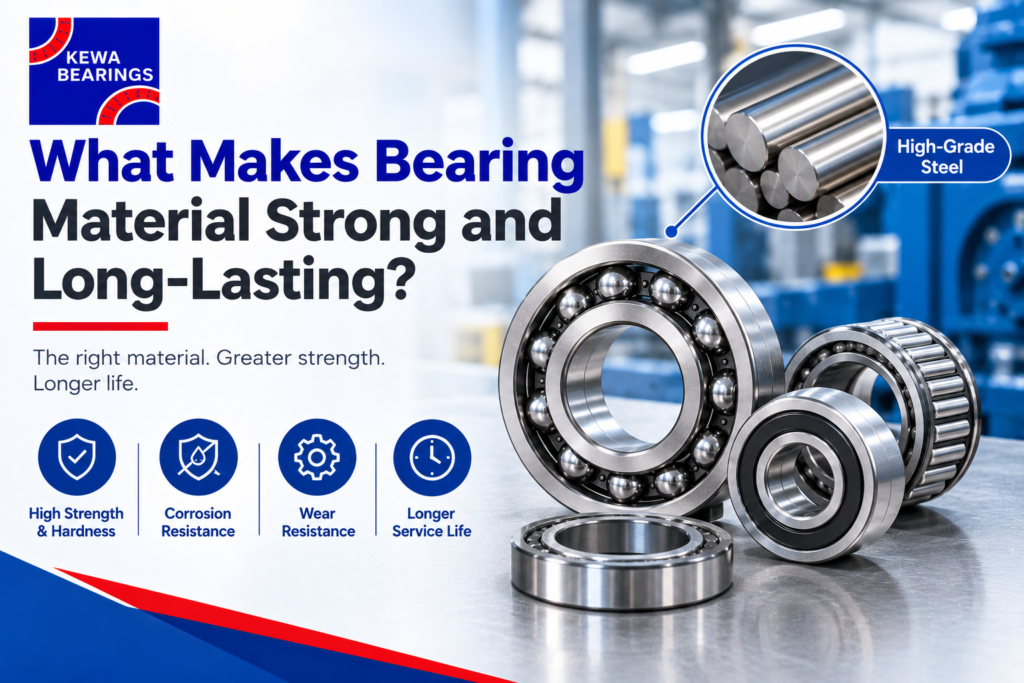
Bearings may look like small mechanical components, but they play a major role in keeping machines, vehicles, industrial equipment, and everyday appliances running smoothly. They reduce friction between moving parts, support loads, and help rotating components work efficiently. However, not every bearing performs the same way. One of the most important factors behind a bearing’s strength, durability, and service life is the quality of the material used to manufacture it.
The right bearing material must withstand continuous movement, pressure, friction, heat, and changing operating conditions without wearing out quickly. This is why manufacturers carefully select materials according to the application, load requirements, speed, temperature, and environmental conditions.
Understanding what makes bearing materials strong can help industries, mechanics, and buyers make better decisions when selecting bearings for different applications.
Why Is Bearing Material Important?
A bearing operates under constant mechanical stress. During operation, its rolling elements and raceways remain in contact while carrying loads and supporting movement. If the material is weak or unsuitable for the application, the bearing may develop wear, cracks, surface damage, deformation, or premature failure.
Good bearing material provides the strength and stability required for reliable performance. It should have suitable hardness, toughness, fatigue resistance, wear resistance, and dimensional stability.
The material also affects how a bearing responds to heat and lubrication conditions. A bearing operating inside an industrial machine may experience very different conditions from one used in a washing machine, automobile, electric motor, or agricultural machine. Therefore, material selection is not simply about choosing the hardest metal. It is about choosing a material that provides the right combination of properties for the application.
Key Properties of Strong Bearing Materials
Several characteristics determine whether a material can provide reliable bearing performance over a long period.
High Hardness
Hardness is essential because bearing surfaces experience repeated contact and friction. A sufficiently hard surface can resist indentation, scratching, and surface wear.
If the material is too soft, repeated loading can damage the raceways or rolling elements. Proper heat treatment is often used to achieve the required hardness while maintaining other important properties.
Excellent Wear Resistance
Bearings are designed to operate through thousands or even millions of rotations. Continuous movement can gradually wear down surfaces if the material is not resistant to abrasion and contact fatigue.
A wear-resistant material helps maintain the smooth surfaces needed for efficient rotation. This can contribute to longer bearing life and more consistent machine performance.
High Fatigue Strength
Bearing components are repeatedly loaded during operation. Even when the load is within the recommended limit, the material experiences stress over and over again.
This makes fatigue strength extremely important. A strong bearing material should withstand repeated stresses without developing cracks or other forms of structural failure.
Toughness
Hardness alone is not enough. A material can be very hard but still become brittle if it lacks toughness.
Toughness allows the material to absorb mechanical energy and resist sudden cracking or breakage. This is particularly important in applications where bearings experience shock loads, vibration, or changing operating conditions.
Heat Resistance
Temperature can significantly affect bearing performance. High operating temperatures may change material properties, reduce lubricant effectiveness, and increase the risk of premature wear.
A suitable material should maintain its required mechanical properties within the expected operating temperature range. For applications involving high temperatures, specialized materials and treatments may be considered.
Common Materials Used in Bearings
Different types of materials are used in bearing manufacturing depending on the application and performance requirements.
Bearing Steel
High-quality bearing steel is one of the most widely used choices for rolling bearings. It provides a useful combination of hardness, strength, wear resistance, and fatigue performance.
Steel bearings are commonly found in electric motors, automobiles, industrial machinery, pumps, gearboxes, agricultural equipment, and many other applications.
The quality of the steel, manufacturing process, cleanliness, and heat treatment all influence the final performance of the bearing.
Stainless Steel
Stainless steel is selected when corrosion resistance is particularly important. It can be useful in environments where bearings may be exposed to moisture, humidity, chemicals, or other corrosive conditions.
Although stainless steel bearings may have different performance characteristics compared with conventional bearing steels, they can provide valuable advantages in demanding environments.
Ceramic Materials
Ceramic materials such as silicon nitride are used in certain high-performance bearing applications. Ceramic rolling elements can offer low friction, good wear resistance, and excellent performance at high speeds.
Hybrid bearings often combine ceramic rolling elements with steel rings. These are used in applications where reduced friction, high rotational speed, or electrical insulation is important.
Polymer and Special Materials
Some specialized applications use polymer or engineered materials. These may be selected for their corrosion resistance, low weight, self-lubricating characteristics, or suitability for specific operating environments.
Material selection should always depend on the actual application rather than choosing a material simply because it is commonly used.
How Heat Treatment Improves Bearing Strength
The manufacturing process has a major influence on the final properties of a bearing. Heat treatment is one of the most important processes used to improve performance.
During heat treatment, steel components are heated and cooled under controlled conditions to modify their internal structure. The process can increase hardness, improve wear resistance, and enhance fatigue performance.
However, heat treatment must be carefully controlled. Incorrect processing can create undesirable changes in the material and negatively affect bearing performance.
It is therefore essential to select the right manufacturing process as well as the right raw material.
The Role of Manufacturing Precision
Even the best bearing material cannot compensate for poor manufacturing quality.
Bearing components require highly accurate dimensions and smooth surface finishes. The raceways and rolling elements must work together with the correct geometry and clearances.
Precision manufacturing helps distribute loads more evenly and reduces unnecessary friction and vibration. Proper grinding, finishing, heat treatment, inspection, and quality control can therefore contribute significantly to bearing reliability.
Small manufacturing differences can sometimes have a major effect on service life, especially in high-speed or heavily loaded applications.
Lubrication and Bearing Life
Material quality is important, but it is only one part of bearing performance. Lubrication also plays a critical role.
Lubricants create a protective layer between moving surfaces and help reduce friction and heat. The correct lubricant can reduce wear and help prevent surface damage.
Using too little lubricant can increase friction and temperature, while excessive or unsuitable lubrication can also create problems. The lubricant should therefore match the bearing type, speed, temperature, and operating environment.
Good maintenance combined with the right bearing material can help maximize the useful service life of a bearing.
How Operating Conditions Affect Material Selection
A bearing designed for one application may not be ideal for another. Several operating factors should be considered before selecting a bearing.
Load is one of the first considerations. Heavy radial or axial loads require materials and bearing designs capable of handling significant stress.
Speed is another important factor. High-speed applications generate different levels of friction and heat compared with slower machinery.
Temperature, moisture, dust, chemicals, vibration, shock loads, and installation conditions can also affect bearing performance.
For example, bearings used in industrial machinery may require high fatigue resistance, while bearings used in environments exposed to moisture may require better corrosion resistance.
Therefore, selecting the correct bearing material should always be based on the complete operating environment.
Why Quality Matters for Long-Term Performance
A bearing is expected to deliver reliable performance for a long period. Choosing a low-quality component simply because it has a lower initial price can lead to frequent replacements, machine downtime, and higher maintenance costs.
High-quality bearings are manufactured using carefully selected materials and controlled processes. Consistent material quality helps manufacturers achieve predictable hardness, strength, dimensional accuracy, and surface finish.
For businesses and industries, reliable bearings can help reduce unexpected maintenance and keep machines operating efficiently.
Choosing the Right Bearing for Your Application
Before purchasing a bearing, consider the machine, operating speed, load type, temperature, environment, lubrication requirements, and expected service life.
It is also important to choose a bearing from a reliable manufacturer or supplier that follows appropriate quality-control practices.
Kewa Bearings offers bearing solutions designed for a wide range of industrial and mechanical applications. Selecting the right product based on actual operating requirements can help ensure smooth movement, dependable performance, and longer service life.
Remember that there is no single material that is perfect for every bearing application. The ideal bearing material depends on the combination of strength, hardness, toughness, wear resistance, temperature performance, and environmental requirements.
Conclusion
For longer-lasting bearing performance, choose the right bearing material based on your machine’s load, speed, temperature, and working environment. Always use suitable lubrication, ensure proper installation and alignment, and follow regular maintenance practices. These simple steps can reduce wear, prevent premature failure, and help your bearings deliver smooth, reliable performance for longer.
FAQs
1. What is bearing material?
It is the material used to manufacture bearing components like rings and rolling elements.
2. Which material is commonly used for bearings?
High-quality bearing steel is commonly used for its strength, hardness, and wear resistance.
3. Does hardness make a bearing stronger?
Yes, hardness helps resist wear, surface damage, and deformation.
4. Why is heat treatment important?
It improves hardness, durability, wear resistance, and fatigue performance.
5. Are stainless steel bearings better?
They are useful where corrosion resistance is especially important.
6. Can ceramic bearings last longer?
They can offer excellent durability in suitable high-speed applications.
7. Does lubrication affect bearing life?
Yes, proper lubrication reduces friction, heat, and wear.
8. What causes bearing material to wear?
Heavy loads, friction, poor lubrication, contamination, and excessive heat can cause wear.
9. How can bearing life be increased?
Use proper installation, lubrication, alignment, and regular maintenance.
10. How do I choose the right bearing?
Consider the load, speed, temperature, environment, and application requirements.