
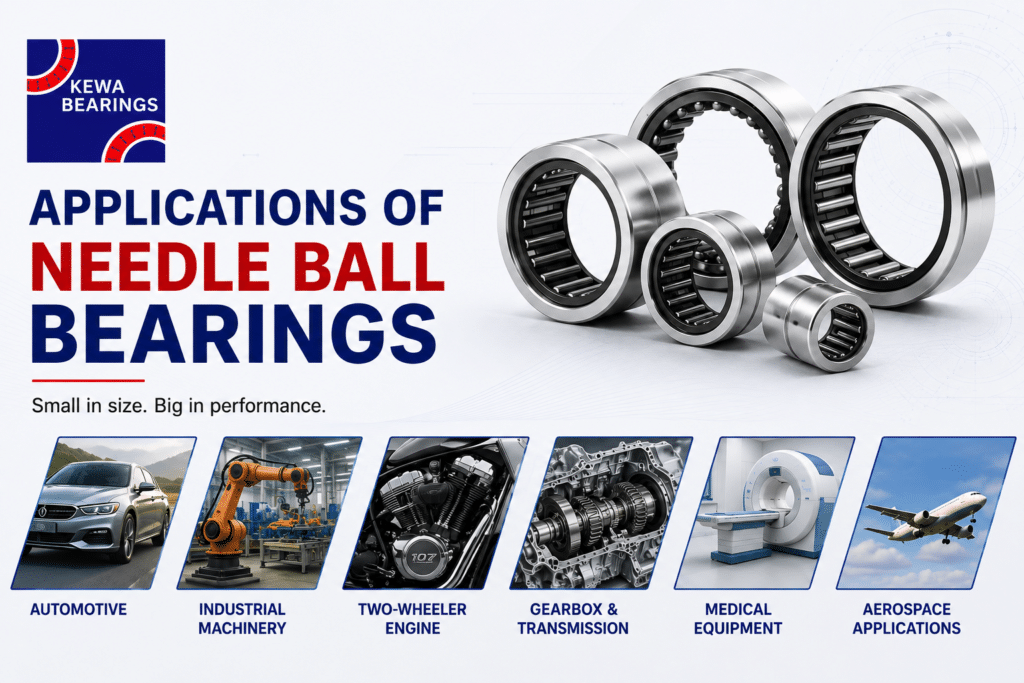
A needle ball bearing can be considered for different types of machinery where compact dimensions and radial load support are important. Depending on the specific design, similar needle-style bearing solutions can be found in automotive systems, transmissions, pumps, industrial machinery, machine tools, agricultural equipment, and other mechanical applications.
In automotive and industrial equipment, bearings may operate under changing loads, speeds, and temperatures. This makes correct bearing selection especially important.
Before choosing a bearing, users should understand the exact requirements of their equipment. The bearing should match the shaft size, housing dimensions, load, operating speed, lubrication system, and working environment.
Factors to Consider Before Choosing a Needle Ball Bearing
Selecting a needle ball bearing simply because it is compact may not be enough. Every application has different operating requirements.
Load capacity should be considered first. The bearing must be able to handle the expected radial load without exceeding its operating limits. Speed is another important factor because high-speed applications can generate additional heat and place greater demands on lubrication.
The available installation space should also be checked carefully. Correct dimensions are essential for proper fitting and reliable operation.
Temperature, contamination, moisture, lubrication, alignment, and operating environment should also be considered. A bearing used in a dusty industrial environment may have different requirements from one operating inside a clean, enclosed machine.
Choosing the correct bearing specification can help improve reliability and reduce the possibility of premature failure.
Importance of Bearing Quality
The quality of a bearing can directly affect machine performance. Low-quality or incorrectly manufactured bearings may result in increased friction, noise, vibration, and wear.
A reliable needle ball bearing should have accurate dimensions, suitable material quality, consistent manufacturing, and appropriate surface finishing. These factors can influence how smoothly the bearing performs under operating conditions.
Businesses should therefore consider more than the initial purchase price. Bearing reliability, expected service life, application suitability, and supplier support can all influence the total cost of ownership.
Maintenance Tips for Better Bearing Performance
Even a high-quality needle ball bearing requires proper maintenance. Regular inspection can help identify early signs of problems before they become major equipment failures.
Users should monitor unusual noise, vibration, heat, or changes in machine performance. Lubrication should be maintained according to the bearing and machine manufacturer’s requirements. Excessive or insufficient lubrication can both affect bearing performance.
Proper alignment is also essential. Misalignment can place uneven loads on the bearing and accelerate wear. During installation, users should follow appropriate procedures and avoid applying force incorrectly.
Keeping the bearing and surrounding components clean can also help prevent contamination-related damage.
Why Choose the Right Bearing Supplier?
Industrial businesses often require bearings that can perform consistently under demanding operating conditions. Working with an experienced bearing supplier can make the selection process easier.
Kewa Bearings focuses on providing bearing solutions for different industrial and mechanical requirements. When selecting a needle ball bearing, businesses should communicate their application details, including load, speed, dimensions, operating conditions, and machine type.
With the correct technical information, it becomes easier to identify a bearing that matches the application rather than choosing a product based only on size or price.
Conclusion
A needle ball bearing can improve machine performance by reducing friction, supporting radial loads, and enabling smooth, efficient operation in compact spaces. The right bearing can also help reduce wear and improve equipment reliability.
Proper installation, lubrication, alignment, and regular maintenance are important for longer bearing life. Choosing a reliable supplier like Kewa Bearings can help ensure the bearing suits your machine’s requirements.
FAQs
1. What is a needle ball bearing?
A needle ball bearing is a compact bearing designed to reduce friction and support moving machine parts.
2. How does it improve machine performance?
It reduces friction, supports loads, and enables smoother machine operation.
3. Where are needle ball bearings used?
They are used in automotive systems, industrial machinery, pumps, transmissions, and machine tools.
4. Can needle ball bearings handle heavy loads?
Yes, they can handle high radial loads despite their compact size.
5. Do needle ball bearings reduce friction?
Yes, their rolling elements help reduce friction between moving components.
6. Why is lubrication important?
Proper lubrication reduces friction, heat, and wear, helping improve bearing life.
7. What causes bearing failure?
Overloading, poor lubrication, contamination, misalignment, and incorrect installation can cause failure.
8. How can bearing life be extended?
Regular inspection, proper lubrication, correct installation, and alignment can improve bearing life.
9. How do I choose the right needle ball bearing?
Consider load, speed, dimensions, temperature, lubrication, and operating conditions.
10. Why choose quality needle ball bearings?
Quality needle ball bearings can provide smoother operation, better reliability, and reduced machine downtime.
Pingback: Common Applications of Needle Roller Bearings - KEWA BEARINGS
Pingback: Why Ball Bearing Design Matters in Modern Machines - KEWA BEARINGS