
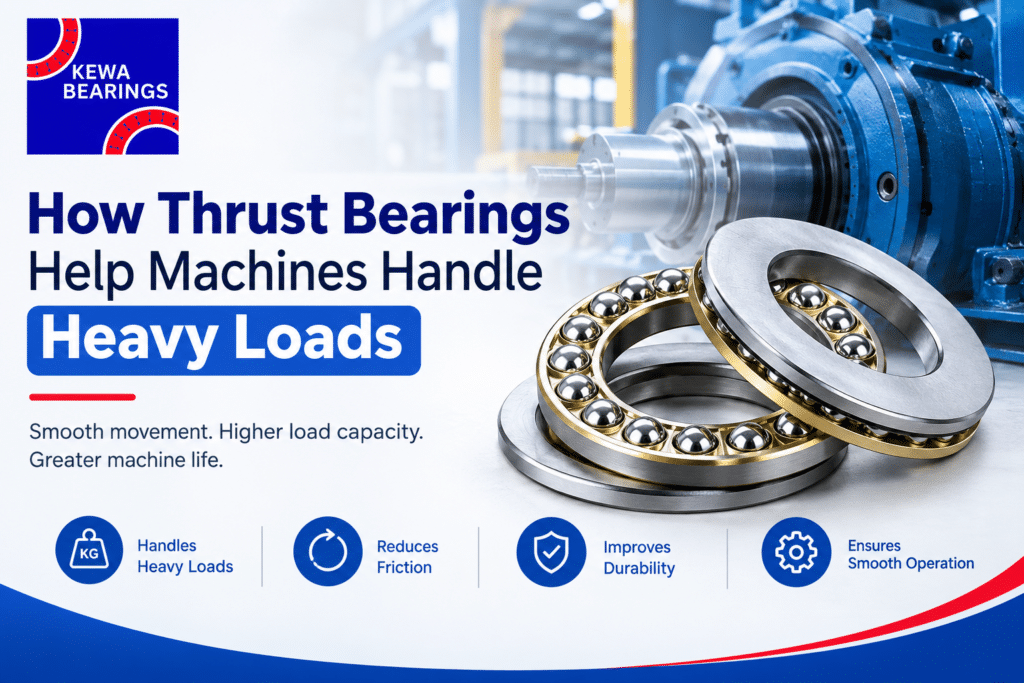
Machines used in industrial and automotive applications often operate under heavy loads, continuous motion, and demanding working conditions. To keep these machines running smoothly, every component must perform its role efficiently. Bearings are especially important because they help reduce friction and support moving parts during operation.
Among different types of bearings, thrust bearings are specifically designed to handle axial loads. These are loads that act parallel to the shaft rather than perpendicular to it. By supporting axial forces and allowing smooth rotational movement, thrust bearings help improve machine performance, reduce wear, and contribute to longer equipment life.
What Are Thrust Bearings?
Thrust bearings are mechanical components designed primarily to support axial or thrust loads. Unlike radial bearings, which mainly support loads acting perpendicular to a shaft, thrust bearings are designed to manage forces that act along the shaft’s axis.
When a machine operates, shafts and other rotating components may experience pressure that pushes them forward or backward. Without suitable support, this force can increase friction, cause misalignment, and accelerate component wear. Thrust bearings help manage this pressure and maintain controlled movement.
Depending on the application, thrust bearings are available in different designs and materials. The correct bearing is selected according to factors such as load capacity, operating speed, temperature, lubrication requirements, and available space.
How Do Thrust Bearings Handle Heavy Loads?
The primary function of thrust bearings is to distribute axial loads across their rolling or sliding surfaces. Instead of allowing the entire force to act directly on the shaft or housing, the bearing provides a controlled contact area through which the load can be transferred.
When the shaft rotates, the bearing’s rolling elements or contact surfaces allow movement with reduced friction. This makes it easier for the machine to operate while managing significant axial forces.
A properly selected thrust bearing can help prevent excessive pressure on other machine components. It also helps maintain the correct position of the shaft during operation. This is particularly important in machines where even small amounts of unwanted axial movement can affect performance.
Reducing Friction During Operation
Friction is one of the major causes of energy loss and component wear in machinery. When two surfaces move against each other without proper support, heat and wear can increase quickly.
Thrust bearings help reduce friction between moving components. Their design allows controlled movement while supporting axial forces. Reduced friction can help machinery operate more efficiently and may also reduce heat generation during continuous operation.
Lower friction can be particularly valuable in machines that run for long periods. However, the actual performance depends on bearing design, lubrication, load, speed, installation, and operating conditions.
Supporting Axial Loads
One of the biggest advantages of thrust bearings is their ability to support axial loads. These loads can occur in pumps, gearboxes, automotive systems, turbines, compressors, and other rotating equipment.
For example, a rotating shaft may experience a force that pushes it in one direction. If this force is not properly controlled, it can lead to unwanted shaft movement. Over time, this may affect gears, seals, couplings, and other connected components.
Thrust bearings provide support against this movement. They help keep the shaft in its intended position while allowing it to rotate smoothly.
Improving Machine Stability
Stable movement is essential for reliable machine performance. Excessive axial movement can create vibration, noise, uneven wear, and operational problems.
By controlling axial forces, thrust bearings can contribute to greater mechanical stability. A suitable bearing helps maintain the relationship between rotating and stationary components, allowing the machine to operate more consistently.
This is especially important in precision equipment and high-load machinery, where uncontrolled shaft movement can affect the performance of the complete system.
Applications of Thrust Bearings
Thrust bearings are used across many industries because axial loads are common in rotating machinery. Their applications depend on their specific design and load-handling capabilities.
In automotive systems, thrust bearings may be used in transmissions and other mechanisms where shafts experience axial forces. Industrial gearboxes can also use thrust bearings to support axial loads generated by gears.
Pumps and compressors may require thrust bearings to manage forces created during fluid movement and rotating shaft operation. In turbines and other heavy machinery, these bearings can help support substantial axial loads while maintaining controlled rotation.
They can also be found in motors, generators, machine tools, construction equipment, and other industrial systems.
Types of Thrust Bearings
There are several types of thrust bearings, and each is designed for specific operating conditions.
Ball Thrust Bearings
Ball thrust bearings use balls between raceways to support axial loads. They are suitable for applications where moderate thrust loads and controlled operating speeds are involved. Their compact design can make them useful where installation space is limited.
Roller Thrust Bearings
Roller thrust bearings use rollers instead of balls. Their larger contact area allows them to handle higher axial loads in many applications. Different roller designs are available depending on the load and operating requirements.
Tapered Roller Thrust Bearings
Tapered roller thrust bearings are designed to manage axial loads and can also accommodate certain radial loads. They are commonly considered for demanding applications where combined loading occurs.
Spherical Roller Thrust Bearings
Spherical roller thrust bearings are designed for heavy axial loads and can accommodate misalignment within specified limits. They are often used in demanding industrial applications where load capacity and reliability are important.
Why Correct Bearing Selection Matters
Choosing the right thrust bearings is essential for reliable machine operation. A bearing should not be selected only according to its size. Factors such as axial load, speed, temperature, lubrication, shaft dimensions, mounting arrangement, and operating environment should all be considered.
Using a bearing that is too small for the application can result in excessive stress and premature failure. Similarly, using an unsuitable bearing design can affect efficiency and machine stability.
Working with an experienced bearing manufacturer or supplier can help businesses identify the appropriate bearing for their equipment.
Importance of Lubrication
Lubrication plays an important role in the performance and service life of thrust bearings. Proper lubrication helps reduce friction between moving surfaces and assists in controlling heat and wear.
The lubricant used should be suitable for the bearing design and operating environment. Factors such as operating temperature, speed, load, and exposure to contaminants should be considered when choosing a lubrication method.
Insufficient lubrication can increase friction and wear, while incorrect lubrication practices may also affect bearing performance. Regular inspection and maintenance can help identify lubrication-related problems before they cause major equipment damage.
Installation and Maintenance
Even a high-quality bearing can experience premature failure if it is installed incorrectly. Proper installation helps ensure that the bearing is correctly aligned and seated on the shaft or housing.
During installation, excessive force should be avoided. The appropriate tools and procedures should be used to prevent damage to bearing surfaces.
Regular maintenance is equally important. Machinery operators should monitor unusual noise, vibration, temperature increases, and changes in machine performance. These signs may indicate bearing wear or other mechanical problems.
Keeping the bearing and surrounding components clean can also help prevent contamination. Dust, dirt, moisture, and other contaminants can negatively affect bearing performance.
Benefits of Using the Right Thrust Bearings
The correct thrust bearings can provide several benefits to industrial machinery. They help support axial loads, reduce friction, control shaft movement, and improve mechanical stability.
By reducing unnecessary stress on connected components, a suitable bearing can also contribute to improved equipment reliability. Better load distribution may help reduce premature wear and support longer service intervals.
However, bearing performance depends on more than the bearing itself. Correct selection, installation, lubrication, alignment, load management, and maintenance all contribute to achieving reliable results.
How Kewa Bearings Can Help
For machinery manufacturers, automotive businesses, and industrial users, selecting dependable bearings is an important part of maintaining equipment performance. Kewa Bearings focuses on providing bearing solutions for different industrial and mechanical requirements.
When choosing thrust bearings, users should consider the specific load, speed, application, and operating environment rather than selecting a bearing based only on dimensions. The right product can help machinery handle axial forces more effectively and operate smoothly.
A reliable bearing solution, combined with proper installation and maintenance, can support better machine performance and help reduce avoidable downtime.
Conclusion
Heavy loads can put significant stress on rotating machinery. Thrust bearings help handle axial loads, reduce friction, and control shaft movement for smoother operation.
Choosing the right bearing based on load, speed, lubrication, and operating conditions is essential. Proper installation and maintenance can also improve performance, reliability, and bearing life. This helps reduce unnecessary wear and supports consistent machine performance. A suitable thrust bearing can also contribute to lower downtime and more efficient equipment operation.
FAQs
1. What are thrust bearings used for?
Thrust bearings support axial loads and help shafts rotate smoothly.
2. Can thrust bearings handle heavy loads?
Yes, heavy-duty thrust bearings are designed to handle high axial loads.
3. What is the difference between thrust and radial bearings?
Thrust bearings handle axial loads, while radial bearings mainly handle radial loads.
4. Where are thrust bearings used?
They are used in gearboxes, pumps, turbines, compressors, and automotive machinery.
5. Why is lubrication important?
Lubrication reduces friction, heat, and wear, helping extend bearing life.
6. How do I choose the right thrust bearing?
Consider the load, speed, temperature, shaft size, and operating conditions.
7. Can thrust bearings handle misalignment?
Some types, such as spherical roller thrust bearings, can accommodate limited misalignment.
8. What causes thrust bearing failure?
Overloading, poor lubrication, contamination, misalignment, and incorrect installation can cause failure.
9. How can bearing life be improved?
Use proper lubrication, installation, alignment, maintenance, and suitable thrust bearings.
10. Why are quality thrust bearings important?
Quality thrust bearings provide reliable load support and help machines operate smoothly.
Pingback: Single-Direction vs Double-Direction Thrust Ball Bearings - KEWA BEARINGS