
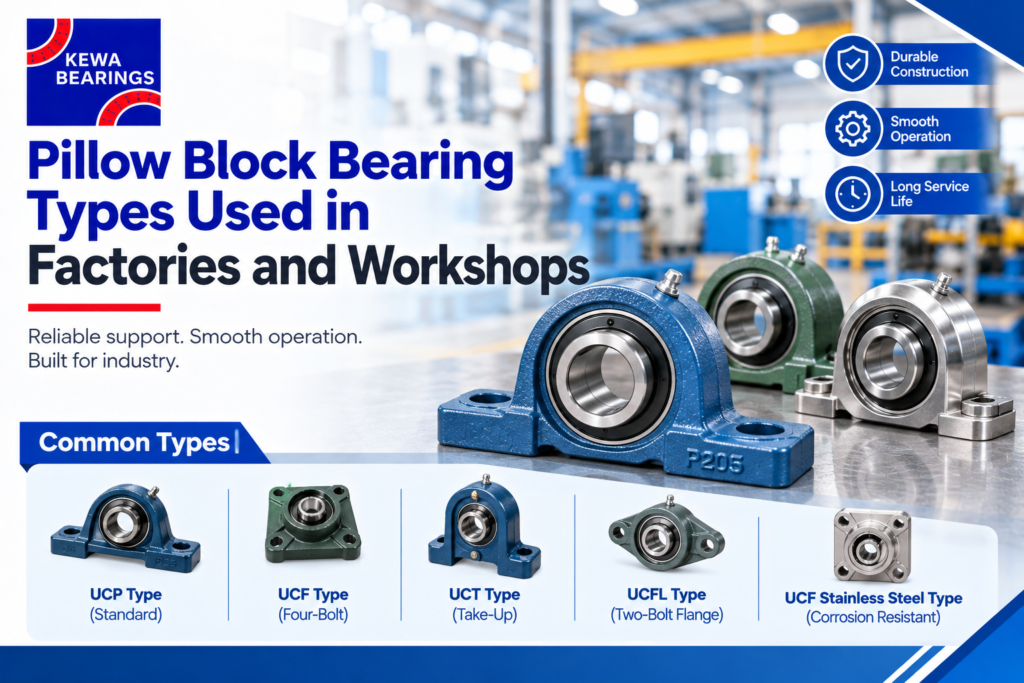
Pillow block bearings are essential components in factories, workshops, and industrial machinery. They support rotating shafts, reduce friction, and ensure smooth operation in conveyor systems, agricultural equipment, and manufacturing units.
Understanding pillow block bearing types and applications helps businesses choose suitable bearings based on load, speed, and operating conditions, improving machine performance and service life.
Kewa Bearings offers bearing solutions for various industrial requirements, helping buyers make informed decisions.
What Is a Pillow Block Bearing?
A pillow block bearing is a mounted bearing unit designed to support a rotating shaft. It generally consists of a bearing insert fitted inside a housing that can be securely attached to a machine frame or supporting surface.
The housing provides stability, while the bearing insert allows the shaft to rotate with reduced friction. Depending on the design, pillow block bearings may also accommodate minor shaft misalignment and simplify installation and replacement.
These bearings are widely used in industrial environments because they are practical, easy to mount, and available in different sizes and configurations. Understanding pillow block bearing types and applications is particularly useful when selecting components for equipment that operates under different loads and working conditions.
Common Pillow Block Bearing Types Used in Industries
Different industries require different bearing arrangements depending on machinery design, shaft dimensions, and operating conditions. Below you will find a list of some of the more common pillow block bearing types.
1. Standard Pillow Block Bearings
Standard pillow block bearings are widely used in factories and workshops. They feature a housing with a bearing insert and mounting holes for easy installation on flat surfaces.
Suitable for moderate loads and regular operating conditions, they are commonly used in conveyor rollers, agricultural machinery, and production equipment. Understanding pillow block bearing types and applications helps businesses choose reliable bearings for general industrial needs.
2. UCP Pillow Block Bearings
UCP pillow block bearings consist of a bearing insert mounted inside a cast-iron or other suitable housing. They are commonly designed with two mounting bolt holes, making them easy to install on supporting structures.
These units are widely used in conveyor systems, food processing machinery, agricultural equipment, and material handling applications. Their design provides reliable shaft support and allows convenient replacement when maintenance is required.
UCP bearings are available in different shaft sizes to accommodate various machinery requirements. However, the correct selection depends on load, speed, lubrication, and operating conditions.
3. UCF Flange Bearings
UCF bearings are four-bolt flange-mounted units designed for installation on suitable vertical or other mounting surfaces. Kewa bearings’ UCF Flange Bearings are used in conveyor systems, packaging equipment, and industrial processing machinery.
Understanding the difference between UCP and UCF units helps buyers choose the correct mounting arrangement. Comparing pillow block bearing types and applications ensures better compatibility with industrial machinery.
4. UCFL Flange Bearings
UCFL bearings are oval-shaped, two-bolt flange-mounted units ideal for compact installations. Kewa bearings’ UCFL Flange Bearings are commonly used in conveyor systems, agricultural machinery, and packaging equipment.
Their design allows convenient installation where space is limited. Before selecting a UCFL bearing, check shaft size, load capacity, housing compatibility, and mounting space to ensure proper performance.
5. Stainless Steel Pillow Block Bearings
Stainless steel pillow block bearings offer corrosion resistance and are suitable for applications exposed to moisture and frequent cleaning. They are commonly used in food processing, pharmaceutical machinery, and packaging systems.
Before selecting these bearings, check the seals, lubricant, operating temperature, and cleaning requirements to ensure reliable performance in the intended environment.
6. Self-Aligning Pillow Block Bearings
Self-aligning pillow block bearings accommodate limited shaft misalignment, making them suitable for machinery where perfect alignment is difficult to maintain.
This equipment uses them extensively as do material handling systems and agricultural equipment. However, proper shaft alignment, secure mounting, and balanced load distribution remain essential for reliable performance.
Applications of Pillow Block Bearings in Factories and Workshops
Pillow block bearings are used across several industrial sectors because they provide practical shaft support and simplify equipment maintenance. The most suitable option depends on the machinery design and operating environment.
Conveyor Systems
Conveyor systems use rotating shafts and rollers to move products, raw materials, and packaged goods between different production stages. Pillow block bearings support these rotating components and help maintain smooth movement.
They are commonly used in manufacturing plants, warehouses, distribution facilities, and material handling systems. Selecting appropriate pillow block bearing types and applications for conveyors requires considering load capacity, shaft speed, dust exposure, and operating hours.
Manufacturing Machinery
Manufacturing facilities rely on machines that operate for extended periods. Pillow block bearings support rotating shafts in selected production machines, helping reduce friction and maintain consistent movement.
They may be used in assembly lines, industrial processing equipment, production conveyors, and other machinery with compatible shaft arrangements. Correct bearing selection and regular maintenance can help reduce unexpected downtime and improve equipment reliability.
Agricultural Equipment
Agricultural machinery frequently operates in dusty environments and may be exposed to moisture, dirt, and changing temperatures. Agricultural equipment like selected conveyor and material handling systems use rotating shafts, which require Pillow block bearings for support.
For the aforementioned equipment, proper lubrication and sealing is especially important. Buyers should select bearings according to the expected load, contamination level, operating speed, and maintenance schedule.
Packaging and Food Processing
Packaging machinery often contains rotating shafts, rollers, and conveyor components that require stable support. Pillow block bearings can be used in compatible packaging systems to help maintain smooth machine movement.
Food processing facilities may require corrosion-resistant materials, suitable seals, and hygienic designs. In these environments, the bearing unit must meet the specific cleaning, temperature, and contamination-control requirements of the application.
Workshops and Repair Facilities
Workshops use different types of machinery for fabrication, material handling, and equipment repair. Pillow block bearings may be installed in suitable workshop conveyors, rotating fixtures, and other shaft-driven equipment.
Their convenient mounting arrangement can make replacement and routine inspection easier. Understanding pillow block bearing types and applications helps workshop owners identify suitable products while considering machine compatibility and maintenance costs.
Benefits of Using Pillow Block Bearings
Pillow block bearings offer several advantages for industrial machinery when selected and installed correctly.
Easy installation: Their mounted housing design simplifies attachment to compatible machine frames and supporting structures.
Reduced friction: The bearing insert supports shaft rotation and helps reduce friction when the unit is correctly lubricated and operated within its specified limits.
Convenient maintenance: Many pillow block bearing units allow inspection, lubrication, and replacement without extensive changes to the surrounding equipment.
Versatile applications: They are available in different housing styles, materials, shaft sizes, and sealing arrangements for various industrial requirements.
Reliable shaft support: Properly selected units help maintain shaft stability and support consistent machinery operation.
These advantages make pillow block bearings a practical option for numerous factory and workshop applications.
How to Choose the Right Pillow Block Bearing
Choosing the right bearing involves more than matching the shaft diameter. Check shaft size, mounting dimensions, load capacity, operating speed, and expected service life to ensure compatibility with your machinery.
Consider environmental conditions such as dust, moisture, and heat when selecting suitable seals, housing materials, and lubrication. Proper mounting and shaft alignment are also essential for reliable performance.
Understanding pillow block bearing types and applications helps businesses select suitable products, reduce maintenance costs, and improve machinery efficiency.
Common Pillow Block Bearing Maintenance Tips
Regular maintenance helps prevent bearing damage, reduce downtime, and improve machinery performance. Understanding pillow block bearing types and applications helps businesses identify suitable maintenance practices for different industrial requirements.
Regularly examine bearings for noise, vibrations, and damage, all of which may be signs of issues related to lubrication or the bearing being out of place. Utilize the suggested lubrication, and follow the schedule as recommended by the manufacturer. Clean the bearings, check the seals for any signs of wear, and ensure the bearings are firmly and properly secured and the shafts are properly aligned.
Timely inspections and preventive maintenance can extend bearing service life, improve equipment reliability, and reduce unexpected production interruptions in factories and workshops.
Why Choose Kewa Bearings?
Selecting suitable bearing products is important for maintaining industrial productivity and controlling maintenance costs. Kewa Bearings focuses on bearing solutions for different machinery and industrial requirements.
When purchasing pillow block bearings, buyers should consider product dimensions, construction quality, load specifications, sealing arrangements, and suitability for the intended application. Maintenance and procurement teams can improve their decision-making process with access to quality technical information.
Whether a factory requires bearings for conveyor systems, production machinery, or general material handling equipment, selecting the right product is essential for reliable operation. Kewa Bearings can be considered when exploring bearing solutions that match specific equipment requirements.
Conclusion
Pillow block bearings support rotating shafts in factories, workshops, conveyors, and agricultural machinery. Different designs meet various industrial needs.
Understanding pillow block bearing types and applications helps businesses select suitable bearings based on load, shaft size, and operating conditions.
Proper selection and maintenance improve machinery performance and reduce downtime. Kewa Bearings offers solutions for diverse industrial requirements.
Frequently Asked Questions
1. What is a pillow block bearing?
It supports rotating shafts and reduces friction.
2. What are the common types of pillow block bearings?
Common types include UCP, UCF, UCFL, stainless steel, and self-aligning bearings.
3. What are UCP pillow block bearings used for?
They are used in conveyors, agricultural machinery, and manufacturing equipment.
4. What is the difference between UCP and UCF bearings?
UCP has a two-bolt housing, while UCF has a four-bolt flange housing.
5. Where are pillow block bearings commonly used?
They are used in factories, workshops, conveyors, and packaging machinery.
6. Are pillow block bearings suitable for heavy loads?
Yes, certain models support heavy loads, depending on their specifications.
7. Can pillow block bearings handle misalignment?
Self-aligning designs accommodate limited shaft misalignment.
8. How often should pillow block bearings be lubricated?
Follow the manufacturer’s lubrication schedule.
9. How can pillow block bearing life be extended?
Use proper lubrication, correct alignment, and regular maintenance.
10. How do I select the right pillow block bearing?
Check shaft size, load capacity, speed, mounting, and operating conditions.