Bearings support shafts and minimize friction in rotating machinery. Bearings serve various roles within industry with their many different designs and varying abilities. Certain designs will best suit particular load and operating conditions for various applications. Among them, taper roller bearings are widely used in automotive systems, heavy machinery, and industrial equipment because of their ability to handle both radial and axial loads.
Understanding how taper roller bearings differ from other bearing types can help manufacturers, mechanics, and machine operators select the right component for their equipment. In this blog, we will explore their design, working principle, benefits, and key differences from other bearings.
What Are Taper Roller Bearings?
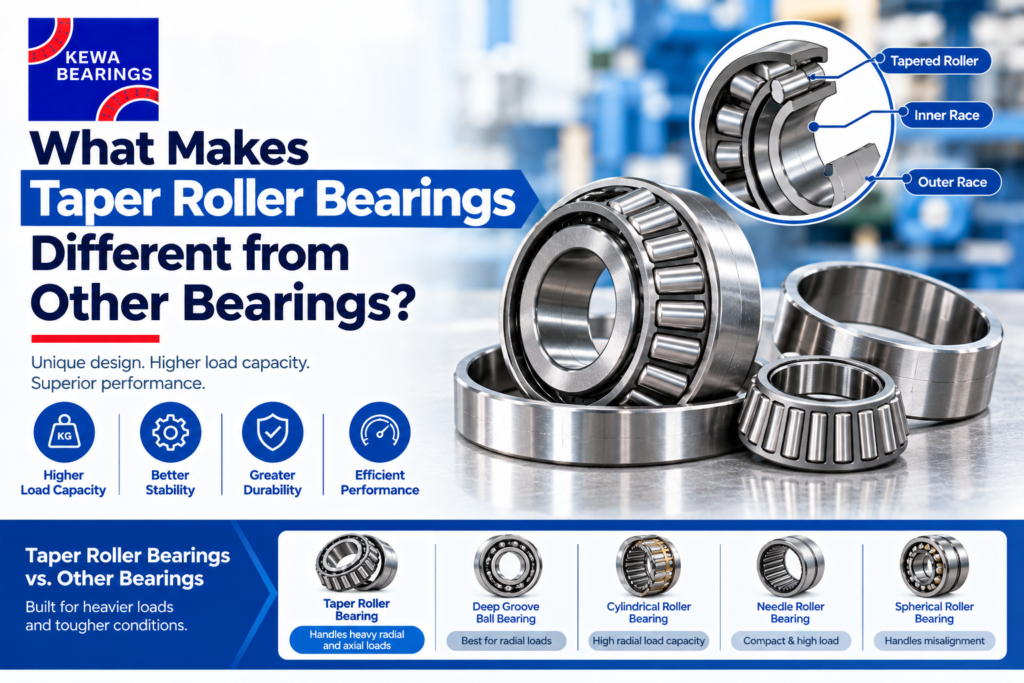
Taper roller bearings are mechanical components designed with tapered inner and outer raceways and conical rollers. These bearing rollers are placed at an angle, allowing the bearing to accommodate both radial and axial loads.
Taper roller bearings are excellent for a large variety of heavy-load applications, as well as situations requiring high accuracy for the position of a shaft. Their design helps distribute loads across the roller contact surfaces, supporting stable operation under demanding conditions.
When searching for a taper roller ball bearing, it is important to understand that taper roller bearings and ball bearings have different rolling elements and load-handling capabilities. Taper roller bearings use conical rollers, while ball bearings use spherical balls.
How Are Taper Roller Bearings Different from Other Bearings?
Several features distinguish taper roller bearings from other commonly used bearing types.
1. Ability to Handle Combined Loads
One of the main differences is their ability to support both radial and axial loads. Radial loads act perpendicular to the shaft, whereas axial loads act along the shaft’s axis.
Taper roller bearings can manage these combined forces effectively when correctly selected and installed. In comparison, standard radial ball bearings are generally better suited to lighter loads and applications where low friction and higher speeds are priorities.
2. Unique Tapered Roller Design
Taper roller bearings use conical rollers that contact the raceways along a larger contact area than typical ball bearings. This design helps distribute loads and provides good support under heavy operating conditions.
A taper roller ball bearing may be considered during bearing selection, but the correct choice depends on the machine’s load requirements, operating speed, and installation conditions. Understanding the difference between rollers and balls helps prevent incorrect product selection.
3. High Load-Carrying Capacity
Taper roller bearings are suitable for applications that experience significant loads, including vehicle wheel hubs, gearboxes, industrial machinery, and agricultural equipment.
With designs like theirs, bearing supports can be combined with other components under different load cases to achieve higher bearing design performance and lower bearing cost. However, in designs where low friction, smaller footprint, and/or high-speed rotation is the objective, ball bearings are used, but their selection also hinges on the bearing design.
4. Adjustable Installation and Clearance
Many taper roller bearing arrangements allow preload or clearance to be adjusted during installation. Correct adjustment helps achieve suitable operating conditions, improve shaft positioning, and reduce unwanted movement.
However, excessive preload can increase friction and operating temperature, while excessive clearance may affect stability. Following manufacturer recommendations is essential for dependable performance.
5. Speed and Operating Requirements
Taper roller bearings can perform well in demanding applications, but their suitable operating speed depends on bearing size, lubrication, load, and installation. Ball bearings may be a better option for applications that require very high speeds and minimal friction.
Therefore, selecting a taper roller ball bearing or another bearing type should involve evaluating the complete operating environment rather than focusing on one feature alone.
Taper Roller Bearings vs. Ball Bearings
Both ball and tapered roller bearings have distinct purposes in mechanical designs.
A ball bearing utilizes rolling elements that are spherical to provide low friction rotation. Most of the ball bearings in electric motors, appliances, and rotating machinery utilize low speed to medium speed ball bearings.
Tapered roller bearings are well suited for applications involving heavy loads and axial and radial thrust loads. The design is typical for automotive transmissions and other mechanical transmissions that employ rotation under high loads and radial loads.
When choosing a bearing for an application, you have to consider how well it will hold up under the load it is likely to see, the speed at which it will rotate, how much space it will take up, whether it needs lubrication, and how easily it can be maintained. There isn’t really one design that works best in all applications.
Common Applications of Taper Roller Bearings
Taper roller bearings are used across several industries because of their load-handling capabilities and reliable mechanical support.
Automotive industry: They are commonly used in wheel hubs, differentials, transmissions, and other assemblies that experience combined loads.
Industrial machinery: Gearboxes, heavy-duty equipment, and power transmission systems may use taper roller bearings to support rotating shafts.
Agricultural equipment: Tractors, harvesters, and other agricultural machines can benefit from bearings designed to handle demanding working conditions.
Construction equipment: Certain heavy-duty machines use taper roller bearings in assemblies exposed to substantial loads and vibration.
Selecting the appropriate bearing for each application helps maintain smooth operation and reduce the risk of premature failure.
Tips for Choosing the Right Taper Roller Bearing
Choosing a suitable bearing requires careful consideration of the equipment’s operating conditions.
First, determine the radial and axial loads the bearing must support. Next, check the shaft dimensions, housing arrangement, and required bearing size. You should also consider speed and operating temperature for a particular application, as bearing choice will affect both performance and longevity in that application.
Lubrication is another important factor. Using the recommended lubricant and maintaining an appropriate lubrication schedule can help reduce friction and wear.
Finally, consider the manufacturer’s specifications, material quality, installation requirements, and maintenance needs. If you are comparing a taper roller ball bearing with other options, evaluate the actual application before making a decision.
Why Bearing Quality Matters
Bearing quality directly affects machinery performance, operating efficiency, and maintenance requirements. Poor-quality or incorrectly selected bearings may lead to excessive vibration, overheating, noise, and premature wear.
Reliable bearings, when correctly installed and maintained, help support consistent machine operation and reduce unexpected downtime. Regular inspection, proper lubrication, and correct mounting practices are equally important for achieving dependable results.
Kewa Bearings understands the importance of selecting suitable bearing solutions for different industrial and mechanical requirements. Evaluating application needs and choosing the right bearing design can help businesses maintain efficient equipment performance.
Conclusion
Taper roller bearings stand out because of their tapered roller design, combined-load capacity, and suitability for heavy-duty applications. While ball bearings are often preferred for smooth, low-friction rotation, taper roller bearings can provide better support in applications involving substantial radial and axial loads.
Before selecting a taper roller ball bearing, consider the load, speed, lubrication, and installation requirements of your machinery. Choosing the right bearing and maintaining it properly can help improve reliability and support long-term equipment performance.
Frequently Asked Questions
1. What is a taper roller bearing?
A taper roller bearing uses conical rollers to support radial and axial loads in mechanical systems.
2. What makes taper roller bearings different from ball bearings?
Taper roller bearings use conical rollers, while ball bearings use spherical balls. Their load-handling capabilities and applications also differ.
3. Can taper roller bearings handle axial loads?
Yes, they can support axial loads, but the direction and magnitude depend on the bearing arrangement and design.
4. Where are taper roller bearings commonly used?
They are commonly used in automotive wheel hubs, transmissions, gearboxes, and heavy industrial machinery.
5. Are taper roller bearings suitable for heavy loads?
Yes, they are designed for demanding applications involving substantial radial and axial loads.
6. Do taper roller bearings require lubrication?
Yes, appropriate lubrication helps reduce friction, control wear, and support reliable operation.
7. At what kind of speed can tapered roller bearings work?
With the right setup, design, load, and operating conditions, taper roller bearings can run at appropriate speeds.
8. What can go wrong to make tapered roller bearings fail?
Usually, if not well lubricated, overloaded, installed wrong, misadjusted, or if something has entered the race, they will fail.
9. What are the best ways to keep tapered roller bearings from wearing out?
Keeping them well lubricated, clean, well installed, and regularly inspected are the keys to longer life.
10. How do I choose the right taper roller bearing?
Consider load requirements, operating speed, dimensions, lubrication, installation conditions, and manufacturer specifications.