
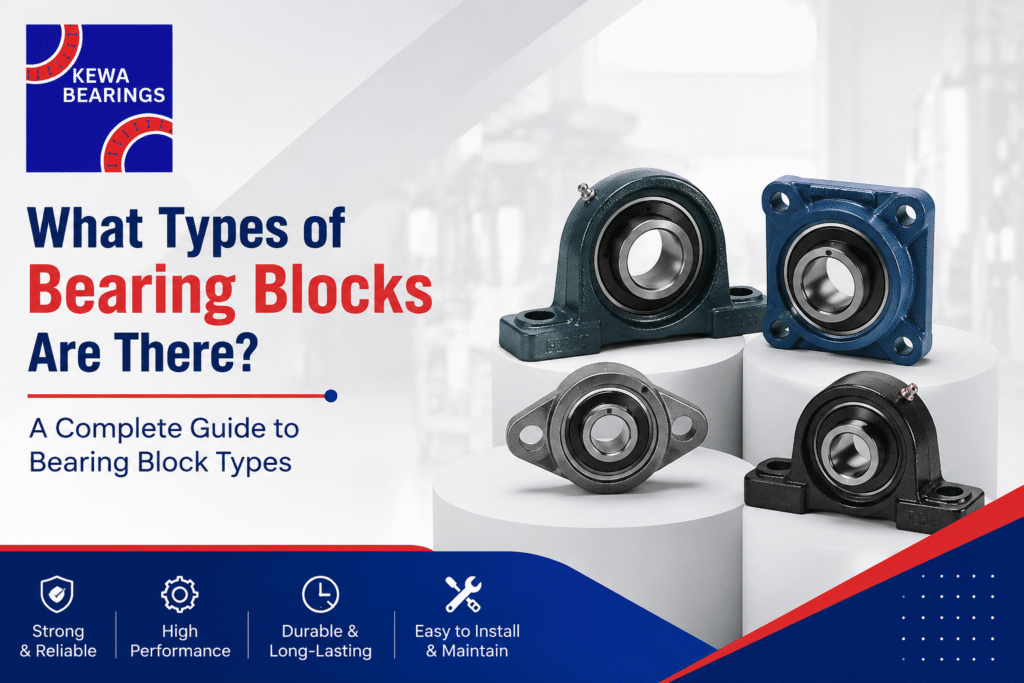
Bearing blocks support rotating shafts, maintain alignment, reduce friction, and ensure smooth machine operation across industries such as manufacturing, agriculture, automotive, and material handling.
Since different bearing blocks are designed for specific loads, speeds, environments, shaft sizes, and applications, choosing the right one is essential for reliable performance and lower maintenance. This guide covers the major types of bearing blocks, their applications, and key selection factors, including the bearing material used.
What Is a Bearing Block?
A bearing block is a housing unit that supports a bearing and rotating shaft while maintaining proper alignment. It can be mounted on a base, flange, or machine structure and typically includes a housing, bearing insert, mounting arrangement, seals, and lubrication fittings. The housing also protects the bearing from contaminants and supports smooth operation.
Why Are Bearing Blocks Important?
Bearing blocks play an important role in the performance and reliability of rotating machinery. Without proper support, a shaft can experience excessive vibration, misalignment, friction, and wear.
A properly selected bearing block can help improve machine efficiency and extend bearing life. It also makes installation, inspection, replacement, and maintenance easier.
The design and bearing material can also affect performance. Materials such as cast iron, stainless steel, steel, and thermoplastic are selected according to the operating environment and load requirements.
Major Types of Bearing Blocks
1. Pillow Block Bearings
Pillow block bearings are among the most commonly used bearing block types. They consist of a bearing mounted inside a housing that is attached to a supporting surface.
The housing is usually mounted parallel to the shaft. Pillow block units are easy to install and are available in different sizes and designs.
They are commonly used in:
- Conveyor systems
- Agricultural machinery
- Industrial equipment
- Material handling systems
- Packaging machines
- Textile machinery
Pillow block bearings are popular because they are simple, reliable, and easy to replace.
2. Flange Bearing Blocks
Flange bearing blocks are designed to be mounted on the side of a machine or equipment structure. They usually have a flange with mounting holes that allows the unit to be securely attached to a surface.
Common flange designs include two-bolt, three-bolt, and four-bolt flange units. The correct design depends on the available mounting space and load requirements.
Flange bearing blocks are commonly used in conveyors, fans, pumps, and other applications where the shaft is positioned through a machine wall or panel.
3. Take-Up Bearing Blocks
Take-up bearing blocks are used in applications where shaft position needs to be adjusted. They are commonly used with conveyor systems to maintain proper belt tension.
These bearing blocks can move along a track or frame, allowing the shaft position to be adjusted when required.
Take-up units are particularly useful in:
- Conveyor systems
- Belt-driven machinery
- Material handling equipment
- Industrial production lines
Their adjustable design makes them suitable for applications where belt tension and shaft alignment are important.
4. Split Bearing Blocks
Split bearing blocks have a housing that is divided into two or more sections. This design allows the bearing to be installed or removed without completely dismantling the shaft or surrounding machinery.
Split bearing blocks are often used in heavy-duty industrial equipment where maintenance access may be difficult.
They are commonly found in:
- Mining machinery
- Steel production equipment
- Heavy industrial machines
- Large conveyor systems
- Power generation equipment
The main advantage of split bearing blocks is their easy maintenance and replacement.
5. Hanger Bearing Blocks
Hanger bearing blocks are designed to support shafts that are suspended from a structure. They are often used in conveyor systems and equipment where the shaft needs to be supported from above.
These units help maintain shaft alignment while providing stable support during rotation.
Hanger bearing blocks are commonly used in industrial conveyors and material handling systems.
6. Cartridge Bearing Blocks
Cartridge bearing blocks are compact units in which the bearing is enclosed within a cylindrical housing. They are designed for applications that require a clean and compact mounting arrangement.
Cartridge units can be mounted inside a machine housing or other supporting structure. Their enclosed design helps protect the bearing from contamination.
They are often used in:
- Machinery
- Pumps
- Fans
- Processing equipment
- Automated systems
7. Tensioner Bearing Blocks
Tensioner bearing blocks are designed for applications where the bearing position needs to be adjusted to maintain correct tension.
They are often used in belt-driven systems and conveyor equipment. By allowing adjustment, they help maintain efficient power transmission and reduce unnecessary belt wear.
8. Two-Bolt Bearing Blocks
Two-bolt bearing blocks use two mounting bolts to secure the housing to the machine frame. They are simple to install and are suitable for many general-purpose applications.
These units are commonly used in light and medium-duty machinery where space and installation simplicity are important.
9. Four-Bolt Bearing Blocks
Four-bolt bearing blocks use four mounting points for additional stability. They are generally selected for applications that require stronger support and improved resistance to movement.
They are suitable for higher-load applications and equipment that experiences vibration or demanding operating conditions.
Bearing Block Materials
The material used to manufacture a bearing block can significantly affect its performance and durability. Different materials are selected based on load, temperature, moisture, corrosion, and operating environment.
Cast Iron
Cast iron is commonly used for industrial bearing housings because it provides good strength, durability, and vibration resistance. It is suitable for many general industrial applications.
Stainless Steel
Stainless steel bearing blocks are preferred in environments where corrosion resistance is important. They are commonly used in food processing, chemical industries, pharmaceutical equipment, and outdoor applications.
Steel
Steel offers high strength and durability. It is suitable for heavy-duty applications where the bearing block must withstand significant loads and demanding operating conditions.
Thermoplastic
Thermoplastic bearing blocks are lightweight and resistant to corrosion. They are commonly used in applications where hygiene, moisture resistance, and reduced weight are important.
The right bearing material and housing material should always be selected according to the application requirements.
How to Choose the Right Bearing Block?
Choosing the correct bearing block requires careful consideration of several factors.
Load Capacity
Determine the radial and axial loads the bearing block will need to support. Heavy-duty applications require stronger housing designs and bearings with higher load capacity.
Shaft Size
The bearing block must match the shaft diameter. An incorrect size can result in poor fitting, vibration, and premature failure.
Operating Speed
High-speed applications require bearings designed to operate efficiently at the required speed. Lubrication and heat generation should also be considered.
Operating Environment
Consider whether the equipment operates in a dusty, wet, corrosive, high-temperature, or hygienic environment. The housing and bearing material should be selected accordingly.
Mounting Arrangement
Check how the bearing block will be installed. Pillow blocks, flange units, take-up units, and split housings are designed for different mounting requirements.
Maintenance Requirements
If regular maintenance or bearing replacement is expected, a split or easily accessible bearing block may be a better option.
Common Applications of Bearing Blocks
Bearing blocks are used across a wide range of industries. Some common applications include conveyor systems, agricultural equipment, food processing machinery, manufacturing equipment, textile machines, mining equipment, pumps, fans, packaging machines, and material handling systems.
Their ability to support rotating shafts makes them essential in many types of mechanical equipment.
Common Problems with Bearing Blocks
Even a high-quality bearing block can experience problems if it is incorrectly installed or poorly maintained.
Common issues include:
- Excessive vibration
- Bearing overheating
- Shaft misalignment
- Insufficient lubrication
- Contamination
- Loose mounting
- Overloading
- Incorrect bearing selection
Regular inspection and proper lubrication can help identify potential problems before they cause serious equipment failure.
Tips for Maintaining Bearing Blocks
Proper maintenance can significantly increase the service life of bearing blocks. Inspect the unit regularly for unusual noise, vibration, temperature, or visible damage.
Use the correct lubricant and follow the manufacturer’s lubrication recommendations. Avoid over-lubrication, as excessive grease can also increase heat generation.
Check mounting bolts regularly and make sure the shaft remains properly aligned. Keep seals and protective components in good condition to prevent dust, dirt, and moisture from entering the bearing.
Conclusion
Bearing blocks support rotating shafts and help machinery operate smoothly. Different types, including pillow block, flange, split, take-up, hanger, cartridge, and tensioner designs, are made for specific applications.
Choosing the right bearing block depends on load, shaft size, speed, operating environment, maintenance needs, and bearing material. The right selection can reduce friction, improve efficiency, and extend equipment life. For reliable performance, always choose a quality bearing block suited to your specific application.
FAQs
1. What is a bearing block?
A housing unit that supports a bearing and rotating shaft while providing stability and alignment.
2. What is the most common type of bearing block?
Pillow block bearings are among the most commonly used due to their easy installation and versatility.
3. What are flange bearing blocks used for?
They mount bearings to the side of machines, panels, or supporting structures.
4. What are split bearing blocks?
Bearing blocks with separable housings that make installation and replacement easier.
5. How do I choose the right bearing block?
Consider the load, shaft size, speed, environment, mounting arrangement, maintenance needs, and bearing material.
6. What materials are used to make bearing blocks?
Common materials include cast iron, steel, stainless steel, and thermoplastic.
7. Are bearing blocks suitable for heavy-duty applications?
Yes, heavy-duty bearing blocks are designed for industries such as mining, steel, and power generation.
8. Can bearing blocks reduce machine vibration?
Yes, proper installation and alignment can help reduce vibration.
9. How often should bearing blocks be maintained?
Maintenance depends on the application and manufacturer recommendations. Regular inspection is essential.
10. Why is bearing material important?
It affects durability, friction, corrosion resistance, temperature performance, and service life.