
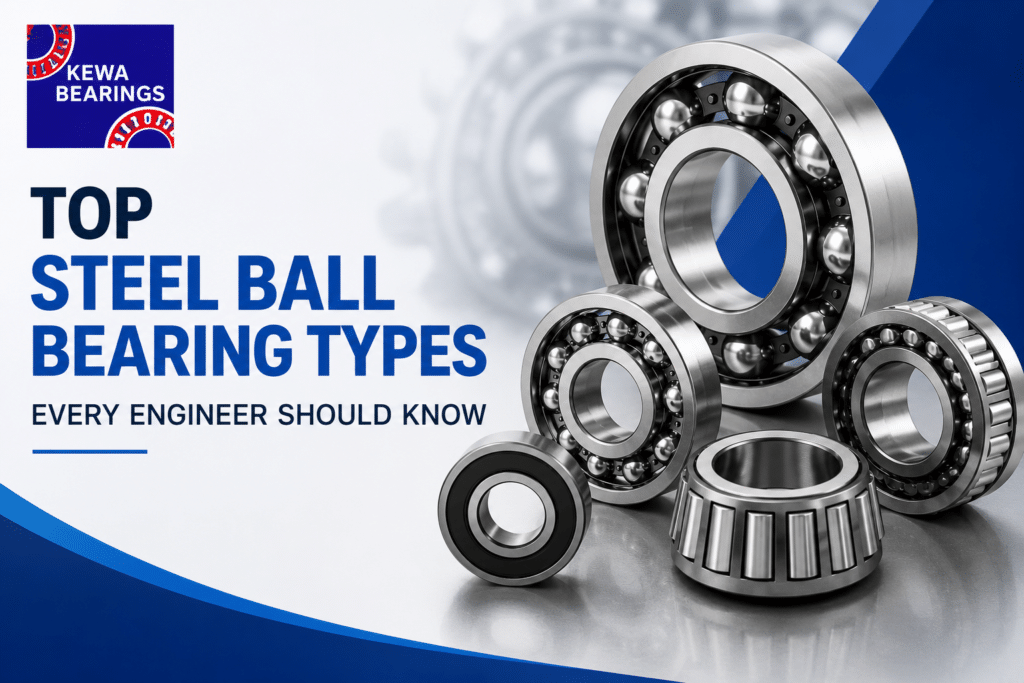
When it comes to ensuring smooth rotation, reducing friction, and improving machine performance, steel ball bearings play an essential role. From automobiles and industrial machinery to agricultural equipment and household appliances, these bearings are used in countless applications where reliability and efficiency matter.
Engineers often have to choose the right bearing based on load capacity, speed, operating conditions, and maintenance requirements. Selecting the wrong bearing can lead to excessive wear, machine failure, increased downtime, and higher maintenance costs.
In this guide, we’ll explore the most common steel ball bearings, their features, benefits, and applications so every engineer can make informed decisions.
What Are Steel Ball Bearings?
Steel ball bearings are rolling-element bearings that use hardened steel balls to reduce friction between moving parts. The balls roll between an inner ring and an outer ring, allowing shafts or machine components to rotate smoothly while carrying radial, axial, or combined loads.
High-quality steel bearings are manufactured using premium bearing steel that offers:
- High hardness
- Excellent wear resistance
- Superior load-carrying capacity
- Long service life
- Corrosion resistance (depending on material and coating)
Because of their strength and durability, steel bearings remain one of the most widely used bearing types across industries.
Why Are Steel Ball Bearings So Popular?
The popularity of steel ball bearings comes from their ability to provide reliable performance under various operating conditions.
Some of their major advantages include:
- Reduced friction
- High rotational speed
- Longer machine life
- Low maintenance
- Smooth and quiet operation
- Excellent dimensional accuracy
- Cost-effective performance
These benefits make them suitable for both light-duty and heavy-duty applications.
Top Steel Ball Bearing Types Every Engineer Should Know
Understanding the different types of bearings helps engineers choose the right solution for each application.
1. Deep Groove Ball Bearings
Deep groove ball bearings are the most commonly used steel ball bearings worldwide.
They have deep raceway grooves that allow them to handle radial loads while also supporting moderate axial loads in both directions.
Features
- Simple design
- High-speed capability
- Low friction
- Quiet operation
- Minimal maintenance
Applications
- Electric motors
- Pumps
- Fans
- Household appliances
- Gearboxes
- Conveyor systems
These bearings are ideal for general-purpose industrial applications.
2. Angular Contact Ball Bearings
Angular contact bearings are specially designed to handle combined radial and axial loads.
Their raceways are offset, allowing them to support significant thrust loads while maintaining high rotational speeds.
Features
- Excellent axial load capacity
- High precision
- High-speed performance
- Available in single and double-row designs
Applications
- CNC machines
- Automotive transmissions
- Machine tools
- Compressors
- Industrial pumps
They are commonly used where precision and stiffness are important.
3. Self-Aligning Ball Bearings
Misalignment is common in many industrial machines. Self-aligning bearings solve this problem by allowing the inner ring and balls to adjust automatically.
These steel ball bearings feature two rows of balls with a spherical outer raceway.
Features
- Compensates for shaft misalignment
- Low friction
- Smooth rotation
- Reduced vibration
Applications
- Agricultural machinery
- Textile equipment
- Paper mills
- Food processing equipment
- Fans and blowers
These items help extend equipment life by easing the stresses that show up due to shaft deflection.
4. Thrust Ball Bearings
Thrust ball bearings are specifically designed to carry axial loads.
Unlike deep groove bearings, they cannot handle heavy radial loads.
Features
- High axial load capacity
- Low friction
- Compact design
- Easy installation
Applications
- Automotive steering systems
- Turntables
- Vertical shafts
- Industrial presses
- Lifting equipment
These bearings perform best in applications where loads act parallel to the shaft.
5. Miniature Ball Bearings
Miniature bearings are compact steel ball bearings designed for small machines and precision equipment.
Although small in size, they deliver excellent rotational accuracy.
Features
- Lightweight
- High precision
- Low noise
- Smooth movement
Applications
- Medical equipment
- Robotics
- Drones
- Small electric motors
- Precision instruments
Their compact size makes them suitable for space-constrained applications.
6. Double Row Ball Bearings
Double row ball bearings offer higher load capacity than single-row bearings.
They combine the advantages of two single-row bearings while occupying less installation space.
Features
- Greater radial load capacity
- Improved stability
- High durability
- Longer service life
Applications
- Heavy machinery
- Industrial gearboxes
- Construction equipment
- Material handling systems
These bearings are preferred where increased load capacity is required without increasing shaft size.
7. Stainless Steel Ball Bearings
Although standard chrome steel bearings dominate industrial applications, stainless steel variants are ideal for corrosive environments.
Features
- Rust resistant
- Hygienic
- Excellent corrosion resistance
- Low maintenance
Applications
- Food processing
- Marine equipment
- Pharmaceutical machinery
- Chemical plants
- Medical devices
These steel ball bearings perform well where moisture and chemicals are present.
Factors Engineers Should Consider Before Choosing Steel Ball Bearings
Selecting the correct bearing involves more than simply matching dimensions.
Load Type
Determine whether the bearing will carry:
- Radial load
- Axial load
- Combined load
Different bearings are designed for different loading conditions.
Speed Requirements
Some bearings perform better at high rotational speeds than others.
Deep groove bearings are excellent for high-speed applications, while thrust bearings are better suited for slower rotational speeds under heavy axial loads.
Operating Environment
Engineers should evaluate:
- Dust
- Moisture
- Chemicals
- High temperature
- Low temperature
These conditions influence bearing material, lubrication, and sealing requirements.
Precision Requirements
Applications like CNC machines, robotics, and aerospace demand high-precision bearings with minimal vibration.
General industrial machinery may not require such tight tolerances.
Lubrication
Proper lubrication significantly affects bearing life.
Depending on operating conditions, engineers may choose:
- Grease lubrication
- Oil lubrication
- Automatic lubrication systems
Good lubrication reduces friction, heat, and wear.
Industries That Depend on Steel Ball Bearings
Today, steel ball bearings are used across nearly every manufacturing sector.
Some major industries include:
Automotive
Used in wheel hubs, gearboxes, transmissions, steering systems, and electric motors.
Manufacturing
Installed in conveyor systems, industrial robots, machine tools, and production equipment.
Agriculture
Found in harvesters, tractors, irrigation systems, and tillers.
Construction
Used in cranes, excavators, loaders, and heavy machinery.
Power Generation
Installed in turbines, generators, pumps, and compressors.
Mining
Operate in crushers, conveyors, vibrating screens, and drilling equipment.
Common Signs That Steel Ball Bearings Need Replacement
Even the highest-quality bearings eventually wear out.
Watch for these warning signs:
- Unusual noise
- Excessive vibration
- Increased operating temperature
- Lubricant leakage
- Rough rotation
- Visible rust or corrosion
- Cracks on bearing rings
- Increased power consumption
Replacing worn bearings before complete failure prevents expensive downtime.
Tips to Extend the Life of Steel Ball Bearings
Proper maintenance greatly improves bearing lifespan.
Follow these best practices:
- Use the correct bearing for the application.
- Install bearings using proper tools.
- Keep bearings clean during installation.
- Lubricate at recommended intervals.
- Prevent contamination from dust and moisture.
- Avoid overloading equipment.
- Monitor vibration and operating temperature.
- Inspect bearings during routine maintenance.
These simple steps help maximize machine reliability.
Why Choose High-Quality Steel Ball Bearings?
Not every bearing gives the same performance. The better, premium-quality bearings do deliver, generally:
- Better dimensional accuracy
- Superior load capacity
- Reduced maintenance costs
- Lower operating noise
- Longer service life
- Improved equipment efficiency
- Enhanced reliability
Choosing high-quality steel ball bearings from a trusted manufacturer helps reduce downtime and improves overall operational productivity.
Conclusion
Choosing the right steel ball bearings improves equipment performance, efficiency, and lifespan. Each type is designed for specific applications and load requirements, making proper selection essential for reliable operation and lower maintenance costs. By choosing high-quality steel ball bearings from trusted manufacturers like Kewa Bearings, you can ensure smoother performance, greater durability, and long-term reliability across various industrial applications.
FAQs
1. What are steel ball bearings used for?
Steel ball bearings reduce friction and support rotating shafts in machinery, vehicles, motors, pumps, and industrial equipment.
2. Which type of steel ball bearing is most commonly used?
Deep groove ball bearings are the most widely used due to their versatility, high-speed capability, and ability to handle radial and moderate axial loads.
3. What is the difference between deep groove and angular contact ball bearings?
Deep groove bearings mainly handle radial loads, while angular contact bearings are designed for combined radial and higher axial loads.
4. Are steel ball bearings suitable for high-speed applications?
Yes. Many steel ball bearings, especially deep groove and angular contact types, are designed for high-speed performance.
5. How long do steel ball bearings last?
Their lifespan depends on load, lubrication, operating conditions, and maintenance. Properly maintained bearings can last for many years.
6. What causes steel ball bearings to fail?
Common causes include poor lubrication, contamination, overloading, misalignment, corrosion, and improper installation.
7. Can steel ball bearings be reused?
If they show no signs of wear, damage, or contamination after inspection, they may be reused in some applications. However, replacing worn bearings is generally recommended.
8. How often should steel ball bearings be lubricated?
Lubrication intervals depend on the application, operating speed, temperature, and environmental conditions. Always follow the manufacturer’s recommendations.
9. What industries commonly use steel ball bearings?
Automotive, manufacturing, agriculture, mining, construction, food processing, power generation, and medical equipment industries all rely on steel ball bearings.
10. Why should engineers choose premium-quality steel ball bearings?
Premium bearings offer better durability, higher precision, improved load capacity, reduced maintenance, and longer service life, resulting in more reliable machine performance.