
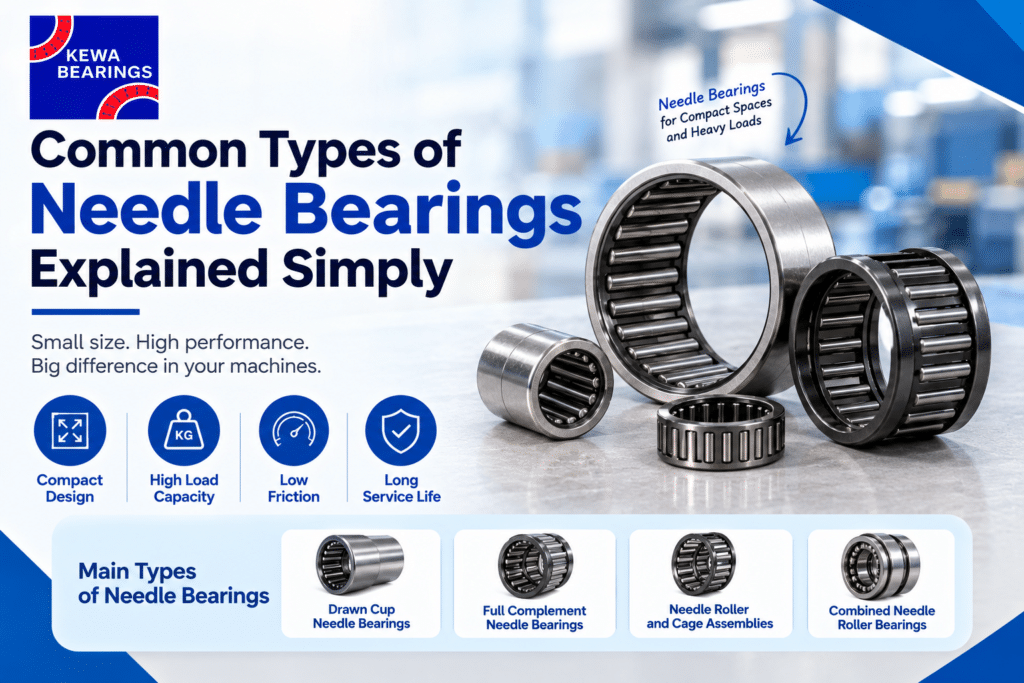
Needle bearings are essential components used in many machines, vehicles, and industrial applications. They help reduce friction between moving parts, allowing machines to operate smoothly and efficiently. Due to their compact design and ability to carry heavy radial loads, they are widely used in automotive systems, gearboxes, agricultural equipment, and industrial machinery.
However, not all needle bearings are designed for the same purpose. Different applications require different bearing designs depending on the available space, load requirements, operating speed, and working conditions. Understanding the common needle bearing types can help manufacturers, mechanics, and buyers select the right bearing for their specific needs.
At Kewa Bearings, we understand the importance of reliable bearing solutions for smooth machine operation. Let us explore the most common types of needle bearings, their features, and where they are used.
What Is a Needle Bearing?
Needle bearings are a type of roller bearings that use long, thin cylindrical rollers to handle high radial loads while occupying minimal space. Their compact design makes them ideal for applications where space-saving and reliable performance are essential. Depending on the design, they may include inner and outer rings, a cage, or needle rollers. Different needle bearing types are developed to meet specific mechanical requirements across various industrial and automotive applications.
Common Types of Needle Bearings
1. Drawn Cup Needle Roller Bearings
Drawn cup needle roller bearings feature a thin outer shell made from formed steel. Their lightweight construction and compact dimensions make them suitable for applications where installation space is limited.
These bearings usually contain needle rollers held inside the drawn cup. Sometimes the design leaves one end open. Other designs seal the end.
Key Features:
- Compact and lightweight construction.
- High radial load capacity relative to their size.
- Simple installation in appropriately designed housings.
- Suitable for applications with limited radial space.
Common Applications:
Drawn cup needle roller bearings are commonly used in automotive transmissions, small gearboxes, pumps, power tools, and other compact mechanical assemblies.
They are a practical choice when space is limited and the housing can provide a suitable running surface for the rollers.
2. Needle Roller Bearings with an Inner Ring
Some applications do not have a suitable shaft surface to act as the inner raceway. In such cases, needle roller bearings with an inner ring can be a useful solution.
The inner ring provides a hardened, precision-ground surface for the needle rollers to operate against. This design is particularly beneficial when the shaft material or surface finish is not appropriate for direct roller contact.
Key Features:
- Includes a dedicated inner ring.
- Provides a suitable rolling surface for the needle rollers.
- Can simplify bearing selection when shaft conditions are unsuitable.
- Supports reliable operation when properly installed and lubricated.
Common Applications:
These bearings are used in gearboxes, agricultural machinery, industrial equipment, and automotive components where the shaft cannot directly serve as the bearing raceway.
Among the different needle bearing types, this design is worth considering when shaft surface quality and installation requirements are important factors.
3. Needle Roller and Cage Assemblies
Needle roller and cage assemblies consist of needle rollers held in position by a specially designed cage. Unlike complete bearings, these assemblies do not include their own inner and outer rings.
Instead, they operate directly between suitable hardened and finished shaft and housing raceways.
The cage separates the rollers, maintains their spacing, and helps guide their movement during operation.
Key Features:
- Very compact design.
- Low weight and reduced space requirements.
- Efficient use of available radial space.
- Suitable for applications requiring high radial load capacity.
Common Applications:
These assemblies are frequently found in automotive transmissions, connecting rods, compressors, two-stroke engines, and industrial gear systems.
They are ideal when the surrounding machine components can provide the required raceways. Proper alignment, lubrication, and surface hardness are important for dependable performance.
4. Full Complement Needle Roller Bearings
Full complement needle roller bearings contain as many needle rollers as the design permits, without a cage separating the rollers. This allows more rollers to share the applied load.
Because of the increased number of rollers, these bearings can offer high load-carrying capacity in a compact space. However, the absence of a cage can increase friction and may limit operating speed compared with some caged designs.
Key Features:
- High number of needle rollers.
- High radial load capacity.
- Compact construction.
- Suitable for applications where heavy loads are more important than high operating speed.
Common Applications:
Full complement designs are used in selected industrial machinery, heavy-duty gear systems, and other mechanisms that require substantial radial load support.
When comparing needle bearing types, it is important to consider both load capacity and operating speed rather than selecting a bearing based on load alone.
5. Thrust Needle Roller Bearings
Thrust needle roller bearings are designed to support axial loads, which act parallel to the shaft. They use thin needle rollers arranged between suitable thrust raceways or washers.
Unlike conventional radial needle bearings, these bearings are specifically intended to handle forces along the shaft axis. They can support significant axial loads while requiring relatively little space.
Key Features:
- Designed for axial load support.
- Compact axial dimensions.
- High load capacity relative to their size.
- Suitable for applications where space is restricted.
Common Applications:
Thrust needle roller bearings are used in automotive transmissions, clutches, machine tools, gear assemblies, and other mechanisms where axial forces must be managed.
Correct installation and alignment are essential because these bearings require suitable supporting surfaces to operate effectively.
6. Machined Ring Needle Roller Bearings
Machined ring needle roller bearings feature solid inner or outer rings manufactured to provide strong and precise bearing surfaces. Depending on the design, they may be available with or without an inner ring and with different cage arrangements.
The build is strong. It works well when conditions are tough. They are often selected when the application requires greater structural strength, precision, or flexibility in bearing configuration.
Key Features:
- Strong and rigid ring construction.
- Available in different configurations.
- Suitable for demanding industrial applications.
- Can provide reliable operation under appropriate loading and lubrication conditions.
Common Applications:
These bearings are used in industrial gearboxes, construction machinery, agricultural equipment, and heavy-duty mechanical systems.
They are a suitable option when the application requires a robust bearing design and the available installation space permits a machined ring arrangement.
How to Choose the Right Needle Bearing
Selecting the right bearing is essential for achieving smooth machine operation, reducing wear, and avoiding unnecessary maintenance. Before choosing from the available needle bearing types, consider the following factors.
Understand the Load Requirements
First, determine whether the application involves radial loads, axial loads, or a combination of both. Radial needle roller bearings are primarily designed for radial loads, while thrust needle roller bearings are intended for axial loads.
Choosing a bearing that matches the load direction helps improve reliability and service life.
Check the Available Space
Needle bearings are popular because they can provide high radial load capacity within a compact design. However, different configurations have different dimensional requirements.
Measure the available space carefully and check the bearing’s inner diameter, outer diameter, and width before making a selection.
Consider Operating Speed
Operating speed affects bearing performance, heat generation, and lubrication requirements. Caged needle roller bearings may be more suitable for applications requiring higher speeds, while full complement designs are often preferred for applications prioritising load capacity.
Always check the manufacturer’s speed recommendations for the intended operating conditions.
Evaluate Lubrication Requirements
The proper application of lubricant reduces friction and prevents premature wear. Depending on the bearing design and application, grease or oil may be used.
The choice of lubricant should account for operating temperature, speed, load, and the working environment. Following the manufacturer’s lubrication recommendations can help extend bearing service life.
Check Installation and Maintenance Needs
Correct installation is essential for reliable bearing performance. Incorrect alignment, contamination, excessive clearance, or unsuitable shaft hardness can cause premature damage.
Choose a bearing that matches the machine’s design and can be installed and maintained correctly.
Common Applications of Needle Bearings
Needle bearings are used across several industries because of their compact dimensions and load-carrying capabilities.
Automotive Industry: Needle bearings are commonly used in transmissions, gearboxes, clutches, and other drivetrain components where space is limited.
Industrial Machinery: Manufacturing equipment, compressors, pumps, and mechanical drives may use needle bearings to support moving components.
Agricultural Equipment: Tractors, harvesters, and other agricultural machines use bearings in various rotating and reciprocating mechanisms.
Power Tools: Compact needle bearings can support rotating components in tools where weight and space are important considerations.
Construction Equipment: Selected machinery uses robust needle bearing arrangements to support loads and maintain reliable movement under demanding working conditions.
The best bearing for each application depends on the load, operating speed, available space, lubrication, and environmental conditions.
Why Quality Matters When Buying Needle Bearings
Bearing quality directly affects machine efficiency, durability, and maintenance costs. Poor-quality bearings may cause premature wear, increased friction, and unexpected downtime. When choosing needle bearing types, consider material quality, load capacity, dimensions, and application requirements. Proper selection and lubrication also help improve bearing performance and service life. Kewa Bearings offers bearing solutions for automotive and industrial needs, helping buyers select suitable bearings for reliable machine operation.
Conclusion
Needle bearings provide compact and efficient support for moving machine components. Understanding different needle bearing types helps you choose the right bearing based on load, speed, space, and lubrication requirements. For reliable performance and durability, choose suitable bearing solutions from a trusted supplier like Kewa Bearings.
Frequently Asked Questions
1. What is a needle bearing?
A needle bearing uses thin cylindrical rollers to support loads in limited spaces.
2. What are the main types of needle bearings?
Common types include drawn cup, thrust, full complement, and caged needle roller bearings.
3. What is the main advantage of needle bearings?
In addition to their high radial load capacity, they have a compact design.
4. Are needle bearings suitable for heavy loads?
Yes, many designs support heavy radial loads relative to their size.
5. What is the difference between radial and thrust needle bearings?
The thrust bearing supports axial loads, whereas the radial bearing supports radial loads.
6. Do needle bearings require lubrication?
Yes, proper lubrication helps reduce friction and wear.
7. Where are needle bearings commonly used?
The use of these components extends to automotive systems, gearboxes, power tools, and industrial machinery.
8. Can needle bearings operate at high speeds?
Yes, certain designs support high speeds, depending on operating conditions.
9. How can I select the right needle bearing?
Consider load, speed, dimensions, lubrication, and installation requirements.
10. Why choose a reliable bearing supplier?
A reliable supplier helps you find suitable bearings for your application.