
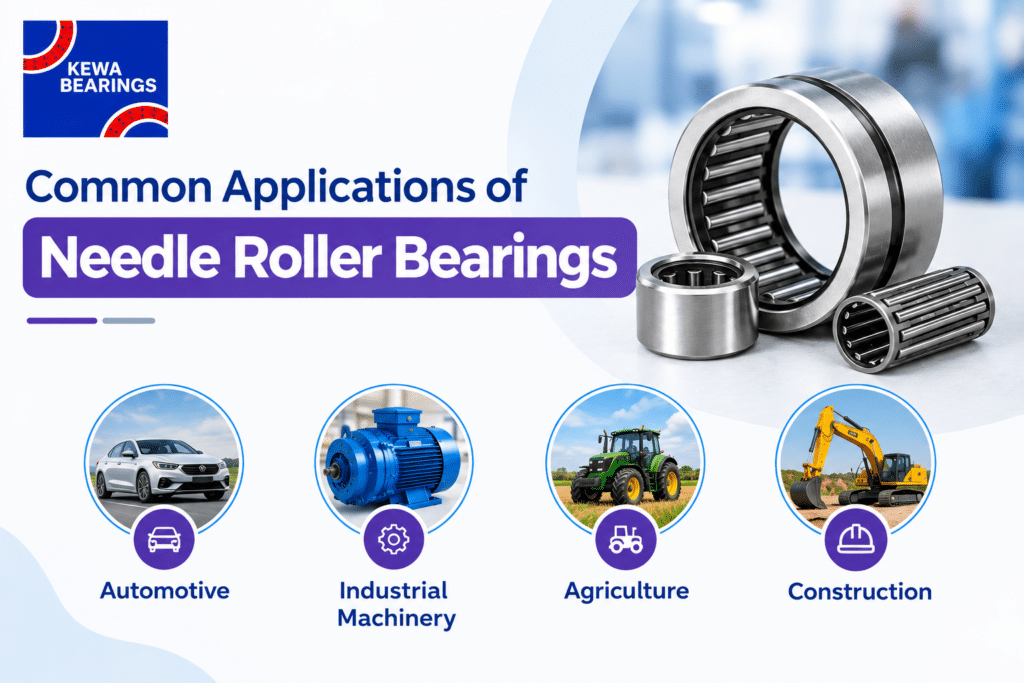
Needle roller bearings from Kewa Bearings are widely used in machines where space is limited but reliable motion and load support are required. Their compact design, high load-carrying capacity, and ability to handle rotational movement make them useful across many industries. They help reduce friction between moving parts and support smooth operation.
A needle roller bearing uses long, thin cylindrical rollers with a relatively small diameter compared with their length. This design allows the bearing to carry substantial radial loads while taking up less radial space than many other bearing types. This makes them useful when machinery needs reliable support without extra space.
What Are Needle Roller Bearings?
A needle roller bearing is a type of rolling-element bearing that uses slender cylindrical rollers. The rollers have a small diameter and a comparatively greater length, giving the bearing a large contact area with the raceway. This construction helps distribute loads effectively and provides good performance in compact applications. In compact assemblies, a needle roller bearing provides dependable radial support without adding unnecessary bulk.
Depending on the design, needle roller bearings may have an inner ring, outer ring, cage, or integrated raceway arrangement. Some designs can operate directly on a suitable shaft surface, which can further reduce the required installation space. The right configuration depends on load, speed, lubrication, alignment, and the available space in the machine.
Why Are Needle Roller Bearings Used?
One of the main reasons for using a needle roller bearing is its ability to support high radial loads while maintaining a compact cross-section. This is particularly useful where designers need to save space without compromising mechanical performance.
Their low friction can support smooth movement and efficient machine operation. However, performance depends on correct sizing, lubrication, installation, shaft condition, and operating conditions.
They are available in several configurations, including drawn-cup, machined-ring, and caged versions. Each design is suitable for different machine requirements.
Automotive Applications
The automotive industry is one of the major areas where needle roller bearing solutions are used. They can be found in transmissions, gearboxes, rocker arms, universal joints, steering systems, and other mechanisms where compact radial support is needed.
In vehicle transmissions, a needle roller bearing can support gears and rotating shafts while keeping the assembly relatively compact. They are useful where components need to rotate at different speeds while carrying radial loads. Their small cross-section helps manufacturers make efficient use of the limited space inside a gearbox.
They can also be used in engines and valve-train mechanisms. In certain designs, these bearings support rocker arms or other moving components, helping reduce friction during repeated movement. Their suitability for oscillating motion makes them valuable in selected automotive mechanisms.
Gearboxes and Power Transmission Systems
Gearboxes often contain several shafts, gears, and rotating components packed into a limited area. A needle roller bearing can provide radial support without requiring the larger radial dimensions associated with some conventional bearing designs.
They are used in industrial gearboxes, speed reducers, power transmission units, and other mechanical systems. Their ability to carry radial loads and fit into compact spaces makes them suitable for applications where efficient power transmission is important.
Correct bearing selection is essential in these systems. Engineers need to consider load direction, rotational speed, lubrication, temperature, shaft and housing dimensions, and expected service life before choosing a bearing.
Industrial Machinery
Needle roller bearings are also common in industrial machinery. They can be used in printing equipment, textile machines, packaging machines, material-handling systems, and automated production equipment.
These machines often contain compact shafts, cams, rollers, or linkages that move continuously or intermittently. A suitable bearing helps support these components and allows controlled movement with reduced friction.
In production environments, unexpected bearing damage can cause downtime. Correct selection, installation, and lubrication help maintain machine performance and reduce the possibility of premature failure.
Pumps and Compressors
Certain pumps, compressors, and fluid-handling machines use needle roller bearings in mechanisms where compact radial support is required. The bearing may support rotating or oscillating components and help maintain proper movement between connected parts.
The arrangement depends on machine design, speed, load, lubrication, and environment. Exposure to moisture, dust, chemicals, or heat may also require suitable materials and seals.
Regular inspection is useful in demanding applications because unusual noise, vibration, or excessive heat can indicate a developing bearing problem.
Construction and Agricultural Equipment
Construction and agricultural machinery operate under demanding conditions and may experience vibration, shock loads, dust, and repeated movement. Needle roller bearings can be used in selected joints, transmissions, linkages, and rotating assemblies where their compact structure and load capacity are useful.
Equipment such as tractors, harvesters, excavators, and other heavy machines contains many moving connections. The bearing used in each location must be selected according to the actual load and movement pattern. Proper sealing and lubrication can be particularly important in dusty outdoor environments.
Two-Wheelers and Motorcycles
Motorcycles and other two-wheelers use compact mechanical assemblies where available space can be limited. Needle roller bearings can be found in selected transmission, suspension, clutch, and linkage applications.
Their ability to support radial loads while occupying limited space makes them useful in mechanisms that require controlled rotation or oscillation. In these applications, choosing the correct bearing size and ensuring proper lubrication are important for smooth operation and longer service life.
Aerospace and Precision Equipment
Some aerospace and precision mechanical systems use needle roller bearings where low weight, compact dimensions, and dependable movement are required. Such applications can have strict requirements for material quality, dimensional accuracy, lubrication, temperature resistance, and reliability.
Precision equipment may also use these bearings in mechanisms involving controlled rotation or oscillation. Because operating conditions can vary considerably, the bearing specification should always match the equipment manufacturer’s requirements.
Robotics and Automation
Robotic arms, automated machinery, and motion-control equipment contain many compact joints and moving mechanisms. Needle roller bearings can be suitable for selected applications where space is restricted and radial load support is required.
Automation systems may perform thousands or millions of repeated movements. Bearing selection therefore needs to account for load cycles, speed, oscillation, alignment, lubrication, and operating environment. A correctly selected bearing can contribute to smooth and repeatable movement.
How to Select the Right Needle Roller Bearing
Choosing the correct bearing starts with understanding the machine’s operating conditions. Shaft diameter, housing dimensions, radial load, speed, temperature, lubrication, and available space should all be evaluated.
The type of movement also matters. Continuous rotation and oscillating movement can place different demands on the bearing. Engineers should also check whether the shaft or raceway provides a suitable surface for the rollers.
Installation is equally important. Excessive mounting force, contamination, poor alignment, or inadequate lubrication can shorten bearing life even when the bearing itself is of good quality. Regular inspection can help identify unusual noise, vibration, heat, or wear before a larger mechanical problem develops.
Importance of Quality Bearings
Bearing quality affects machine reliability. A well-made bearing should have accurate dimensions, suitable materials, consistent roller geometry, and dependable manufacturing quality.
Kewa Bearings provides bearing solutions for different industrial requirements, helping customers select products according to their machinery and application needs. Before purchasing, users should confirm the bearing designation, dimensions, load requirements, speed, and operating environment.
Final Thoughts
Needle roller bearings are ideal for compact applications requiring reliable radial load support. They are used in automotive, industrial, construction, automation, and precision machinery.
Proper selection based on load, speed, lubrication, temperature, alignment, and installation is essential for reliable performance. Kewa Bearings offers suitable bearing solutions for different machine requirements, helping support smooth and efficient operation.
FAQs
1. What is a needle roller bearing?
It is a bearing that uses long, thin rollers to support radial loads in limited space.
2. Where are needle roller bearings commonly used?
They are used in automotive, industrial, agricultural, motorcycle, and automation applications.
3. Can needle roller bearings handle high loads?
Yes, they can support high radial loads relative to their compact size.
4. Are needle roller bearings suitable for oscillating motion?
Yes, certain designs are suitable for oscillating and reciprocating movements.
5. Do needle roller bearings require lubrication?
Yes, proper lubrication helps reduce friction, heat, and wear.
6. Can these bearings save space?
Yes, their compact cross-section makes them suitable for space-restricted assemblies.
7. What affects bearing service life?
Load, speed, lubrication, alignment, contamination, temperature, and installation can affect service life.
8. Where are needle roller bearings used in vehicles?
They can be used in transmissions, gearboxes, rocker arms, clutches, and selected linkages.
9. How should a needle roller bearing be selected?
Consider the load, speed, dimensions, movement, lubrication, temperature, and operating environment.
10. Why is proper bearing installation important?
Correct installation helps prevent premature wear, damage, vibration, and bearing failure.