
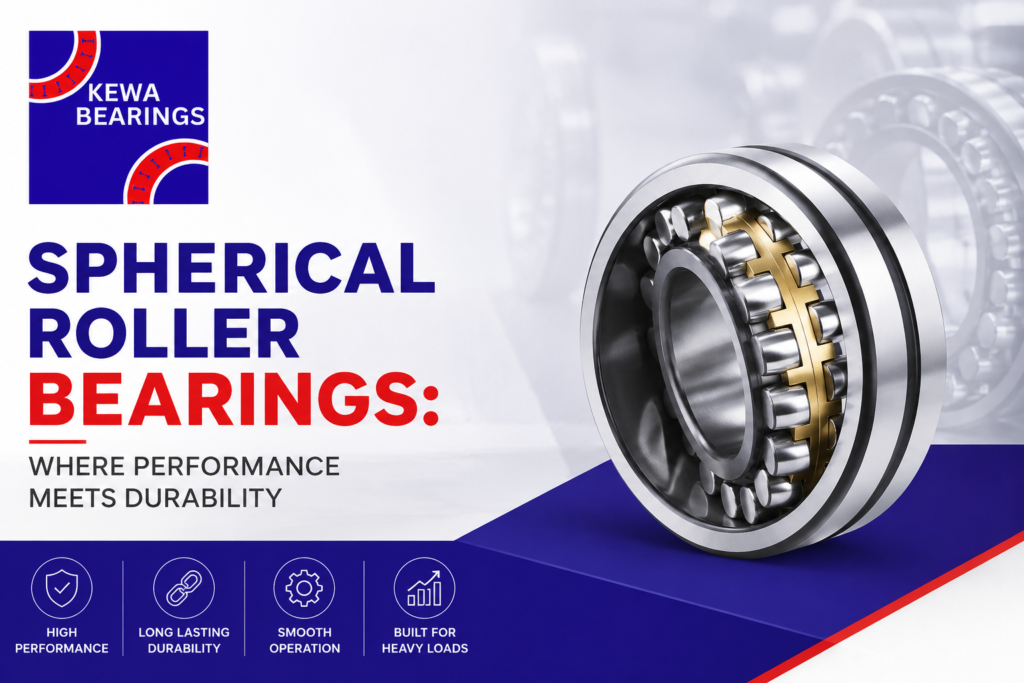
In heavy-duty industries, machinery often works under demanding conditions involving high loads, continuous operation, vibration, and difficult working environments. In such situations, every machine component must deliver dependable performance. Bearings are especially important because they support rotating shafts, reduce friction, and help machinery operate smoothly.
Among the different types of industrial bearings, spherical roller bearings are known for their excellent load-carrying capacity, durability, and ability to accommodate misalignment. They are commonly used in applications where ordinary bearings may struggle to handle heavy loads or shaft alignment challenges.
A roller spherical bearing combines a robust design with rolling elements that help support heavy radial loads. Depending on its design, it can also handle axial loads and compensate for certain levels of shaft misalignment. This makes spherical roller bearings a practical choice for demanding industrial applications.
What Are Spherical Roller Bearings?
Spherical roller bearings are rolling-element bearings designed primarily to support heavy radial loads. They contain barrel-shaped rollers arranged between an inner ring and an outer ring. The outer raceway has a spherical shape, which gives the bearing its ability to accommodate angular misalignment.
Unlike some conventional bearings that require highly precise alignment between the shaft and housing, spherical roller bearings can tolerate a certain amount of misalignment. This feature is particularly useful in large industrial machines where shaft deflection, housing deformation, or installation conditions can affect alignment.
A roller spherical bearing is therefore suitable for applications where both high load capacity and reliable operation are important.
How Does a Spherical Roller Bearing Work?
The basic function of a spherical roller bearing is to allow a shaft to rotate while supporting the load placed on it. As the shaft rotates, the rollers move between the inner and outer raceways. Rolling contact helps reduce friction and allows smooth movement.
The spherical outer raceway provides another important advantage. When slight misalignment occurs between the shaft and housing, the rollers can adjust their position within the bearing. This helps prevent excessive stress from being transferred to the bearing and other machine components.
Because of this combination of load capacity and misalignment tolerance, a roller spherical bearing can provide reliable performance in equipment operating under challenging conditions.
Key Benefits of Spherical Roller Bearings
High Load-Carrying Capacity
One of the biggest advantages of spherical roller bearings is their ability to support heavy radial loads. Their roller design provides a larger contact area compared with many other bearing types.
This makes them suitable for machinery where substantial loads are placed on rotating shafts. Industries such as mining, steel, construction, and manufacturing often require bearings capable of handling these demanding conditions.
Ability to Accommodate Misalignment
Perfect shaft and housing alignment is not always possible in large machines. Shaft deflection, thermal expansion, installation errors, and housing deformation can create alignment issues.
Spherical roller bearings are designed to accommodate a certain degree of misalignment. This helps the bearing continue operating smoothly without placing unnecessary stress on connected components.
Strong and Durable Construction
Heavy-duty machinery requires components that can withstand continuous operation. Spherical roller bearings are designed with robust components that provide dependable performance under demanding conditions.
When properly selected, installed, lubricated, and maintained, a roller spherical bearing can offer a long service life and help reduce the frequency of bearing replacement.
Reliable Performance Under Vibration
Industrial machinery can generate significant vibration during operation. Excessive vibration can affect bearing performance and accelerate wear.
Spherical roller bearings are commonly selected for applications where vibration and heavy loads are part of normal operating conditions. Their strong design allows them to perform reliably in many demanding environments.
Support for Heavy-Duty Machinery
From conveyors to crushers and industrial gearboxes, many machines operate under substantial loads. Spherical roller bearings provide the strength and stability required for these applications.
Their ability to support heavy loads while accommodating misalignment makes them a valuable component in many industrial systems.
Where Are Spherical Roller Bearings Used?
Spherical roller bearings are used across a wide range of industries. Their versatility makes them suitable for equipment that requires reliable performance under heavy loads.
In the mining industry, they can be used in crushers, conveyors, screens, and other heavy equipment. Mining machinery often operates continuously under harsh conditions, making durable bearings essential.
In steel plants, spherical roller bearings can be found in equipment such as rolling mills, conveyors, and material-handling systems. These machines often experience high temperatures, heavy loads, and continuous operation.
The construction industry also uses spherical roller bearings in heavy machinery and equipment where large loads and vibration are common.
In paper manufacturing, these bearings may be used in rollers, conveyors, and other rotating equipment. Reliable bearing performance is important because unexpected machine downtime can affect production.
They are also used in industrial gearboxes, pumps, fans, material-handling systems, and manufacturing equipment where high load capacity and durability are required.
Why Proper Bearing Selection Matters
Choosing the correct bearing is essential for achieving reliable machine performance. A bearing that is too small, incorrectly designed, or unsuitable for the operating conditions may experience premature wear or failure.
Before selecting a roller spherical bearing, several factors should be considered. These include the load applied to the bearing, shaft speed, operating temperature, lubrication method, shaft size, housing design, and environmental conditions.
The type of load is particularly important. If the bearing is exposed to high radial loads, it should have sufficient load-carrying capacity. If axial loads are also present, the bearing’s ability to handle those loads must be considered.
Operating speed is another important factor. The bearing must be suitable for the rotational speed of the machine to prevent overheating and excessive wear.
Importance of Proper Lubrication
Lubrication plays a major role in bearing performance and service life. It helps reduce friction between the rolling elements and raceways while also helping control heat and wear.
Using the correct lubricant and maintaining suitable lubrication intervals can help prevent premature bearing damage. Overlubrication as well as inadequate lubrication can lead to problems.
The lubricant should be selected according to factors such as operating temperature, speed, load, and environmental conditions. Following the manufacturer’s recommendations is one of the best ways to maintain reliable bearing performance.
Common Causes of Bearing Failure
Even a high-quality spherical roller bearing can fail if it is incorrectly installed or maintained. Several common issues can reduce bearing life.
Poor lubrication can increase friction, heat, and wear. Contamination from dust, dirt, water, or other particles can damage the bearing’s internal surfaces.
Improper installation can also create problems. Excessive mounting force, incorrect fitting, or unsuitable tools may damage the bearing before the machine even begins normal operation.
Overloading is another common cause of premature failure. Every bearing has specific load limits, and continuously exceeding them can cause excessive stress and damage.
Misalignment beyond the bearing’s designed tolerance can also reduce service life. Spherical roller bearings can handle a bit of misalignment, but they aren’t meant to mop up every kind of alignment problem. They are not really built to compensate for unlimited misalignment issues; you know, it has limits.
Regular inspections can help identify unusual noise, vibration, temperature increases, lubricant leakage, or visible damage before the problem becomes more serious.
How to Extend Bearing Service Life
Proper maintenance can significantly improve bearing performance. Start by following the recommended lubrication schedule and using the correct lubricant.
Regularly inspect the bearing and surrounding components for signs of wear, overheating, unusual noise, or vibration. Early detection allows maintenance teams to address small problems before they result in major equipment downtime.
Correct installation is equally important. Use suitable tools and follow the recommended mounting procedure. Avoid applying force directly to the rolling elements or other sensitive bearing components.
It is also important to protect bearings from contamination. Dust, moisture, and other contaminants can enter the bearing and accelerate wear.
By combining proper installation, lubrication, inspection, and operating practices, businesses can get better performance and longer service life from their roller spherical bearing solutions.
Spherical Roller Bearings and Machine Efficiency
Bearing performance can directly affect overall machine efficiency. A damaged or poorly lubricated bearing can create additional friction, increase energy consumption, generate heat, and affect machine performance.
A properly selected spherical roller bearing helps maintain smooth shaft rotation and supports the machine’s operating load effectively. This can contribute to more stable operation and reduce the risk of unexpected breakdowns.
For industries where equipment downtime can affect production schedules and operating costs, reliable bearing performance is particularly important.
Why Choose Kewa Bearings?
Kewa Bearings focuses on providing bearing solutions designed to meet the requirements of different industrial applications. Choosing the right bearing involves understanding the machine, operating environment, load conditions, and performance requirements.
A dependable bearing supplier can help businesses identify suitable products for their machinery and applications. Whether the requirement involves heavy industrial equipment, conveyors, manufacturing machinery, or other rotating systems, selecting a suitable bearing can make a significant difference.
Quality bearings combined with correct installation and maintenance can help businesses achieve smoother operation, reduced downtime, and better equipment reliability.
Conclusion
Spherical roller bearings are ideal for heavy-duty machines because they offer high load capacity, durability, vibration resistance, and misalignment tolerance. A roller spherical bearing supports smooth shaft rotation and reliable performance.
Proper installation, lubrication, and regular maintenance can further extend bearing life, reduce downtime, and improve machine efficiency. Choosing a reliable bearing solution from Kewa Bearings can help businesses achieve consistent and dependable equipment performance.
FAQs
1. What is a spherical roller bearing?
It supports heavy radial loads and allows limited shaft misalignment.
2. What is a roller spherical bearing used for?
It is used in conveyors, crushers, mining equipment, gearboxes, and heavy machinery.
3. What makes spherical roller bearings durable?
Their strong construction, high load capacity, and misalignment tolerance improve durability.
4. Can spherical roller bearings handle axial loads?
Yes, many designs can handle both radial and axial loads.
5. Where are spherical roller bearings commonly used?
There are many uses for them, including mining, steel production, construction, paper mills, and manufacturing.
6. Why is misalignment tolerance important?
It helps the bearing operate smoothly despite slight shaft or housing misalignment.
7. How can I increase bearing life?
Use proper lubrication, installation, inspection, and protection from contamination.
8. What causes bearing failure?
Poor lubrication, contamination, overloading, overheating, and improper installation can cause failure.
9. How do I select the right spherical roller bearing?
Consider the load, speed, shaft size, temperature, lubrication, and operating conditions.
10. Why choose a quality roller spherical bearing?
It offers reliable load support, durability, smooth operation, and better machine performance.
Pingback: Common Problems with 240 Series Spherical Roller Bearings - KEWA BEARINGS