Tapered roller bearings are widely used in machines and vehicles where components need to handle heavy loads, continuous rotation, and demanding operating conditions. Their unique design allows them to support both radial loads and axial loads, making them suitable for applications where ordinary bearings may not provide the required performance.
From automobile wheels and transmissions to industrial machinery and heavy-duty equipment, Tapered Roller Bearings play an important role in maintaining smooth and reliable movement. Their ability to manage combined loads makes them a preferred choice across several industries.
But where exactly are these bearings used, and why are they suitable for such demanding applications? Let’s understand their common applications and advantages.
What Are Tapered Roller Bearings?
Tapered roller bearings consist of tapered rollers positioned between an inner ring, outer ring, and a cage. Unlike some other roller bearings, their rolling elements are shaped like truncated cones. This tapered design allows the bearing to handle forces acting in both radial and axial directions.
When a machine operates, the bearing experiences different types of loads. A radial load acts perpendicular to the shaft, while an axial load acts along the shaft. Tapered Roller Bearings can manage both types of loads effectively, which makes them particularly useful in applications involving combined or changing loads.
Another important advantage is their ability to provide stable performance under heavy loads. With proper lubrication, installation, and maintenance, they can offer reliable service for extended periods.
Where Are Tapered Roller Bearings Used?
Automotive Applications
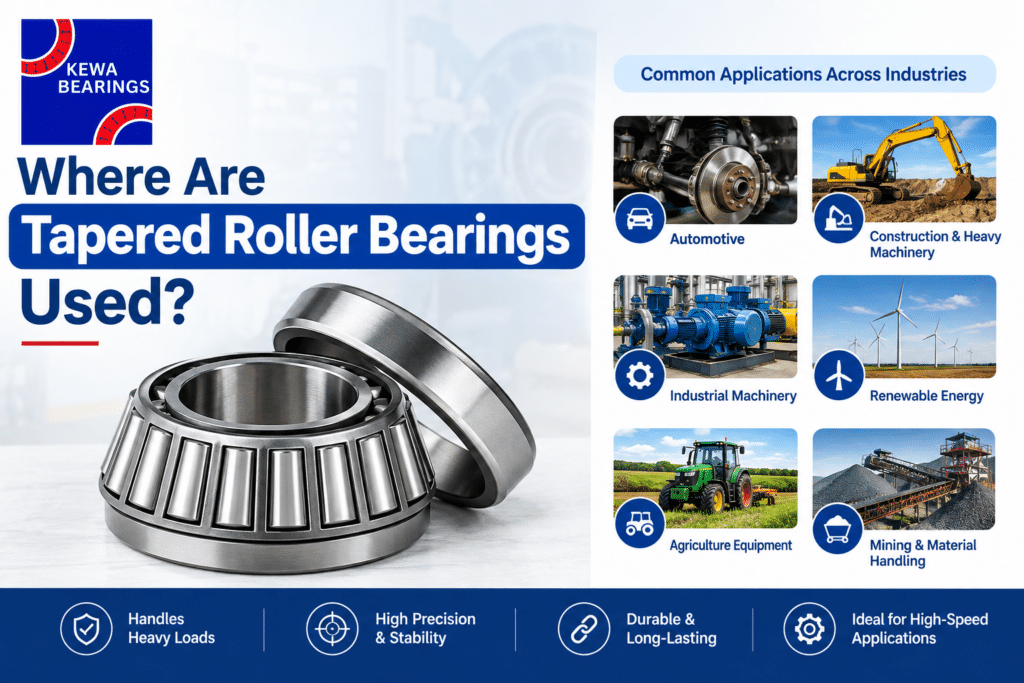
One of the most common applications of Tapered Roller Bearings is the automotive industry. They are frequently used in wheel hubs, differentials, transmissions, and other drivetrain components.
Vehicle wheels are exposed to radial loads from the weight of the vehicle as well as axial forces generated while cornering. A bearing used in these applications needs to handle both types of forces while allowing the wheel to rotate smoothly.
Tapered roller bearings are well suited for this purpose because their design can accommodate combined loading. They are also commonly used in differentials and transmissions, where gears generate significant radial and axial forces.
Their ability to operate reliably under demanding conditions makes them an important component in commercial vehicles, passenger vehicles, trucks, and other automotive systems.
Truck and Heavy Vehicle Applications
Heavy vehicles operate under significantly higher loads than many passenger vehicles. Trucks, buses, trailers, and other commercial vehicles require bearing solutions capable of handling substantial forces and repeated operating cycles.
Tapered Roller Bearings are commonly used in heavy-duty wheel-end applications because they can support high radial and axial loads. Their robust construction makes them suitable for applications where durability and load-handling capacity are essential.
In these vehicles, bearing performance can directly affect wheel rotation, operating efficiency, and maintenance requirements. Selecting the correct bearing according to the vehicle and operating conditions is therefore important.
Industrial Gearboxes
Industrial gearboxes transfer power from one component to another and are used in manufacturing equipment, conveyors, material-handling systems, and many other machines.
Gear teeth generate both radial and axial forces during operation. Tapered Roller Bearings can handle these combined forces, making them suitable for several gearbox designs.
They help support rotating shafts and maintain proper alignment between moving components. This can contribute to smoother operation and reduce unwanted vibration and wear.
Industries that depend on continuous machinery operation often require bearings that can perform consistently under heavy loads and varying speeds. Tapered roller bearings can be a practical solution for these requirements when correctly selected and installed.
Construction Equipment
Construction machinery often works in harsh environments and under heavy loads. Excavators, loaders, cranes, bulldozers, and other equipment have rotating components that require dependable bearing support.
Tapered Roller Bearings can be used in applications where components experience a combination of radial and axial forces. Their load-handling capability makes them suitable for demanding construction equipment.
Construction machines may also experience shock loads, vibration, dust, and changing operating conditions. Therefore, the bearing must be selected according to the machine’s load, speed, lubrication, operating environment, and expected service life.
Agricultural Machinery
Agricultural equipment such as tractors, harvesters, tillers, and other farm machines operate under challenging conditions. Components can experience heavy loads, vibration, dust, and irregular operating cycles.
Tapered roller bearings are used in various agricultural machinery applications because they can handle combined loads and provide support to rotating components.
For agricultural equipment, choosing a bearing that matches the machine’s operating conditions is important. Proper sealing and lubrication may also be required depending on the environment in which the equipment operates.
Railway Applications
Railway systems require highly reliable mechanical components because trains operate under heavy loads and repeated cycles. Bearings used in railway equipment must withstand substantial forces while maintaining smooth rotation.
Tapered Roller Bearings are used in certain railway applications, including wheel and axle-related systems, where their ability to handle combined loads can be beneficial.
The exact bearing design and specifications depend on the railway application, load requirements, speed, operating environment, and relevant industry standards.
Mining Equipment
Mining machinery operates under some of the most demanding conditions in the industrial sector. Crushers, conveyors, drilling equipment, and other mining machines may experience heavy loads, vibration, shock, and contamination.
Tapered Roller Bearings can be used in mining equipment where high load capacity and reliable shaft support are required.
Because mining environments can be particularly harsh, bearing selection should consider contamination protection, lubrication, load conditions, operating speed, and maintenance practices.
Material Handling Equipment
Conveyors, forklifts, cranes, and other material-handling systems depend on rotating components to move and transport materials.
Tapered roller bearings can be used in applications where shafts and rotating assemblies experience combined radial and axial loads. Their design allows them to support these forces while maintaining controlled movement.
In high-use material-handling equipment, choosing the correct bearing can help improve operational reliability and reduce unexpected maintenance.
Why Are Tapered Roller Bearings Preferred?
The main reason Tapered Roller Bearings are widely used is their ability to handle both radial and axial loads. This makes them different from bearings designed primarily for one type of load.
Their tapered geometry also provides effective load distribution between the rollers and raceways. This makes them suitable for applications involving heavy loads.
Another benefit is their flexibility in different arrangements. Depending on the application, tapered roller bearings can be arranged to accommodate axial loads in different directions.
However, bearing performance depends on more than the bearing type. Correct sizing, preload, alignment, lubrication, installation, and maintenance all have an impact on service life.
How to Choose the Right Tapered Roller Bearing?
Before selecting a bearing, it is important to understand the actual operating conditions of the machine.
Start by determining the radial and axial loads. If the equipment experiences shock or fluctuating loads, these should also be considered.
Operating speed is another important factor. A bearing suitable for low-speed heavy-load equipment may not be the right choice for a high-speed application.
Temperature, lubrication, contamination, shaft dimensions, available space, and expected operating life should also be evaluated.
The correct fit and preload are particularly important for tapered roller bearings. Incorrect adjustment can result in excessive heat, vibration, premature wear, or bearing failure.
Working with an experienced bearing supplier can make the selection process easier and help ensure that the bearing matches the application.
Maintenance Tips for Tapered Roller Bearings
Even a high-quality bearing can experience premature failure if it is not installed or maintained correctly.
Proper lubrication is one of the most important maintenance requirements. The correct lubricant and lubrication quantity should be used according to the application and manufacturer’s recommendations.
Bearings should also be protected from dust, water, dirt, and other contaminants. Regular inspection can help identify signs of overheating, unusual noise, vibration, or excessive play.
Correct installation is equally important. Using improper tools or applying force to the wrong bearing ring can damage the rollers or raceways.
Regular maintenance and timely replacement can help reduce unexpected downtime and keep machinery operating efficiently.
Choose Reliable Tapered Roller Bearings from Kewa Bearings
The right bearing can make a significant difference in the performance and reliability of industrial equipment. Tapered Roller Bearings are a dependable option for applications that require the handling of combined radial and axial loads.
From automotive and heavy vehicles to construction, agriculture, mining, gearboxes, and material-handling equipment, these bearings are used across a wide range of demanding applications.
At Kewa Bearings, selecting the right bearing should be based on the specific requirements of your application. Consider factors such as load, speed, operating conditions, dimensions, lubrication, and expected service life before making a decision.
With the right bearing and proper maintenance, machines can operate more smoothly, efficiently, and reliably.
FAQs About Tapered Roller Bearings
1. What are Tapered Roller Bearings used for?
They handle both radial and axial loads in machinery and vehicles.
2. Can Tapered Roller Bearings handle heavy loads?
Yes, they are designed for high-load and heavy-duty applications.
3. Where are Tapered Roller Bearings commonly used?
They are used in automobiles, gearboxes, construction, mining, and agricultural machinery.
4. Are Tapered Roller Bearings used in cars?
Yes, they are commonly used in wheel hubs, transmissions, and differentials.
5. What loads can Tapered Roller Bearings support?
They can support both radial and axial loads.
6. Do Tapered Roller Bearings need lubrication?
Yes, proper lubrication helps reduce friction, heat, and wear.
7. How can bearing life be increased?
Proper installation, lubrication, alignment, and regular maintenance can extend bearing life.
8. How do I choose the right Tapered Roller Bearing?
Consider the load, speed, dimensions, temperature, and operating conditions.
9. Can Tapered Roller Bearings handle shock loads?
Yes, they can handle heavy and fluctuating loads when correctly selected.
10. Why choose Kewa Bearings?
Kewa Bearings provides reliable bearing solutions for various automotive and industrial applications.