
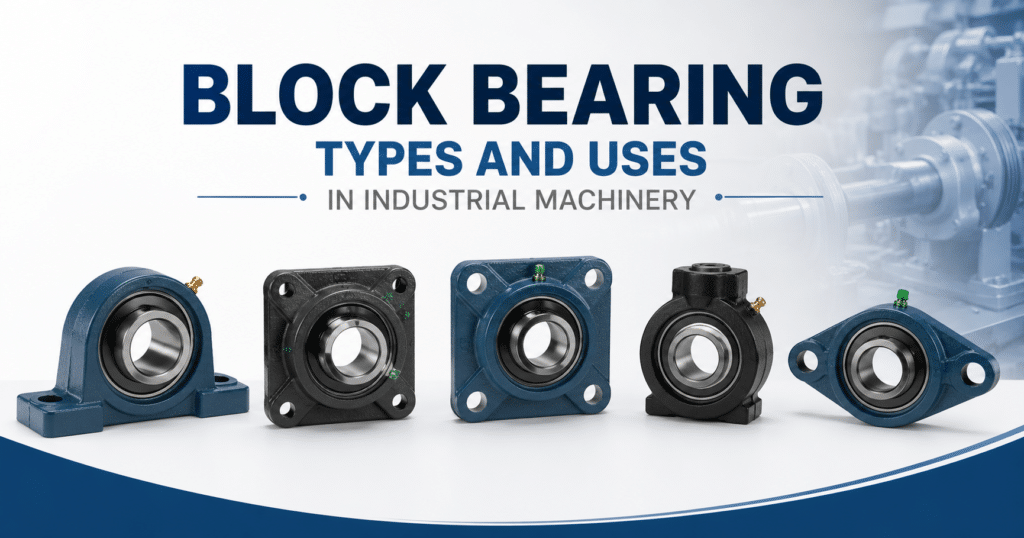
Industrial machines work best when their motion feels smooth and the handling of load stays proper, like it should be, all the time. In heavy equipment, a key part that helps rotating shafts stay in place is the block bearing. You can spot these bearings in a bunch of spots across manufacturing units, conveyor systems, farm equipment, and also inside mining machinery. They usually offer steady support and help reduce friction too so the full system works more efficiently, with less wear over time.
Grasping the various block bearing types can help industries pick the suitable bearing for improved machine performance and better durability in the long run, even if it sounds a bit technical at first.
What Are Block Bearings?
Block bearings, sometimes called mounted bearings or pillow block bearings, are built to help with rotating shafts and keep alignment sort of steady. They typically include a housing unit that makes installing much easier, and also shields the bearing from dust , moisture and vibration.
In industrial machinery these kinds of bearings are often chosen, because they can take heavy loads and manage long-lasting, continuous operation without much trouble.
Common Block Bearing Types
Pillow Block Bearings
Pillow block bearings are among the most commonly used block bearing types in industrial applications. They are mounted on flat surfaces and provide strong shaft support.
These bearings are widely used in conveyor belts, packaging machines, and textile equipment because they are easy to install and maintain.
Flange Block Bearings
Flange block bearings are attached to machine walls or vertical surfaces using a flange. They help maintain shaft alignment in compact spaces.
Industries often use them in food processing machines, pumps, and agricultural equipment where space-saving installation is important.
Take-Up Block Bearings
Take-up bearings are designed for applications where belt or chain tension needs adjustment. The housing can slide within a frame to maintain proper tension.
These bearings are commonly used in conveyor systems, mining machinery, and material handling equipment.
Hanger Block Bearings
Hanger block bearings are suspended from above rather than mounted below. They support shafts in overhead conveyor systems and industrial processing lines.
They are useful in applications where machinery layout does not allow bottom mounting.
Plummer Block Bearings
Plummer block bearings are those heavy-duty bearings that kind of support larger shafts and take the higher loads too. People usually pick them because they’re built for lasting performance, plus the housing construction is strong and solid, you know, it holds up well. Industries like cement plants, steel manufacturing, and power generation often use these bearings for demanding operations, especially where things get rough and steady service is needed.
Uses of Block Bearings in Industrial Machinery
Different block bearing types are used across industries because they improve machine efficiency and reduce wear on rotating parts.
In conveyor systems, block bearings support rollers and shafts for smooth material movement. In agricultural machinery, they help equipment operate under dusty and rough conditions. Manufacturing plants use these bearings in motors and fans, and also in processing units to reduce friction plus the vibration.
In mining and heavy engineering sectors, too, block bearings are a big deal because they manage heavy loads, and they keep going for long hours, with nonstop operation.
Benefits of Using Block Bearings
Block bearings are popular because they are easy to install and replace. Their mounted housing protects internal components and improves bearing life. They also help cut down on maintenance costs by keeping shaft alignment pretty close and lowering vibration.
Another perk is versatility because there are multiple block bearing types on hand, so industries can pick bearings based on the load capacity, how they’re mounted, and the operating circumstances.
Conclusion
Choosing the right block bearing does help boost machine performance a bit and also cut down on downtime like you mean it. There are different block bearing types, each made for certain industrial uses and yeah, it generally supports smoother running, with steadier wear over time. Kewa Bearings offers dependable bearing solutions that fit many industrial applications, from one place to another, as needed.
FAQs
What are block bearings used for?
Block bearings support rotating shafts and reduce friction in machinery.
Which industries use block bearings?
Manufacturing, mining, agriculture, textile, and conveyor industries commonly use them.
What is the difference between pillow block and flange block bearings?
Pillow block bearings mount on flat surfaces, while flange block bearings attach to walls or vertical surfaces.
Why are plummer block bearings used?
They are used for heavy-duty applications and large shaft support.
Are block bearings easy to maintain?
Yes, most block bearings are designed for simple installation and maintenance.