
Thrust bearings play an important role in machines where shafts are exposed to axial loads. Unlike radial loads, which act perpendicular to the shaft, axial loads act along the shaft’s axis. When these forces are not properly supported, they can affect machine stability, increase friction, and contribute to premature component wear.
Among the different types of thrust bearings, single-direction and double-direction thrust ball bearings are commonly used for applications requiring axial load support. Although both are designed for similar basic purposes, their construction, load-handling capabilities, and applications are different.
Understanding these differences can help manufacturers, engineers, and machine operators select the right bearing thrust ball solution for their equipment.
What Are Thrust Ball Bearings?
Thrust ball bearings are specialized bearings designed primarily to support axial loads while allowing smooth rotational movement. They consist of bearing washers, rolling balls, and a cage that keeps the balls properly positioned during operation.
A thrust ball bearing is different from a standard radial ball bearing because its raceways are specifically designed to accommodate forces acting parallel to the shaft. Depending on the design, thrust ball bearings can support axial loads in one or both directions.
The right bearing thrust ball should be selected according to factors such as load direction, load capacity, rotational speed, operating temperature, lubrication, available space, and machine design.
What Is a Single-Direction Thrust Ball Bearing?
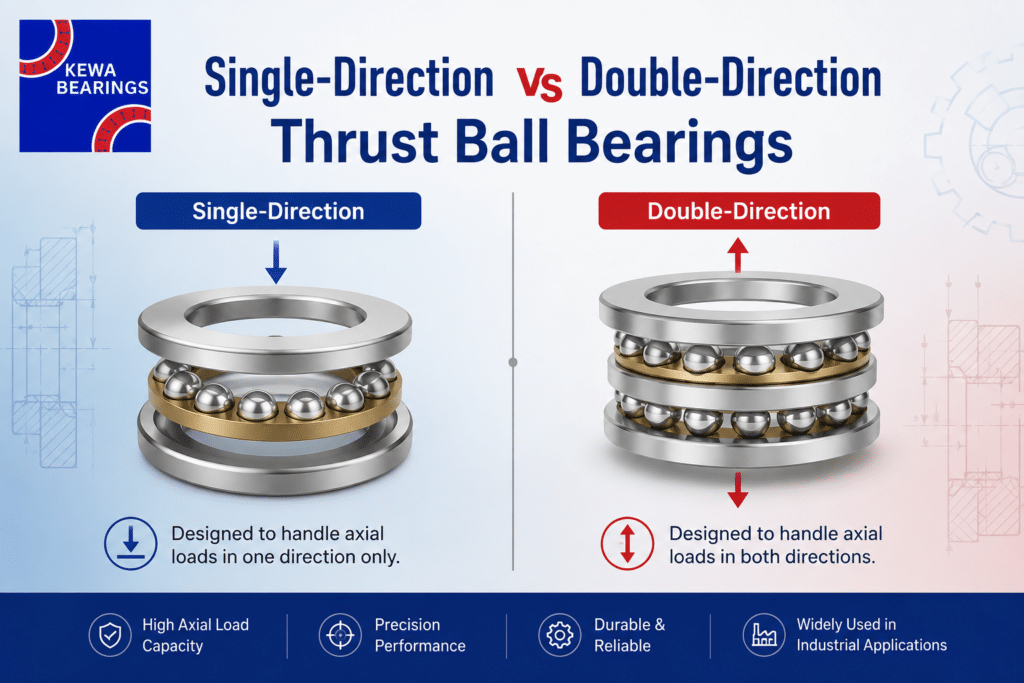
A single-direction thrust ball bearing is designed to support axial loads acting primarily in one direction. Its construction generally includes a shaft washer, housing washer, and ball-and-cage assembly.
When axial force is applied in the intended direction, the bearing transfers the load through the rolling balls and raceways while allowing the shaft to rotate. However, it is not designed to handle substantial axial loads in the opposite direction.
This makes single-direction thrust ball bearings suitable for machines where the direction of axial loading is predictable and remains relatively constant during operation.
Advantages of Single-Direction Thrust Ball Bearings
Single-direction thrust ball bearings can provide an effective solution for applications where axial forces act in only one direction. Their relatively straightforward design makes them suitable for many conventional mechanical systems.
They can help reduce friction between moving components and support controlled shaft rotation. They are also available in different sizes and configurations to meet varying machine requirements.
Another advantage is that there is no need to use a more complex double-direction bearing when the application does not require bidirectional axial load support.
What Is a Double-Direction Thrust Ball Bearing?
A double-direction thrust ball bearing is designed to accommodate axial loads acting in both directions along the shaft. Its construction typically incorporates two ball-and-cage assemblies and corresponding raceway surfaces.
This design allows the bearing to support axial forces whether they act forward or backward along the shaft. As a result, double-direction thrust ball bearings are particularly useful in machines where the direction of axial loading can change during operation.
For example, equipment involving reversing movement or changing operating forces may require a bearing capable of providing axial support in both directions.
Advantages of Double-Direction Thrust Ball Bearings
The main advantage of double-direction thrust ball bearings is their ability to handle axial forces from either direction. This can provide greater flexibility in machine design and operation.
They can be useful where shafts experience changing axial forces or where the machine’s operating cycle involves movement in different directions. Instead of using separate components for each loading direction, a double-direction design can provide support within one bearing arrangement.
However, the bearing should still be selected according to the manufacturer’s load, speed, alignment, and operating specifications.
Single-Direction vs Double-Direction Thrust Ball Bearings
The main difference is the direction of axial load they can handle. Single-direction thrust ball bearings support loads in one direction, making them suitable for machines with a fixed axial force.
Double-direction thrust ball bearings can support axial loads in both directions, making them useful when the force changes during operation.
When choosing a bearing thrust ball, consider the load direction, load capacity, speed, shaft size, and operating conditions. Selecting the right type helps ensure smooth and reliable machine performance.
How Does Load Direction Affect Bearing Selection?
Load direction is one of the first factors to consider when choosing a bearing thrust ball. If the axial force is always applied in one direction, there may be little practical reason to use a double-direction design.
However, some machines experience changes in axial forces during operation. In such cases, using a single-direction bearing without appropriate support for the reverse load may affect bearing performance.
Before selecting a thrust ball bearing, engineers should understand how the shaft behaves under normal and peak operating conditions. Consider whether the axial load remains constant, changes direction, or occasionally produces shock or fluctuating forces.
A proper assessment helps ensure that the selected bearing is capable of supporting the machine’s actual operating requirements.
Applications of Single-Direction Thrust Ball Bearings
Single-direction thrust ball bearings are used in machinery where axial loads primarily act in one direction. Their applications can include pumps, vertical shaft arrangements, automotive components, conveyors, gear mechanisms, and various industrial machines.
They can also be used in applications where the shaft needs axial support while maintaining smooth rotation. The exact application depends on the bearing’s load rating, speed capability, dimensions, and operating conditions.
For every application, manufacturers should verify the bearing specifications instead of selecting a bearing based only on its general application category.
Applications of Double-Direction Thrust Ball Bearings
Double-direction thrust ball bearings are suitable for applications where axial loads can occur from either direction. They may be found in machine tools, gearboxes, automotive systems, industrial equipment, and other machinery involving changing axial forces.
Machine tools are one example where precise shaft movement and axial support can be important. Similarly, mechanical systems involving reversing motion may benefit from bearings designed to support axial forces in both directions.
The exact suitability depends on factors such as speed, load, alignment, lubrication, operating temperature, and available installation space.
Factors to Consider Before Choosing a Thrust Ball Bearing
Selecting the right bearing thrust ball is important for smooth and reliable machine performance. Consider the following factors:
- Axial Load: Check the normal operating load as well as peak or shock loads. The bearing should have enough capacity to handle the expected axial forces.
- Rotational Speed: Consider how fast the shaft will rotate. High-speed applications may require bearings with suitable designs and lubrication for reliable performance.
- Available Space: Check the bearing’s bore, outside diameter, and width to ensure it fits properly within the machine assembly.
- Temperature: Operating temperature can affect bearing performance and lubrication. Choose a bearing that can work effectively within the machine’s temperature range.
- Lubrication: Keeping the bearings lubricated reduces friction, heat, and wear. Always use a lubricant suitable for the bearing and its operating conditions.
- Shaft Alignment: Correct alignment is essential for proper load distribution. Misalignment can increase stress and reduce bearing life.
- Installation & Maintenance: Proper installation and regular maintenance can help prevent premature wear and maintain the performance of the bearing thrust ball over time.
Why Proper Bearing Selection Matters
Using the correct thrust bearing can contribute to smoother machine operation and better component reliability. An unsuitable bearing may not provide adequate axial support, potentially increasing friction, vibration, and wear.
Choosing between a single-direction and double-direction thrust ball bearing should therefore be based on the actual mechanical requirements of the application.
A reliable bearing supplier can also help businesses identify the appropriate bearing size and configuration based on load, speed, shaft dimensions, and operating environment.
Why Choose Kewa Bearings?
Kewa Bearings focuses on providing bearing solutions for different industrial and mechanical applications. Choosing a suitable bearing requires attention to quality, dimensions, application requirements, and expected operating conditions.
Whether a machine requires support for axial loads in one direction or both directions, selecting the appropriate bearing thrust ball can help support efficient and reliable machine operation.
Businesses should always check product specifications and application requirements before finalizing a bearing for critical machinery.
Conclusion
Single-direction thrust ball bearings handle axial loads in one direction, while double-direction bearings support loads in both directions. The right bearing thrust ball depends on factors such as load direction, speed, space, lubrication, and operating conditions. Choosing the correct bearing helps reduce friction and support smooth, reliable machine performance.
Frequently Asked Questions
1. What is a thrust ball bearing?
A thrust ball bearing is designed to support axial loads while allowing smooth shaft rotation.
2. What is a single-direction thrust ball bearing?
It supports axial loads acting in one direction.
3. What is a double-direction thrust ball bearing?
It supports axial loads acting in both directions.
4. What is the main difference between single and double-direction bearings?
Single-direction bearings handle loads in one direction, while double-direction bearings handle loads in both directions.
5. Where are thrust ball bearings used?
They are used in pumps, gearboxes, machine tools, automotive systems, and industrial machinery.
6. How do I choose the right bearing thrust ball?
Consider the load direction, load capacity, speed, shaft size, and operating conditions.
7. Can thrust ball bearings handle radial loads?
They are mainly designed for axial loads and are not suitable for significant radial loads.
8. Why is lubrication important for thrust bearings?
Proper lubrication reduces friction, heat, and wear, helping improve bearing performance.
9. Which is better: single or double-direction thrust bearing?
Neither is universally better. The right choice depends on the machine’s load direction and operating requirements.
10. Why choose Kewa Bearings?
Kewa Bearings offers bearing solutions designed for different industrial and mechanical applications.
Pingback: Why Are Thrust Ball Bearings Used in Machines? - KEWA BEARINGS