
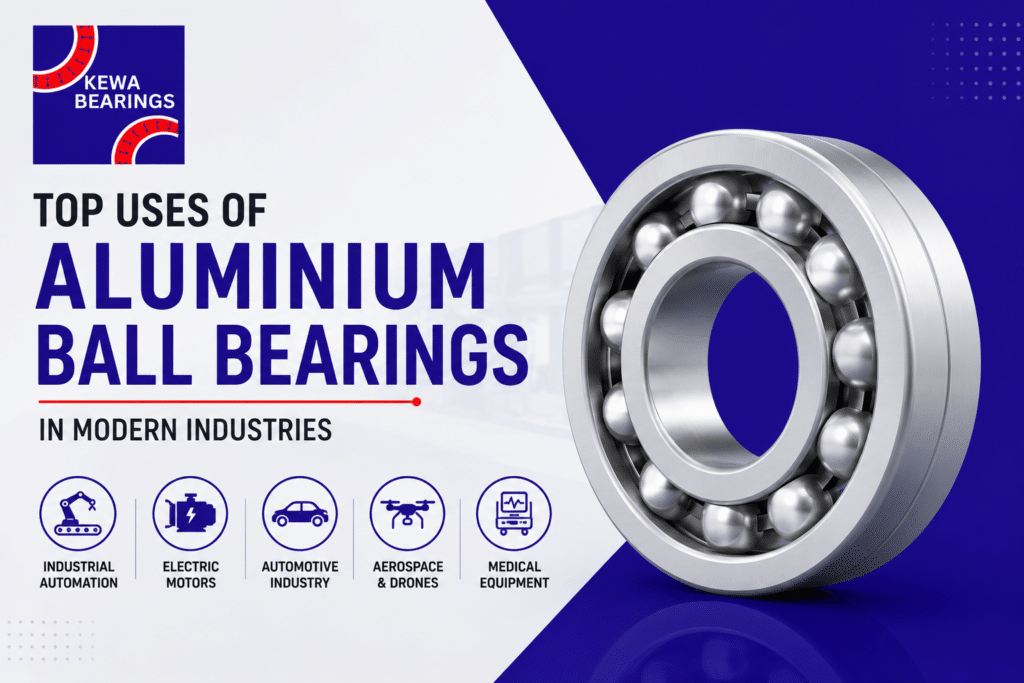
In today’s fast moving industrial world, every machine depends on components that should deliver smooth performance, durable reliability, and efficiency, without too much fuss because it all connects together in the bigger process. Among these essential components, the aluminium ball bearing has become a preferred choice across multiple industries because of its lightweight construction, corrosion resistance, and reliable operation.
From automotive manufacturing to robotics and aerospace, aluminium ball bearings help reduce friction, improve machine efficiency, and increase equipment lifespan. Their ability to perform under demanding conditions while remaining lightweight makes them ideal for applications where traditional steel bearings may add unnecessary weight.
In this blog we are going to look at the main uses for aluminium ball bearing products across modern industries and the benefits, and well, honestly why picking a reliable manufacturer like Kewa Bearings matters for long lasting performance.
What Is an Aluminium Ball Bearing?
An aluminium ball bearing is a rolling-element bearing that uses balls to reduce rotational friction while supporting radial and axial loads. Unlike conventional steel bearings, aluminium-based bearing components are designed to deliver lightweight performance without compromising functionality.
These bearings are widely used in machines that require:
- Reduced weight
- Smooth rotation
- High-speed performance
- Corrosion resistance
- Low maintenance
Their unique properties make them suitable for industries where precision and efficiency are essential.
Why Aluminium Ball Bearings Are Popular
Industries today are constantly looking for components that improve productivity while reducing operational costs. An aluminium ball bearing offers several benefits that make it an excellent investment.
Lightweight Design
One of the biggest advantages of aluminium is its low weight. Lightweight bearings reduce the overall weight of machines, resulting in lower energy consumption and improved efficiency.
Excellent Corrosion Resistance
Aluminium naturally forms a protective oxide layer that resists corrosion. This makes these bearings ideal for humid environments and industries where moisture is common.
High-Speed Performance
Because of their lightweight construction, aluminium ball bearings generate less inertia, allowing equipment to operate smoothly at higher speeds.
Energy Efficiency
Lower friction means motors consume less power, reducing electricity costs and improving overall productivity.
Longer Equipment Life
Smooth movement reduces wear on connected components, helping machines last longer with fewer repairs.
Top Uses of Aluminium Ball Bearings in Modern Industries
Modern industries depend on reliable bearings for continuous operation. Here are some of the most common applications of aluminium ball bearing products.
Automotive Industry
The automotive sector is one of the largest users of aluminium ball bearings.
These bearings are commonly found in:
- Electric vehicles
- Cooling fans
- Steering systems
- Transmission assemblies
- Air conditioning units
- Small motors
Since reducing vehicle weight improves fuel efficiency and battery performance, manufacturers increasingly prefer lightweight bearing solutions.
Aerospace Industry
Aircraft require components that are both lightweight and highly reliable.
An aluminium ball bearing is often used in:
- Flight control systems
- Navigation equipment
- Cabin mechanisms
- Instrument panels
- Aircraft doors
- Auxiliary motors
Weight reduction is extremely important in aerospace, making aluminium an ideal material.
Robotics and Automation
Automation has transformed manufacturing, and robots rely on precision movement.
Aluminium ball bearings help robotic systems by providing:
- Smooth rotation
- Accurate positioning
- Reduced vibration
- Faster motion
- Lower maintenance
Industrial robots perform thousands of repetitive movements every day, making high-quality bearings essential.
Medical Equipment
Medical devices demand exceptional precision and reliability.
An aluminium ball bearing is commonly used in:
- Diagnostic machines
- Surgical equipment
- Dental instruments
- Laboratory devices
- Medical pumps
- Imaging systems
Their lightweight design makes medical equipment easier to handle while maintaining accurate operation.
Food Processing Industry
Food manufacturing facilities require corrosion-resistant components that perform consistently.
Aluminium ball bearings are used in:
- Conveyor systems
- Packaging machines
- Filling equipment
- Sorting systems
- Mixing machines
Their corrosion resistance makes them suitable for environments involving frequent cleaning and moisture exposure.
Textile Industry
Textile machinery operates continuously for long hours.
Bearings in these machines must provide:
- High rotational speed
- Low friction
- Minimal maintenance
- Smooth yarn movement
An aluminium ball bearing helps maintain consistent production while reducing machine downtime.
Printing Industry
Printing machines require exceptional precision.
These bearings are commonly installed in:
- Paper feeding systems
- Rollers
- Ink transfer mechanisms
- High-speed presses
Smooth bearing performance improves print quality while reducing vibration.
Electronics Manufacturing
Electronic manufacturing equipment contains delicate moving parts that require lightweight components.
Applications include:
- PCB manufacturing machines
- Assembly robots
- Semiconductor equipment
- Precision positioning systems
The lightweight nature of aluminium supports fast and accurate production processes.
Packaging Industry
Packaging machines operate at high speed to meet production demands.
Aluminium ball bearings improve:
- Conveyor performance
- Labeling machines
- Wrapping equipment
- Sealing machines
- Filling lines
As a result of reduced friction, production speed is increased while minimizing maintenance.
Renewable Energy Industry
Renewable energy equipment also benefits from aluminium bearings.
Applications include:
- Solar panel tracking systems
- Wind turbine components
- Energy storage equipment
- Automated solar installations
These systems require dependable components capable of operating for extended periods with minimal maintenance.
Material Handling Equipment
Warehouses and factories use material handling systems every day.
An aluminium ball bearing supports:
- Conveyor rollers
- Automated storage systems
- Lifting equipment
- Warehouse robots
- Transfer mechanisms
Reliable bearings help reduce downtime and improve operational efficiency.
Advantages of Choosing High-Quality Aluminium Ball Bearings
Not every bearing offers the same level of performance. Premium-quality bearings provide several long-term benefits.
Reduced Maintenance Costs
Better materials and precision manufacturing reduce wear and minimize maintenance requirements.
Improved Machine Efficiency
Lower friction allows machines to run smoothly while consuming less power.
Enhanced Productivity
Reliable bearings reduce unexpected breakdowns and increase production uptime.
Longer Service Life
High-quality bearings withstand continuous operation without losing performance.
Better Load Distribution
Precision-engineered bearings evenly distribute loads, reducing stress on machinery.
How to Select the Right Aluminium Ball Bearing
Choosing the right bearing depends on your application.
Consider the following factors:
- Load capacity
- Rotational speed
- Operating temperature
- Environmental conditions
- Bearing dimensions
- Lubrication requirements
- Expected service life
Working with an experienced bearing manufacturer ensures you receive the most suitable product for your machinery.
Why Choose Kewa Bearings?
Kewa Bearings is committed to delivering high-performance bearing solutions for industries across India. Every bearing is manufactured with precision engineering and strict quality standards to ensure reliable performance.
When you choose Kewa Bearings, you benefit from:
- Premium-quality products
- Precision manufacturing
- Wide range of industrial bearings
- Excellent durability
- Competitive pricing
- Reliable customer support
- Consistent product quality
Whether your business operates in automotive, manufacturing, robotics, food processing, or heavy industry, Kewa Bearings provides dependable solutions designed to maximize equipment performance.
Maintenance Tips for Aluminium Ball Bearings
Proper maintenance significantly increases bearing life.
Some useful maintenance practices include:
- Keep bearings clean.
- Use the recommended lubricant.
- Avoid excessive loads.
- Inspect bearings regularly.
- Replace damaged bearings promptly.
- Prevent contamination from dust and moisture.
- Follow manufacturer installation guidelines.
Routine maintenance helps ensure smooth machine operation and reduces unexpected failures.
Conclusion
An aluminium ball bearing has become an essential component in modern industries because of its lightweight construction, corrosion resistance, high-speed capability, and excellent efficiency. From automotive and aerospace to robotics, food processing, electronics, and renewable energy, these bearings contribute to smoother operations and improved productivity.
Choosing premium-quality bearings is just as important as selecting the right machinery. Kewa Bearings offers dependable bearing solutions engineered for performance, durability, and long service life. Whether you need bearings for industrial automation, manufacturing equipment, or specialized machinery, Kewa Bearings delivers products that keep your operations running efficiently.
Frequently Asked Questions (FAQs)
1. What is an aluminium ball bearing?
An aluminium ball bearing is a lightweight bearing designed to reduce friction and support smooth rotational movement in machinery.
2. Where are aluminium ball bearings commonly used?
They are widely used in automotive, aerospace, robotics, medical equipment, packaging, food processing, and electronics industries.
3. Why are aluminium ball bearings preferred over heavier materials?
They reduce machine weight, improve energy efficiency, and offer excellent corrosion resistance.
4. Are aluminium ball bearings suitable for high-speed applications?
Yes, their lightweight construction allows them to perform efficiently in high-speed machinery.
5. Do aluminium ball bearings require regular maintenance?
Yes, regular cleaning, lubrication, and inspection help maximize their lifespan.
6. Can aluminium ball bearings resist corrosion?
Yes, aluminium naturally resists corrosion, making these bearings suitable for humid and demanding environments.
7. How do aluminium ball bearings improve machine efficiency?
They reduce friction, minimize wear, and enable smoother machine operation with lower energy consumption.
8. How do I choose the correct aluminium ball bearing?
Consider load capacity, speed, operating conditions, dimensions, and lubrication requirements before selecting a bearing.
9. Why should I buy bearings from Kewa Bearings?
Kewa Bearings offers precision-engineered, durable, and high-quality bearing solutions suitable for various industrial applications.
10. Can aluminium ball bearings increase equipment lifespan?
Yes, by reducing friction and wear, they help extend the service life of machinery and improve overall reliability.