
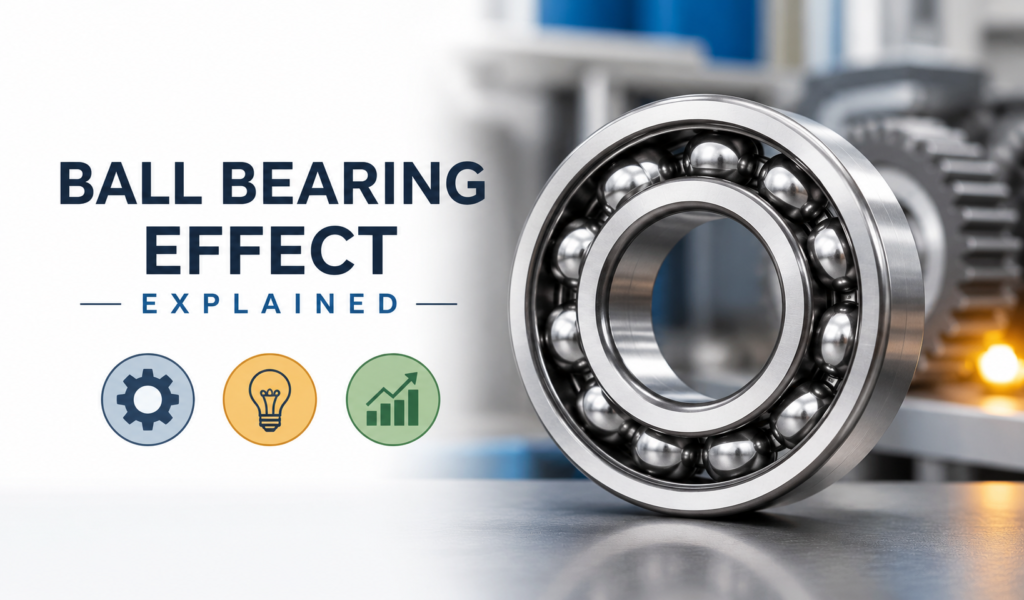
Many machines in the current age require smooth motion, less friction and an advantage of one concept that aids these processes greatly; the ball bearing effect. It is because the industrial machinery, cars and appliances have this effect inscribed into their function which represents an improvement in function as well as reduced tear and wear.
Understanding the ball bearing effect helps industries choose better machinery components and maintain equipment properly for long-term performance.
What is the Ball Bearing Effect?
Theball bearing effect alludes to the process of reducing friction in moving components by placing balls in between surfaces to roll along the contact area. Instead of having surfaces gliding over each other’s surfaces, the balls roll instead and this decreases any interference or resistance due to movement enhancing the motion.
In most cases, ball bearings are constructed from hardened steel, ceramic, or stainless steel. The function of the rolling elements inserted between the bearing rings is to help the machine that carries a wide amount of strain, hence rotate quietly.
This effect is widely used in industrial systems where high-speed rotation and reduced friction are necessary.
Main Causes Behind the Ball Bearing Effect
Several factors contribute to the creation of the ball bearing effect in machinery and equipment.
Rolling Motion Instead of Sliding
This is primarily because rolling friction is so much smaller than the static friction in most applications, allowing any two surfaces that are in contact to easily roll over each other.
Proper Lubrication
Lubricants such as grease or oil reduce heat and prevent direct metal contact. Good lubrication improves the performance of the bearing system.
Precision Bearing Design
Modern bearings are designed with accurate dimensions and smooth surfaces. This precision helps distribute loads evenly and creates stable rotational movement.
Material Strength
High-quality materials increase durability and allow bearings to handle pressure, temperature, and continuous motion effectively.
Common Uses of Ball Bearing Effect
Machine performance and operational performance improve due to the ball-bearing effect, which is why several industries use it.
Automotive Industry
The ball bearings are efficient in ensuring the wheels, engines, steering systems and gearboxes in cars, two-wheelers, and trucks rotate properly with hardly any vibrations.
Manufacturing Machinery
All moving machinery, from conveyor systems and electric motors to pumps and compressors for utilizing bearings to facilitate movement continuously has the usage of bearings.
Electrical Equipment
Fans, washing machines, generators, and electric motors use ball bearings for smooth operation, low noise, and better efficiency.
Agriculture and Construction Equipment
Tractors, harvesters, cranes, and loaders use bearings to handle heavy loads and work smoothly in rough conditions.
Industrial Benefits of Ball Bearing Effect
Industries prefer systems based on the ball bearing effect because they offer several practical advantages.
Reduced Friction
Lower friction helps machines operate smoothly and reduces unnecessary energy loss.
Longer Equipment Life
Bearings prevent wear and tear between moving parts, thereby extending the machinery’s life with reduced maintenance costs.
Better Energy Efficiency
Machines consume less power when rotational resistance is reduced. This helps industries save energy over time.
High-Speed Performance
The ball bearings provide for very rapid rotational motion without a lot of heat build-up, thereby finding an advantageous use in high-tech industrial applications.
Lower Maintenance Requirements
Well-designed Kewa bearing systems reduce breakdowns and improve operational reliability.
Why Choosing Quality Bearings Matters
The quality of bearings greatly impacts the functionality of the ball bearing effect. Inferior bearings may tend to fail quickly and also cause high levels of vibration or spoil the machine’s performance due to the bearing.
Bearings from trusted manufacturers such as Kewa Bearings are designed for use in industries. Such high-performance bearings enhance safety in the workplace, improve working conditions, and enhance output.
Conclusion
The utilization of a ball bearing effect contributes to the machines’ efficient functioning by decreasing friction and aiding in the smooth rotational process. Moreover, this effect enhances the productivity in different industries thus reducing the service costs as well as prolonging the life of the machinery.
FAQs
Can steel bearings work in hot situations?
Yes, Kewa bearings developed for heat resistance can be employed in such situations.
Are ceramic bearings about as durable as regular steel bearings?
Most of the time, they actually resist wear and corrosion more ardently.
Can damaged bearings increase electricity consumption?
Yes, extra friction increases power usage.
Are ball bearings suitable for heavy industrial machines?
Yes, heavy-duty bearings are widely used in industries.
How often should industrial bearings be inspected?
Regular inspections are recommended based on machine usage.