
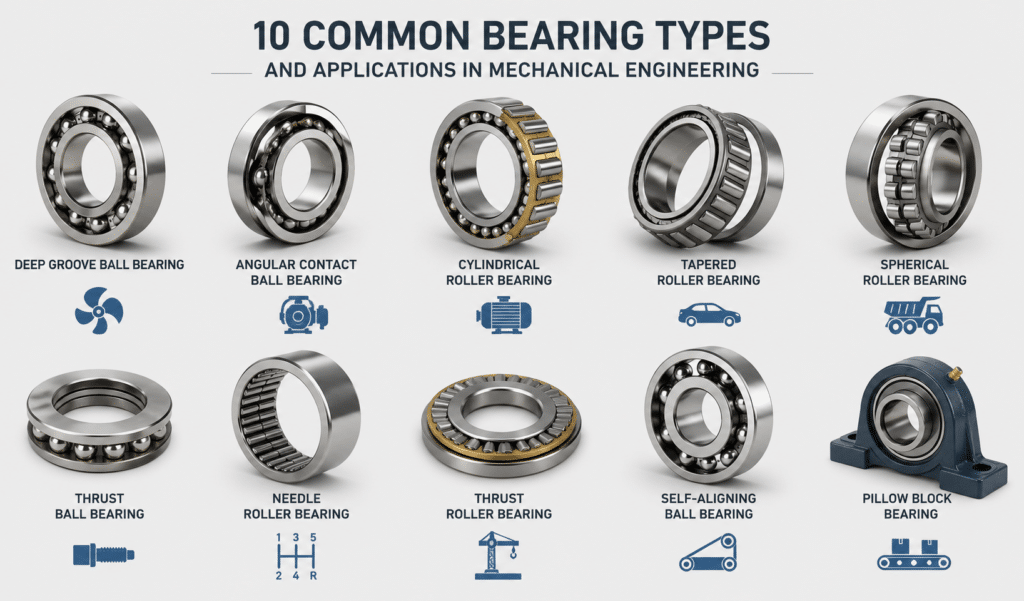
Machines are everywhere kinda around us. From water pumps and cars to factory tools and electric motors, most machines rely on bearings to run smoothly. Without bearings, the moving bits would make too much friction, then you get heat, possible wear, and a shorter machine life . That’s why it really matters to understand the bearings types and applications in mechanical engineering, because it affects how everything performs in practice.
Different machines really do need bearing designs that fit, depending on speed, the load, and the way they work day to day . Here are a few of the most common bearing kinds, plus where you usually find them in real use.
Ball Bearings
Ball bearings are the most widely used bearings because they’re basically simple they’re durable and they fit really well for high speed work. They have small steel balls between the moving or rotating parts, to keep the friction from feeling so high. You can usually spot these bearings in ceiling fans, electric motors, washing machines and also in water pumps.
Roller Bearings
Roller bearings use cylindrical rollers, not little balls, and it generally lets them handle heavier loads better. They show up most often on conveyor belts, industrial machines and a bunch of heavy-duty equipment, where sturdiness matters more than speed, honestly.
Tapered Roller Bearings
These bearings are specially designed to handle both side loads and vertical loads together. Because of this, they are commonly used in vehicle wheels, gear systems, and automotive transmissions where stability is very important.
Needle Bearings
Needle bearings contain thin rollers and are perfect for compact spaces. Even with their small size, they can handle considerable loads. They are often used in motorcycles, automobile engines, and gearbox systems.
Thrust Bearings
Thrust bearings are mostly for holding up axial loads , you know, the push along one direction. You can find them a lot in car steering setups, in cranes, and in various rotating industrial machines where the pressure sort of acts in one direction only. They are basically there to make sure the load doesn’t wander around too much.
Spherical Roller Bearings
Heavy industry tend to like spherical roller bearings, more often than not, because they do well when the conditions are a bit rough, or in other words when everything is not so gentle. Also, they can cope with shaft misalignment, which makes them handy for mining machines, construction equipment and those big industrial plants as well.
Plain Bearings
Plain bearings are among the oldest bearing designs. Instead of rolling elements, they work with sliding motion. They are affordable, simple, and commonly used in agricultural equipment, hydraulic systems, and low-speed machinery.
Magnetic Bearings
Magnetic bearings are advanced bearings that use magnetic force to support rotating parts without direct contact. Since there is very little friction, they are used in high-speed turbines, medical equipment, and compressors.
Linear Bearings
Unlike traditional bearings that just rotate , linear bearings kind of help machines glide in straight lines instead. You often see them in CNC machines, robotic arms, and all sorts of automation systems, where they keep the motion accurate .
Ceramic Bearings
Ceramic bearings are kind of light weight, they also resist corrosion really well, and they can run at extremely high speeds. In practice they are mostly put in aerospace systems, medical devices, and even performance bicycles, stuff like that.
Why Bearings Matter in Mechanical Engineering
The importance of bearings types and applications really goes past just cutting down on friction. Picking the right bearing can boost machine efficiency a lot, lower overall maintenance costs, help reduce energy waste, and extend the whole equipment’s lifespan. In sectors where machines run continuously, it becomes kinda essential to use high quality bearings for steadier, more dependable performance.
Brands like Kewa Bearings are trusted and they offer bearing solutions for a range of industrial and mechanical needs, so the machines keep running more smoothly even when conditions change, and yes, the load or speed may vary.
Conclusion
Bearings might look like small bits or pieces, but they really do something big in mechanical engineering. Basically, every machine needs the correct bearing for good performance and durability, not just “any” one. When you understand the different bearings types and applications. it becomes easier for industries to select suitable bearings. That choice supports higher efficiency, smoother running, and an overall longer service life for the machine.
FAQs
Which bearing is mostly used in household appliances?
Ball bearings are commonly used in household appliances because they provide smooth movement and support high-speed rotation.
Can bearings improve machine life?
Yes, good-quality bearings reduce friction and wear, which helps machines last longer.
Why are ceramic bearings considered premium?
Ceramic bearings are lighter, resist corrosion, and perform better at higher speeds compared to standard steel bearings.
What industries use linear bearings the most?
Automation, robotics, and CNC machining industries widely use linear bearings for accurate straight-line movement.
How do bearings reduce maintenance costs?
Bearings reduce friction and damage between moving parts, which lowers repair needs and improves machine efficiency.