
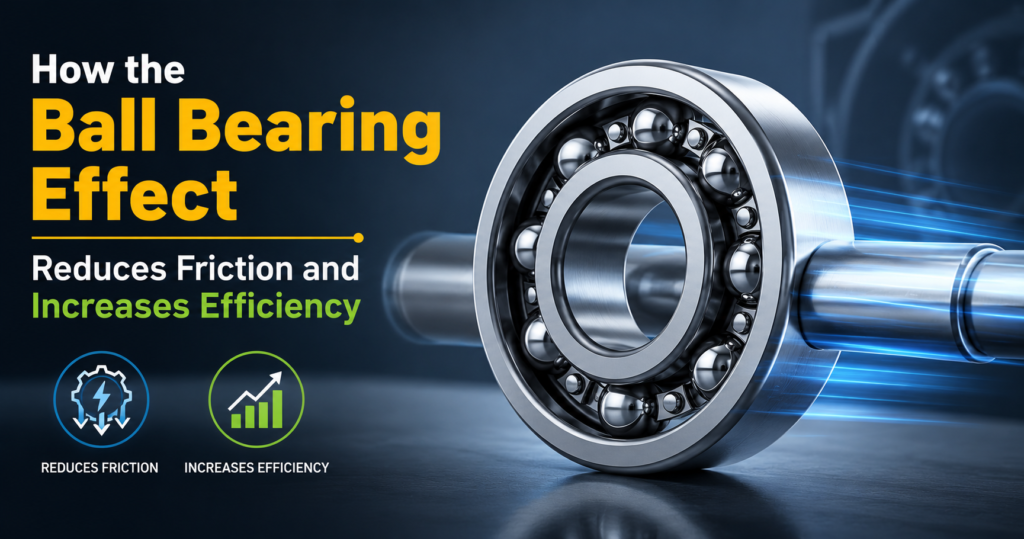
In modern machinery, cutting friction is essential for better operation, less energy spending, and extended equipment life. One of the key principles driving quiet and consistent mechanical movement is the ball bearing effect. You can see this in industrial setups and automotive systems, and also in everyday household appliances, where it helps efficiency and reliability really matter.
Understanding the Ball Bearing Effect
The ball bearing effect is basically the way friction goes down when rolling elements like balls are put between parts that are moving past each other. Instead of the surfaces doing a straight slide against one another, the balls roll in between and the resistance drops.
Rolling friction is usually lower compared with sliding friction. So machines don’t need as much force to keep going, and the motion feels smoother even a bit calmer. Because of that, the whole setup ends up with better energy efficiency.
How Ball Bearings Reduce Friction
When two surfaces slide along each other, they end up producing heat and wear because of the friction involved. Instead of this direct rubbing, ball bearings exchange the sliding action for a rolling action. The steel balls located inside the bearing spin back and forth between the inner and outer rings, so the part can move with very small resistance.
This design offers several advantages:
- Reduced friction between moving parts
- Lower heat generation during operation
- Smoother rotational movement
- Decreased component wear
- Improved overall machine performance
Because of these benefits, ball bearings are widely used in applications that require precise and efficient motion.
How the Ball Bearing Effect Improves Efficiency
The ball bearing effect directly contributes to higher efficiency by minimizing energy losses. Machines equipped with quality bearings can transfer power more effectively, reducing the effort needed to maintain movement.
In industrial environments, this can lead to:
- Lower power consumption
- Increased equipment productivity
- Reduced maintenance requirements
- Longer service life of machinery
- Improved operational reliability
Even small reductions in friction can create significant savings over time, especially in high-speed or continuously operating equipment.
Applications of the Ball Bearing Effect
The ball bearing effect shows up across a bunch of industries. You’ll see it in electric motors, pumps, conveyors, gearboxes, wheels on vehicles, fans, and also in agricultural machinery.
In these kinds of systems, bearings hold rotating shafts in place while keeping everything moving fairly smoothly, even when the loads change and the operating conditions get a little, well, chaotic. And because they reduce friction, they end up being a pretty important piece of modern engineering, honestly.
Choosing High-Quality Ball Bearings
How well the ball bearing effect works depends a lot on bearing quality. Precision manufacturing, right lubrication, and materials that actually last—those things can really make a difference.
When you are picking bearings, you should consider load capacity, what speeds you need, the surrounding environmental conditions around the equipment, and also how much maintenance is realistic. If you go for high quality bearings from trusted manufacturers, it usually helps you keep consistent performance and supports better long term efficiency.
Conclusion
The ball bearing effect is one of those core engineering ideas that helps cut down friction and boosts efficiency in all sorts of machines and industrial setups. Putting money into dependable bearing solutions from Kewa Bearings can help organizations gain a more smoother movement, better output , and a longer service life for their machinery.
FAQs
1. What stuff is usually used to manufacture ball bearings ?
Ball bearings are commonly made from bearing steel, stainless steel, ceramic materials, or mixed hybrid combos, depending on the job.
2. Can ball bearings operate at high speeds, without going off track?
Yes, lots of ball bearings are designed for high speed use while still keeping stability, accuracy, and that smooth feel.
3. How often should ball bearings be checked?
How often you inspect them depends on operating conditions, the load, and how they get used, but routine maintenance checks are usually recommended.
4. What leads to premature ball bearing failure ?
Very typical reasons include contamination, improper fitting or installation, insufficient lubrication, and excessive loading that is just too much.
5. Are ball bearings good for both radial and axial loads, or not really?
Certain types of ball bearings can manage radial loads, axial loads, or even that combined situation, all depending on the design.