
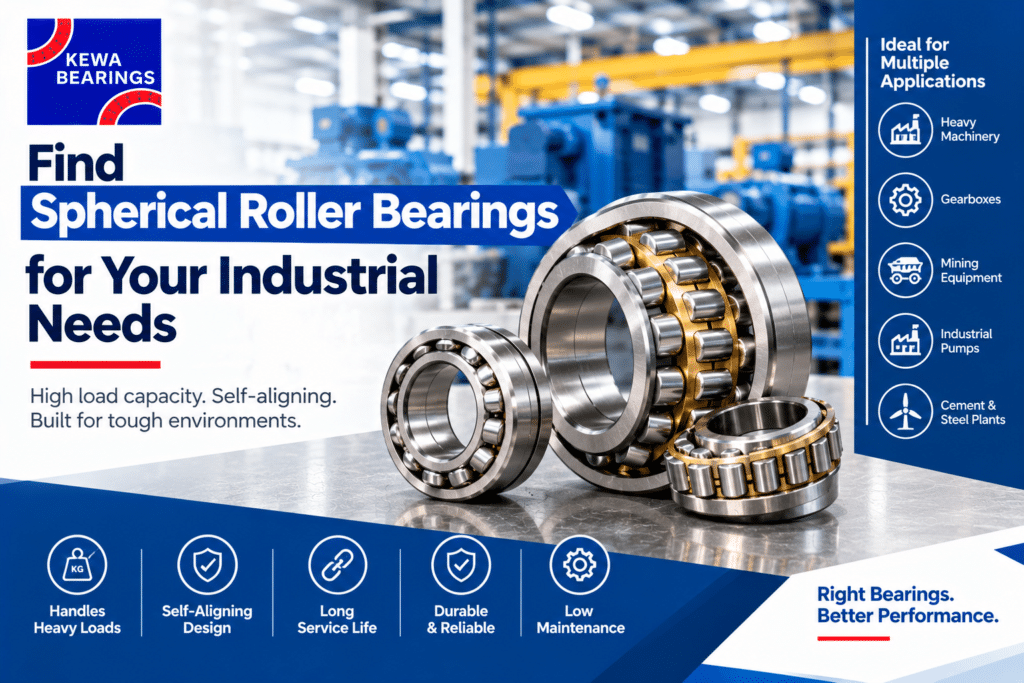
Industrial machines often operate under heavy loads, continuous vibration, and demanding working conditions. Choosing the right bearing helps support rotating components, maintain machine efficiency, and reduce unexpected maintenance expenses. A spherical roller bearing is designed for applications that require heavy-load support and the ability to accommodate limited shaft misalignment.
These bearings are commonly used in mining, cement manufacturing, steel production, agriculture, and material handling. However, selecting the right product requires more than checking its size. Load capacity, operating speed, lubrication, and environmental conditions should also be considered.
What Is a Spherical Roller Bearing?
A spherical roller bearing uses barrel-shaped rollers positioned between inner and outer rings. Its internal design allows it to support heavy radial loads and certain axial loads, depending on the bearing specification.
The spherical outer raceway allows the bearing to accommodate limited angular misalignment between the shaft and housing. This feature is useful in industrial machinery where shafts may deflect slightly under pressure or alignment may change during operation.
When purchasing a spherical roller bearing, buyers should check its dimensions, internal clearance, cage design, and load ratings to ensure compatibility with the intended machine.
Key Benefits of Spherical Roller Bearings
Supports Heavy Industrial Loads
Heavy machinery generates considerable forces during operation. Crushers, conveyors, and industrial gearboxes need bearings capable of supporting these loads within their rated limits. Selecting the correct model helps maintain stable operation under demanding working conditions.
Accommodates Limited Misalignment
Shafts may experience minor alignment changes because of installation variations or operating forces. The self-aligning design accommodates a specified degree of angular misalignment, although correct installation remains essential.
Helps Prevent Unexpected Downtime
Bearing damage can interrupt production and increase repair costs. Proper product selection, suitable lubrication, and routine inspections help reduce the risk of premature wear and equipment breakdowns.
Supports Different Applications
Industrial environments vary in terms of temperature, speed, contamination, and loading conditions. Different bearing specifications and lubrication arrangements allow buyers to select products according to their equipment requirements.
Industrial Applications of Spherical Roller Bearings
Mining and Construction
Mining equipment handles heavy materials and experiences continuous vibration. Crushers, vibrating screens, and conveyor systems require suitable bearings to support rotating components under demanding conditions.
Cement and Steel Manufacturing
Cement plants use conveyors, industrial fans, and heavy processing equipment. Steel production also involves machinery exposed to substantial loads and challenging operating environments. Appropriate bearing selection helps support these applications.
Agriculture and Material Handling
Agricultural machines and material-handling systems use rotating assemblies to move crops, raw materials, and other products. Bearings selected according to load and operating conditions help maintain reliable equipment performance.
Paper Mills and Manufacturing
Paper-processing machines, production lines, and industrial rollers depend on correctly specified bearings. Operating speed, alignment, and lubrication requirements should guide the selection process.
How to Choose the Right Bearing
Before ordering a spherical roller bearing, consider these important factors.
Check Load Capacity
Identify the radial and axial loads acting on the bearing. Also consider sudden impacts, changing loads, and operating conditions. The selected model should meet the machine’s requirements without exceeding its rated capacity.
Verify Dimensions
Check the shaft diameter, housing dimensions, bearing width, and mounting arrangement. Confirm the complete bearing designation because similar-looking models may have different internal specifications.
Consider Operating Speed
Bearing speed limits depend on design, lubrication, load, and temperature. Choose a model suitable for the machine’s operating speed and follow the manufacturer’s recommendations.
Select Appropriate Lubrication
Grease or oil may be suitable depending on the application. Incorrect lubricant selection, insufficient lubrication, or excessive grease can contribute to overheating and premature wear.
Evaluate Environmental Conditions
Dust, moisture, and high temperatures can affect bearing performance. Consider suitable sealing arrangements, lubricant protection, and maintenance requirements before making a purchase.
Common Signs of Bearing Problems
Industrial bearings may show warning signs before complete failure. Unusual noise, increased vibration, excessive heat, contaminated lubricant, and abnormal shaft movement require attention.
These symptoms can result from incorrect installation, misalignment, unsuitable lubrication, or housing damage. Therefore, inspect the complete assembly before deciding whether the bearing needs replacement.
Regular monitoring helps maintenance teams identify developing issues and reduce the likelihood of unexpected machine stoppages.
Why Consider Kewa Bearings?
Choosing a bearing supplier involves checking product specifications and confirming compatibility with the intended application. Buyers should provide accurate technical information to make the selection process easier.
Kewa Bearings is an option for industrial buyers exploring bearing solutions for machinery and equipment. When making an enquiry, share the existing bearing number, shaft dimensions, machine type, operating speed, and load requirements.
If you need a spherical roller bearing, contact Kewa Bearings to check the available specifications and confirm whether a particular model suits your application. Always verify product details and availability before placing an order.
Conclusion
Choosing the right bearing helps improve machinery reliability and control maintenance costs. A suitable spherical roller bearing supports heavy loads and accommodates limited misalignment. Check specifications and explore compatible options from Kewa Bearings.
Frequently Asked Questions (FAQs)
1. What is a spherical roller bearing used for?
It supports heavy loads in industrial machinery.
2. Which industries use these bearings?
Mining, cement, steel, agriculture, and manufacturing.
3. Can these bearings accommodate misalignment?
Yes, within specified angular limits.
4. Can they support axial loads?
Yes, within their design ratings.
5. How do I identify the correct bearing?
Check its number and dimensions.
6. What causes bearing overheating?
Poor lubrication, excessive loads, or incorrect installation.
7. How can I detect bearing problems?
Monitor unusual noise, vibration, and temperature.
8. Can I replace a bearing with another model?
Yes, if its specifications are compatible.
9. How can I improve bearing service life?
Use correct lubrication and perform regular inspections.
10. What information does a supplier need?
The bearing number, dimensions, and machine requirements.