
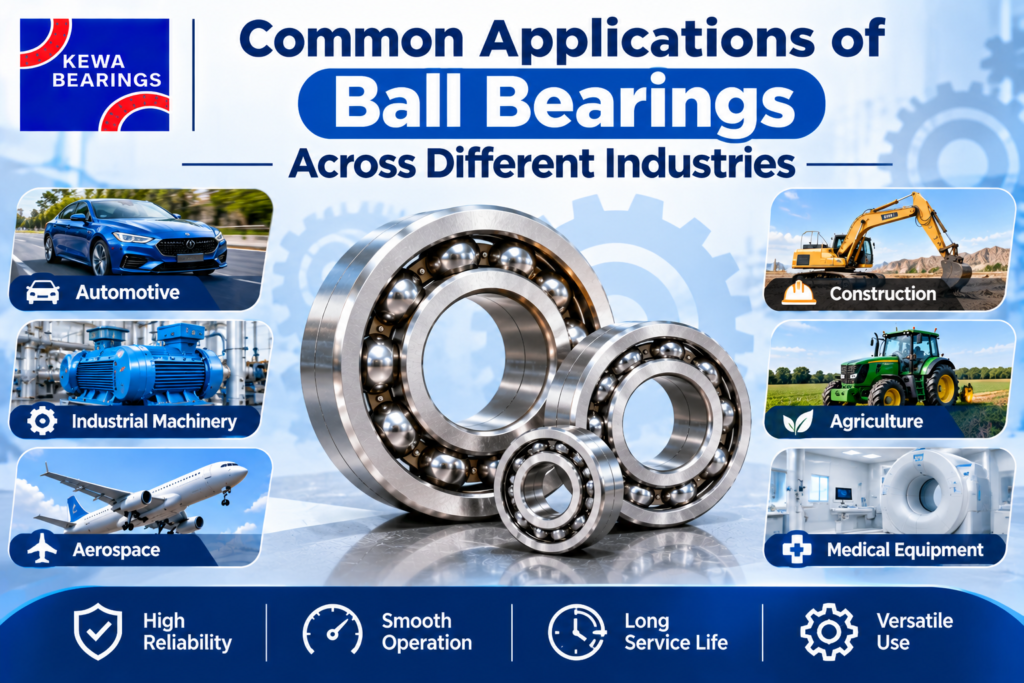
Ball bearings are essential mechanical components used in machines and equipment across various industries. They help reduce friction between moving parts, support rotating shafts, and ensure smooth and efficient movement. From household appliances to heavy industrial machinery, ball bearings play an important role in improving machine performance and reliability.
The applications of ball bearings can be found in almost every industry where rotating components are involved. Their ability to run at different speeds and under different loads helps them fit many kinds of mechanical jobs.
1. Automotive Industry
The automotive industry is one of the major users of ball bearings. These components are used in different vehicle parts, including wheels, transmissions, electric motors, and steering systems. They help reduce friction and allow moving components to operate smoothly.
The applications of ball bearings in vehicles support better performance, reduce wear, and improve the efficiency of mechanical systems. They are commonly used in cars, motorcycles, commercial vehicles, and electric vehicles.
2. Manufacturing and Industrial Machinery
Manufacturing industries depend on different types of machinery for continuous production. You will often find ball bearings in motors, pumps, conveyors, compressors, and many other industrial machines.
One of the important applications of ball bearings in this sector is supporting rotating shafts while reducing friction. They help machines operate smoothly, minimise unnecessary wear, and support consistent production activities.
3. Electrical and Electronic Equipment
Ball bearings show up in many kinds of electrical gear when something inside spins. Electric motors, cooling fans, generators, and other electrical devices depend on bearings for smooth operation.
These applications of ball bearings help maintain shaft alignment and reduce resistance during rotation. Their compact design makes them suitable for equipment where space and operating efficiency are important considerations.
4. Agricultural Industry
Agricultural machinery operates in challenging environments where dust, dirt, and heavy workloads are common. Equipment such as tractors, harvesters, seeders, and irrigation pumps uses ball bearings in different mechanical assemblies.
The applications of ball bearings in agricultural equipment help support rotating parts and ensure smooth machinery operation. Proper bearing selection and maintenance can also help reduce equipment downtime during important farming activities.
5. Aerospace Industry
The aerospace industry requires mechanical components that offer precision, reliability, and consistent performance. Ball bearings are used in selected aircraft systems, including auxiliary equipment, control mechanisms, and certain rotating assemblies.
These applications of ball bearings help maintain smooth movement and reduce friction under specific operating conditions. Aerospace applications require carefully selected bearings that meet strict performance and safety requirements.
6. Medical Equipment Industry
Medical equipment often includes precision-based rotating mechanisms that require smooth and controlled movement. Ball bearings are used in selected medical devices, dental equipment, laboratory instruments, and diagnostic machines.
Their compact structure and ability to support accurate movement make these applications useful in equipment where reliability and precision are important.
7. Home Appliances
Many everyday household appliances use ball bearings to support their rotating components. Washing machines, electric fans, vacuum cleaners, kitchen appliances, and air conditioning systems are some common examples.
The applications of ball bearings in household products help reduce friction, noise, and unnecessary wear. Their use supports smoother operation and can contribute to the overall service life of household equipment.
8. Construction and Heavy Equipment
Construction machinery performs demanding tasks that require durable mechanical components. Cranes, concrete mixers, drilling equipment, and other construction machines use different types of bearings in their assemblies.
The applications of ball bearings in this industry include supporting rotating mechanisms and helping equipment operate efficiently. Selecting suitable bearings according to load, speed, and environmental conditions is important for reliable performance.
9. Food Processing and Packaging Industry
Food processing and packaging machines use ball bearings in motors and conveyor systems. These applications of ball bearings support smooth movement and continuous production while meeting hygiene and operating requirements.
10. Renewable Energy Industry
Renewable energy systems, including solar tracking mechanisms and wind equipment, use ball bearings to support smooth rotation, reduce friction, and ensure efficient operation under different environmental conditions.
How to Choose the Right Ball Bearing?
Choosing the right ball bearing depends on the machine’s design and operating requirements. Before selecting a bearing, consider the following factors:
- Load Capacity: Check whether the bearing can handle the expected radial and axial loads.
- Operating Speed: Select a bearing suitable for the machine’s rotation speed.
- Material Quality: Consider bearing materials according to working conditions and durability requirements.
- Operating Environment: Temperature, moisture, dust, and contamination can affect bearing performance.
- Maintenance Requirements: Proper lubrication and regular inspection help maintain bearing efficiency.
Understanding the applications of ball bearings and these selection factors makes it easier to choose suitable components for different machines and industrial requirements.
Conclusion
Ball bearings play an important role in reducing friction and ensuring smooth machine operation across industries. Understanding the applications of ball bearings helps businesses choose suitable components for their equipment. Kewa Bearings offers bearing solutions for different industrial requirements.
Frequently Asked Questions (FAQs)
1. What is the main function of a ball bearing?
It reduces friction and supports smooth rotational movement.
2. Where are ball bearings commonly used?
They are used in vehicles, motors, appliances, and industrial machines.
3. Are ball bearings used in electric motors?
Yes, they support rotating shafts and reduce friction.
4. Can ball bearings handle heavy loads?
Certain designs can handle higher loads, depending on their specifications.
5. Are ball bearings used in agricultural machinery?
Yes, they are found in tractors, harvesters, and irrigation equipment.
6. Why are ball bearings important in manufacturing?
They help machines operate smoothly and reduce mechanical wear.
7. Do household appliances use ball bearings?
Yes, appliances such as washing machines and fans use them.
8. How does lubrication affect ball bearings?
Proper lubrication reduces friction, heat, and wear.
9. How often should ball bearings be maintained?
Maintenance frequency depends on operating conditions and manufacturer recommendations.
10. How can I select the right ball bearing?
Consider load capacity, speed, dimensions, material, and operating environment.