
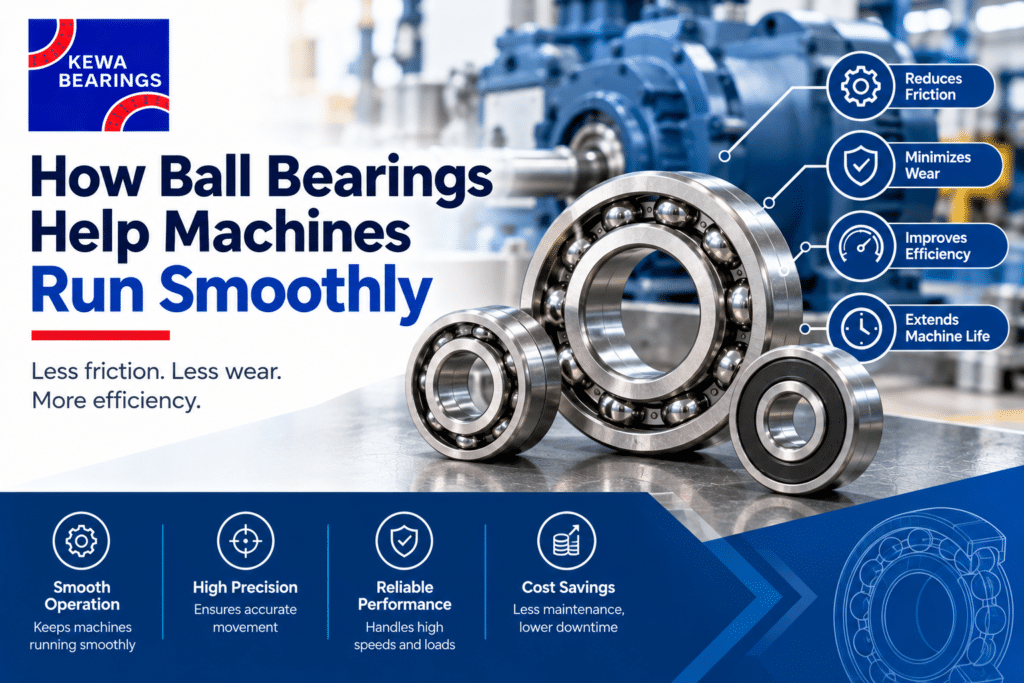
Machines run industries, help move vehicles, and power factories and daily appliances. For them to work well, their parts that spin need to turn with as little drag as possible. Without proper support, friction can create heat, increase wear, and reduce performance. Ball bearings help solve this problem by supporting rotating parts and allowing smoother movement.
Understanding ball bearing types and applications helps businesses select suitable bearings for their equipment, improve reliability, and reduce unnecessary maintenance costs.
What Are Ball Bearings?
A ball bearing is a mechanical component containing small spherical balls positioned between inner and outer rings. These balls roll between the rings, reducing friction between moving surfaces.
The inner ring generally connects to a rotating shaft, while the outer ring fits into the machine housing. This arrangement supports controlled rotation and helps manage forces acting on the shaft.
Ball bearings are commonly used in electric motors, pumps, fans, conveyors, automobiles, and manufacturing equipment. Their design and load capacity determine which applications they can handle effectively.
How Ball Bearings Help Machines Run Smoothly
1. Reduce Friction
Ball bearings have small balls that roll between parts. The rolling action lowers friction while the parts move. Because of that, the parts turn more smoothly, wear slows down, and the machine runs better.
2. Support Rotating Shafts
Ball bearings support rotating shafts and help maintain proper alignment. Depending on their design, they can handle radial loads, axial loads, or both.
3. Reduce Heat and Wear
By reducing friction, ball bearings can limit heat generation and component wear. Keeping them well lubricated matters. So does checking them on a routine schedule.
4. Improve Efficiency
Suitable ball bearings help machinery operate smoothly with less resistance, vibration, and noise, supporting reliable performance.
Common Ball Bearing Types and Their Applications
Knowing ball bearing types and applications can help a business pick the right bearings for its machines.
Deep Groove Ball Bearings
These bearings work mainly with radial loads. They can also take axial loads. You will see them in electric motors, fans, pumps, and common home appliances.
Angular Contact Ball Bearings
Designed for combined radial and axial loads, these bearings are used in machine tool spindles, precision equipment, and selected pump applications.
Thrust Ball Bearings
These bearings primarily support axial loads. They are suitable for certain turntables, vertical shaft assemblies, and specialised machinery.
Self-Aligning Ball Bearings
These bearings allow a small amount of shaft misalignment, so they work well in some conveyor systems, farm machines, and general industrial equipment.
It helps to know ball bearing types and applications so you pick the correct bearing for the load, the speed, and the real operating conditions.
Industries That Depend on Ball Bearings
Ball bearings support smooth machine operation across various industries.
Manufacturing: Used in motors, conveyors, and production equipment.
Automotive: Support rotating components in vehicles.
Agriculture: Help machinery such as threshers and pumps operate efficiently.
Food Processing: Used in mixers and packaging machines.
Construction: Support rotating parts in industrial and material-handling equipment.
Understanding ball bearing types and applications helps businesses select suitable bearings for their machinery and working conditions.
Tips for Maintaining Ball Bearings
Regular maintenance helps bearings last longer and perform reliably. Choose the right bearing, use proper lubrication, and protect it from dust and moisture. Make sure the unit is installed the right way. Then check it often for odd sounds, extra shaking, or heat. Catching these early can stop wear and help you avoid sudden failures.
Why Choose Quality Bearings?
Good bearings let machines run steadier and cut down on downtime during upkeep. When you choose a bearing, check the size, the load rating, the speed it will see, how it will be lubricated, and the conditions where it works.
Kewa Bearings knows that picking the right type of bearing matters for industrial equipment. Businesses should review product specifications and operating requirements before making purchasing decisions.
Conclusion
Ball bearings reduce friction, support rotating shafts, and improve machine efficiency across various industries. Understanding ball bearing types and applications helps businesses select suitable bearings, improve reliability, and reduce maintenance costs.
Frequently Asked Questions (FAQs)
1. Why is it important to have a ball bearing?
It reduces friction and supports smooth rotation between moving components.
2. How do ball bearings reduce friction?
Rolling balls reduce resistance between the inner and outer rings.
3. Where are ball bearings commonly used?
They are used in motors, pumps, fans, vehicles, and industrial machinery.
4. What are common ball bearing types?
The most common types of bearings are deep groove, angular contact, thrust, and self-aligning types.
5. Can you tell me which bearing is commonly used in electric motors?
Yes, sure, it’s deep groove ball bearings.
6. Can ball bearings handle axial loads?
Yes. Certain designs support axial loads within their rated operating limits.
7. Why do ball bearings overheat?
Poor lubrication, excessive loading, contamination, and incorrect installation can cause overheating.
8. How can bearing life be improved?
Correct installation, lubrication, and regular inspection help extend service life.
9. Do all ball bearings support high speeds?
No. Speed limits depend on design, lubrication, and operating conditions.
10. How do I select a suitable ball bearing?
Consider dimensions, loads, speed, temperature, and manufacturer recommendations.