
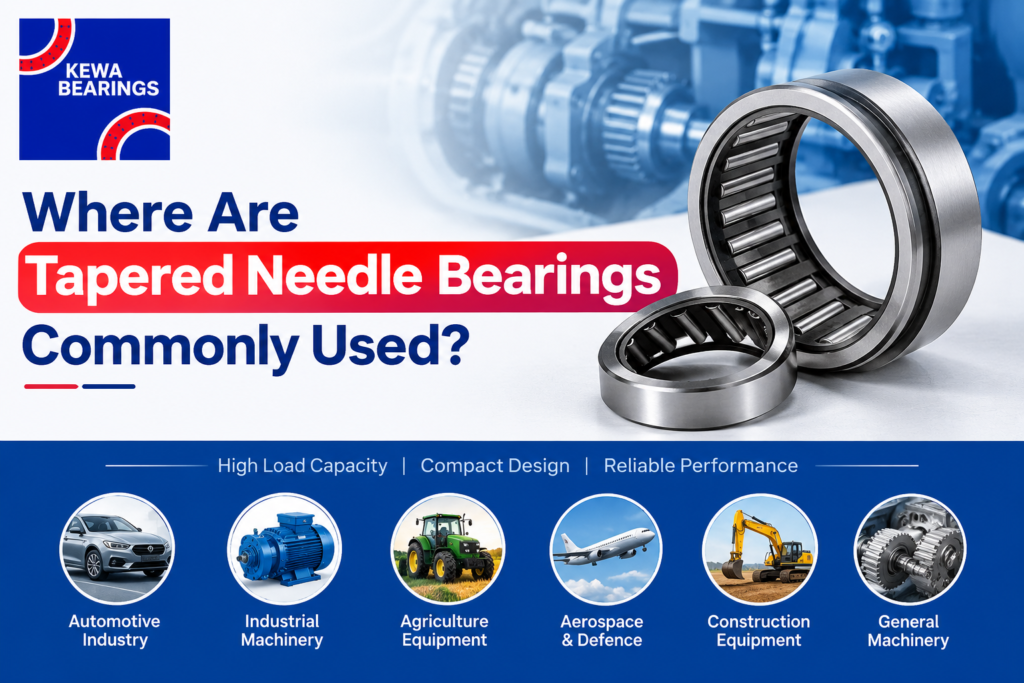
Bearings play an important role in machines by reducing friction and allowing components to move smoothly. Different machines require different types of bearings depending on the load, speed, space, and operating conditions. Among the various bearing designs available, needle bearings are known for their ability to handle loads while taking up less radial space.
A tapered needle bearing is a specialised bearing design that combines the compact nature of needle rollers with a tapered arrangement. Its design can make it suitable for applications where space is limited and controlled movement, load handling, and durability are important. These bearings can be found in several mechanical systems, particularly where efficient power transmission and reliable operation are required.
Understanding where these bearings are commonly used can help manufacturers, engineers, and maintenance professionals select the right bearing for their machinery.
What Is a Tapered Needle Bearing?
A needle bearing generally uses long, thin cylindrical rollers instead of conventional spherical rolling elements. Because the rollers have a relatively small diameter compared with their length, the bearing can provide a high load-carrying capacity without requiring a large amount of radial space.
A tapered needle bearing has a tapered roller arrangement or geometry designed for specific operating requirements. Depending on the bearing design, the tapered arrangement can help accommodate particular load and alignment conditions.
The exact construction can vary according to the manufacturer and application. Some designs are developed for specialised transmission and automotive applications, while others are selected for industrial machinery.
Before choosing a bearing, it is important to consider factors such as radial load, axial load, speed, lubrication, operating temperature, available space, and shaft or housing dimensions.
Why Are Needle Bearings Used in Compact Machinery?
One of the biggest advantages of needle bearings is their compact radial design. Conventional bearings may require more installation space, while needle-type designs can provide suitable load support within a smaller area.
This makes them useful in machinery where engineers need to reduce the overall size or weight of a component. A compact bearing can also help designers make more efficient use of available space.
Needle bearings are especially useful when a shaft needs to carry significant radial loads but there is not enough space for a larger bearing. Their small cross-sectional size makes them a practical choice for many mechanical assemblies.
The design also allows manufacturers to develop compact transmission systems without sacrificing necessary bearing support.
Common Use in Automotive Applications
The automotive industry is one of the major areas where specialised needle bearing designs are used. Modern vehicles contain numerous rotating components, gears, shafts, and transmission assemblies that require smooth and reliable movement.
Bearings used in automotive systems need to withstand repeated loads, vibration, temperature changes, and continuous operation. Compact bearing designs can be particularly useful in areas where installation space is restricted.
Transmission systems are a common example. Gears and shafts need to rotate smoothly while transferring power from one component to another. Properly selected bearings can reduce friction and support these rotating elements.
In specialised automotive mechanisms, a tapered needle bearing may be considered when the application requires a compact bearing arrangement with specific load-handling characteristics.
Applications in Gearboxes and Transmissions
Gearboxes contain several rotating components that operate under changing loads and speeds. Bearings help support shafts and gears while allowing them to rotate with controlled friction.
Because gearbox designs often have limited internal space, compact bearing solutions can be valuable. Needle bearing designs can provide the required support without significantly increasing the size of the assembly.
They may be used in different types of transmission systems, depending on the load and design requirements. Manual transmissions, automatic transmission components, industrial gearboxes, and specialised power transmission equipment can all use different bearing configurations.
The correct bearing must always be selected according to the manufacturer’s specifications and the actual operating conditions of the gearbox.
Use in Industrial Machinery
Industrial machinery often operates continuously for long periods. Equipment such as machine tools, material-handling systems, pumps, compressors, and power transmission units may contain multiple rotating shafts and components.
In such machinery, bearing performance directly affects efficiency, maintenance requirements, and operating reliability. A bearing that is not correctly selected can lead to excessive friction, heat generation, vibration, and premature failure.
Needle bearings can be useful where a compact design and suitable radial load capacity are required. Their small cross-section can help engineers maintain a compact machine design.
For industrial applications, factors such as lubrication, contamination, operating temperature, load direction, and rotational speed should be evaluated before installation.
Applications in Agricultural Equipment
Agricultural machinery works in challenging environments where dust, dirt, vibration, and varying loads can affect mechanical components. Tractors, harvesters, tillers, seeders, and other agricultural machines contain numerous shafts, gears, and rotating assemblies.
Bearings used in agricultural equipment must be able to operate reliably under demanding conditions. Proper sealing, lubrication, and maintenance become particularly important because contamination can reduce bearing life.
Compact needle bearing designs may be used in selected agricultural mechanisms where available installation space is limited. The choice depends on the equipment’s mechanical design and load requirements.
Regular inspection can help identify problems such as unusual noise, excessive play, overheating, or vibration before they cause major machinery downtime.
Use in Two-Wheelers and Small Vehicles
Two-wheelers and compact vehicles also depend on bearings for smooth operation. Their transmission and mechanical systems need components that can perform efficiently while keeping the overall assembly compact and lightweight.
Needle bearing designs are useful in several small mechanical arrangements because they can provide bearing support without requiring a large radial space.
In these applications, bearing dimensions, load capacity, rotational speed, lubrication requirements, and installation conditions should be checked carefully. Even a small bearing failure can affect vehicle performance and result in costly repairs.
Using a quality bearing from a reliable manufacturer can help improve the reliability of the mechanical system when the bearing is correctly matched to the application.
Use in Construction and Heavy Machinery
Construction equipment operates under high loads, vibration, and demanding working conditions. Excavators, loaders, cranes, and other heavy machinery contain many rotating and moving components.
Not every part of heavy machinery requires the same type of bearing. Larger components may require heavy-duty bearing designs, while smaller transmission or linkage assemblies may benefit from compact bearing solutions.
A tapered needle bearing can be considered for specialised applications where its geometry and load characteristics match the requirements of the equipment.
However, bearing selection should never be based only on size. Engineers should evaluate the complete operating environment, including load, speed, shock loading, lubrication, contamination, and expected service life.
Importance of Correct Bearing Selection
Choosing the correct bearing is essential for achieving reliable machine performance. Even a high-quality bearing may fail prematurely if it is incorrectly sized or installed.
Before purchasing a bearing, users should check the shaft diameter, housing dimensions, load requirements, operating speed, lubrication method, and temperature range. The direction and type of load are also important.
Installation quality matters just as much. Incorrect mounting, excessive force, poor alignment, inadequate lubrication, or contamination can damage the rolling elements and raceways.
For specialised applications, it is advisable to consult bearing manufacturers or technical professionals to determine the appropriate bearing design.
How to Increase Bearing Service Life
Proper maintenance can significantly improve bearing performance. One of the most important factors is lubrication. The correct lubricant and lubrication quantity should be used according to the application and bearing manufacturer’s recommendations.
Keeping bearings protected from dust, moisture, and other contaminants is equally important. Contamination can damage the rolling surfaces and increase friction.
Regular inspection can also help detect early warning signs. Unusual noise, increased vibration, excessive temperature, or abnormal movement may indicate a bearing problem.
Machines should also be operated within their specified load and speed limits. Overloading a bearing can create excessive stress and shorten its service life.
Why Quality Matters When Buying Bearings
Bearing quality can have a direct impact on machinery performance. Poor-quality bearings may experience premature wear, dimensional problems, excessive friction, or inconsistent performance.
When selecting a tapered needle bearing, buyers should consider the bearing’s dimensions, material, manufacturing quality, load capacity, and compatibility with the intended application.
Kewa Bearings focuses on providing bearing solutions for different industrial and mechanical requirements. Choosing the correct product and following proper installation and maintenance practices can help businesses reduce unexpected downtime and improve equipment reliability.
Conclusion
Tapered needle bearing designs are widely used in automotive, industrial, agricultural, and transmission applications. Their compact construction makes them ideal where space is limited and reliable load support is needed. Choosing the right bearing based on load, speed, lubrication, and operating conditions can help ensure smoother performance and longer machine life.
FAQs
1. What is a tapered needle bearing?
It is a specialised bearing designed for applications requiring compact size and reliable load support.
2. What industries use needle bearings?
They are commonly used in automotive, agricultural, industrial, and power transmission applications.
3. Can needle bearings work at high speeds?
Yes, certain needle bearings are designed for high-speed applications when properly lubricated and installed.
4. Do needle bearings require lubrication?
Most needle bearings require suitable lubrication to reduce friction, heat, and wear.
5. What materials are used to make needle bearings?
They are commonly manufactured using hardened bearing steel, although material choices can vary by application.
6. Can needle bearings handle shock loads?
Some designs can tolerate varying or shock loads, but the bearing must be selected according to the application’s load conditions.
7. How does contamination affect a needle bearing?
Dust, dirt, and moisture can damage rolling surfaces and increase wear, reducing bearing life.
8. How often should needle bearings be inspected?
Inspection intervals depend on the machine, operating conditions, load, and manufacturer’s maintenance recommendations.
9. What are signs of a damaged needle bearing?
Unusual noise, vibration, overheating, rough rotation, and excessive movement can indicate bearing problems.
10. How do I choose the right needle bearing?
Consider bearing dimensions, load, speed, lubrication, temperature, alignment, and the machine’s operating conditions.