
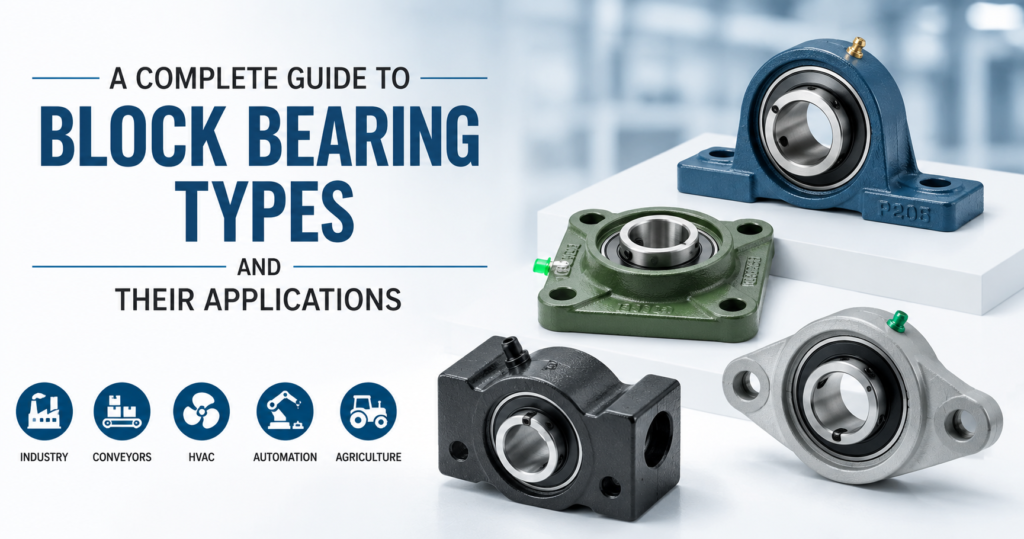
Bearings are really important for supporting rotating shafts and for keeping friction down in all kinds of industrial machinery. Between the many bearing solutions you can use, block bearings are commonly chosen, mainly because installing them is easy, they last a long time, and they can handle heavy loads too. If you learn about the different block bearing types it becomes easier for industries to pick the right option for better performance, plus more reliable equipment.
What Are Block Bearings?
Block bearings are mounted bearing units, that basically bring together a bearing insert plus a housing, so the whole set works as one. They’re made to keep a rotating shaft supported while still keeping things quiet and smooth, and maintaining the proper alignment. You can usually find these bearings in conveyor lines, agricultural machinery, manufacturing systems, and also in material handling machines, where movement has to stay steady and controlled.
Common Block Bearing Types
Pillow Block Bearings
Pillow block bearings are probably the most used block bearing type around. They have a bearing housed inside a solid pedestal style mount, so it can be bolted straight onto a flat surface. The whole unit feels sturdy; it’s common in lots of setups, and people prefer it because it stays in place.
Applications: Conveyors, fans, pumps, and industrial motors.
Flange Block Bearings
Flange block bearings have a flange-shaped housing that can be mounted on walls or machine frames. They are ideal when shaft support is required near a vertical surface.
Applications: Packaging equipment, agricultural machinery, and food-processing systems.
Take-Up Block Bearings
These bearings are designed to allow shaft adjustment and maintain proper belt or chain tension. Their housing can move within a frame for easy positioning.
Applications: Conveyor systems and material-handling equipment.
Hanger Block Bearings
Hanger block bearings are suspended from overhead structures and support shafts from above rather than below.
Applications: Conveyor systems, grain-handling equipment, and industrial processing plants.
Plummer Block Bearings
Plummer block bearings are heavy-duty bearing housings designed to support larger shafts and higher loads. They offer excellent durability in demanding industrial environments.
Applications: Mining equipment, steel plants, and power-generation facilities.
Factors to Consider When Choosing Block Bearings
Selecting the right block bearing types depends on several factors:
- Load capacity requirements
- Shaft size and speed
- Mounting arrangement
- Environmental conditions
- Maintenance needs
A proper selection helps reduce downtime, improve efficiency, and extend equipment life.
Benefits of Using Quality Block Bearings
High-quality block bearings give steady shaft support, help keep alignment, and they reduce friction, realy. They also make installation and replacement more straightforward, which can lower maintenance costs. In addition, manufacturers and industrial operators gain from better output and less equipment wear, in a noticeable way.
Why Choose Kewa Bearings?
Kewa Bearings gives precision-engineered bearing solutions for tough industrial work. It’s all about quality, lasting value and strong performance, so Kewa Bearings can deliver dependable products that support businesses in keeping things turning smoothly and efficiently across different fields.
Conclusion
Grasping the various block bearing types is essential if you want to pick the right bearing solution for each specific industrial use. You have pillow block bearings, flange block bearings, and then heavy-duty plummer blocks too, and each of these handles a different role. When the selection matches the application, you improve overall equipment performance, you also reduce the need for regular servicing, and you maintain long-term operational dependability.
FAQs
1. How often should block bearings be inspected?
Block bearings should be inspected regularly based on operating conditions and maintenance schedules.
2. Can block bearings be used in dusty environments?
Yes, sealed and properly lubricated block bearings can perform effectively in dusty conditions.
3. What causes premature block bearing failure?
Common causes include improper lubrication, contamination, misalignment, and overloading.
4. Are block bearings available in different housing materials?
Yes, they are available in cast iron, stainless steel, thermoplastic, and other materials.
5. Can block bearings handle both radial and axial loads?
Many block bearings can support radial loads and limited axial loads depending on their design.