
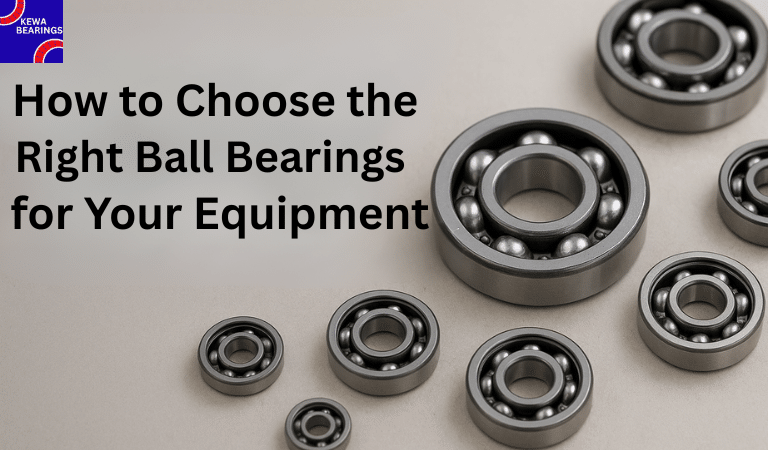
In any machine, there is no denying the fact that selecting appropriate ball bearings is vital to function efficiently. The reason is that they form the core of movement in machinery take different loads, minimizes the friction and permits the free movement of components. It does not matter if one owns machinery for industrial use, cars for automotive purposes or domestic appliances, the right selection of ball bearings in the above-mentioned systems will improve the functioning of the system, reduce the downtime and lower the maintenance expenses.
At Kewa Bearings, we appreciate the fact that with the availability of different kinds of bearings, with parameters, it sometimes becomes a challenge to select the required one. This article aims to assist you in making an appropriate decision for your tools.
Understanding Ball Bearings
Ball bearings facilitate easy movement as these are basically rings with balls either made up of steel or sometimes ceramics, which being surrounded by a bearing ring, reduce the friction to a great extent. Ball bearings have one basic function: they hold – load both radial and thrust, and allow the inner part to rotate freely. Such anti friction roller bearings are useful in many cases, while making machines that include and are not limited to; electric motors, pumps, bicycles, industrial gear boxes etc.
The advantage of ball bearings is that they help in carrying light to moderate loads at high velocities with very low friction losses. The condition exists only when a ball bearing design and type proper for the case are selected.
Things To Consider While Select Ball Bearings
1. Load Type and Capacity
It is highly recommended to figure out beforehand what kind of loads your device is subject to when it comes to selecting the bearing. Two main types of load act upon bearings:
- Radial load acts perpendicularly to the shaft.
- Axial load acts in a parallel fashion to the shaft.
Of course, a deep groove ball bearing really does well with radial and light axial loading; angular contact bearings on the other bar can accommodate greater axial load in one direction. Thrust ball bearings are ideal for pure axial loads.
The bearing should be selected on the basis of load direction and magnitude, so as not to wear prematurely or break under pressure.
2. Speed Requirements
Depending on design, material, and lubrication, every bearing has a maximum speed limit that it can withstand. For example, who needs the precision level of a bearing with the best lubrication and least friction in a motor or turbine running at high speed? For lower speed machinery, some ordinary bearings may do the job.
Also, always check speed ratings recommended by manufacturers to be sure your equipment’s operating speed matches.
3. Operating Environment
Bearing environments are paramount for bearing performance. Dust, moisture, heat, and chemicals can diminish bearing life. For instance, ball bearings requiring corrosion resistance would be better served by stainless steel or ceramic ball bearings in food processing or chemical plants.
When equipment works in extreme temperatures, there, you need bearing seals or lubricants that are heat-resistant.
4. Material and Construction
Material plays a critical aspect in determining the bearing’s durability and performance.
- Chrome steel series bearings-the series bearing for general applications are strong and cost-efficient.
- Stainless steel bearings prevent the corrosion further.
- A hybrid ceramic type delivers speed with a ton of reduced friction.
Depending upon the equipment and working conditions, bearing materials can, thereby, be balanced.
5. Lubrication and Maintenance
Adequate lubrication minimizes the wear and heat generation inside the bearing and ultimately increases the bearing’s life. Bearings are usually pre-lubricated (such as sealed or shielded) or need to be lubricated by hand intermittently.
If your device runs all the time, sealed ball bearings are recommended as they retain the lubricant and prevent contamination.
6. Precision and Tolerance
In contrast, applications in robots or precision instruments demand accuracy applied to the design of the bearing. Precise ball bearings reduce vibration and noise for smooth operations.
Check for bearing tolerance grade because tighter tolerance usually means the better in accuracy and performance of high-speed or sensitive equipment.
Why Choose Kewa Bearings
Kewa Bearings uses high-quality materials and top engineering to develop strong and efficient ball bearings for various industries. Our ball bearings can stand hard conditions to perform at indomitable levels of efficiency and service. We also provide expert guidance to customers so they can select the exact bearing for their application.
Choosing the appropriate bearing means precision and reliability plus trust. Kewa Bearings offers that and more.
Conclusion
Choosing ball bearings for your equipment is one of the essential steps to ensure the best service life and operational efficiency, safety, and performance.
Kewa Bearings are the trusted companions for all your motion needs when the focal point is on quality and trust.
(FAQs)
1. How long do ball bearings last?
With adequate lubrication and maintenance, the life of the bearings can be extended for many years-even in a harsh environment.
2. What are some witness signs from a failing bearing?
Noise and vibration are diagnostic. When your machine begins to run rough, it’s time for a check.
3. Are sealed bearings better than open ones?
Yes, particularly if your equipment operates under dusty or wet conditions. But maintenance of sealed bearings is minimal.
4. Can I reuse old ball bearings?
Not recommended! Worn bearings can cause more damage. It’s safer to replace them.
5. What makes Kewa Bearings a trusted choice?
We combine precision engineering, superior materials, and reliable service to deliver bearings you can count on.