
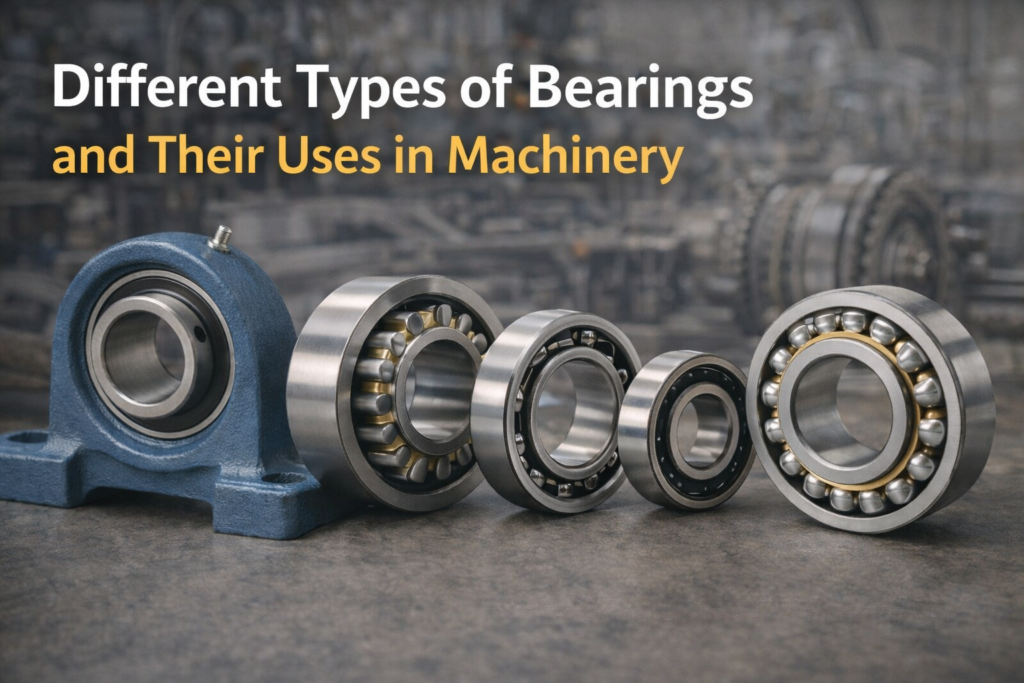
Smooth movement has become crucial in the age of modern machinery. Whether it is small domestic appliances or huge industrial machines, all of the parts that rotate, must be stabilized and regulated. That is why bearings are essential. Bearings reduce friction, carry loads and let parts rotate freely. Knowing about the variety of bearings types and their applications will help industries adopt the most suitable solution that will in return enhance the performance and lifespan of the machine. As Kewa Bearing Company, it is our belief that good bearings , result in better efficiency, safety, and longevity of the machine.
What Are Bearings and Why Are They Important?
Bearings are machine parts that facilitate movement between different parts of the machine and decrease the friction levels. They are the components that enable rotation of the shafts, wheels and other parts of the machinery. If bearings were not present in machines, the machines would break down due to friction and heat in a short span of time. Bearings are used to control friction which is favorable in increasing the efficiency of machines.
There are numerous different bearings types and each type is created with a purpose according to load, speed and condition of operations.
Ball Bearings and Their Common Uses
Ball bearings are one of the most widely used bearings types in machinery. They use small steel balls to reduce friction between moving parts. These are perfect ball bearings for moderate speed and load applications.
Electric motors, fans, pumps, and appliances widely use these ball bearings. They are considered economical and easy to maintain due to their simple design-layout. They further offer smooth and silent-operation applications.
Roller Bearings for Heavy Load Applications
Roller bearings are made to take heavier loads than ball bearings. Instead of balls, the rollers found on this bearing are typically either cylindrical or conical, so it results in a larger contact area which is capable of more evenly spreading the load.
Groups of bearings from this kind are frequently utilized in heavy machinery, in particular the heavy load or pressure for longer hours found in conveyors, gearboxes, and construction equipment. Roller bearings are found in these industries.
Spherical Roller Bearings for Tough Conditions
Spherical roller bearings are precisely designed to cope with huge loads and misalignment. They can rectify themselves when the shafts are not ideally aligned, building up a great trustworthiness for tough environmental conditions.
Now in mining, cement plants, steel mills, and paper industries, rumbling noise, heavy vibration loads, and a filthy environment, hence, these become natural choices on these rough-terrain mediums.
Thrust Bearings for Axial Loads
Thrust bearings are used when the load acts along the axis of the shaft rather than sideways. They are designed to support axial loads efficiently while allowing smooth rotation.
These bearings types are often used in automotive gear systems, machine tool spindles, and industrial pumps. Choosing the right thrust bearing is important to prevent damage caused by excessive axial force.
Needle Bearings for Compact Spaces
Needle bearings are a type of roller bearing with long and thin rollers. They are ideal for applications where space is limited but load capacity is still important.
These bearings types are commonly used in automotive components, compressors, and small engines. Their compact design helps reduce machine size without compromising performance.
Plain Bearings for Simple and Cost-Effective Use
All the bearings have no rolling elements but instead depend on sliding motion between the surfaces. They have neat designs and are incredibly convenient to install.
Plain bearings are pertinent to everything from agricultural machinery to hinges and low-speed machinery. They find places where very low maintenance and low operational speeds are required to begin with.
Choosing the Right Bearing for Machinery
When it comes to selecting the apt bearing, there are different considerations such as the load, speed, temperature and environment that can influence the selection. If an inappropriate bearing is selected, breakdowns will occur more often which is costly in terms of maintenance. Kewa Bearing assists in selecting the appropriate class of bearings types needed for customer’s operations and assures longer durability.
Conclusion
Bearings comprise the core for most of the machines that exist today. Knowing the various bearings types in the market and their application purposes enables businesses to enhance productivity, lower downtime, and increase the machines’ lifespan. Every bearing type has a contained function starting from ordinary use ball Bearings to heavy-duty spherical roller bearings. Opting for the appropriate bearing is a wise move and not purely an engineering one.
FAQs
Q1. What do bearings do in machines?
They help parts move smoothly and reduce friction.
Q2. How many bearings types are commonly used?
There are several types, each made for different loads and movements.
Q3. Which bearing is used when space is limited?
Needle bearings are used in compact spaces.
Q4. Can one bearing type fit all machines?
No, every machine needs a bearing based on its work and load.
Q5. Why is correct bearing selection important?
The right bearing improves machine life and reduces breakdowns.