
There is no machine, vehicle, or industrial equipment without bearings. As a result, they ensure smooth operation, reduce friction, and support moving parts. Understanding their key components helps in selecting the right product for different applications. A suitable bearing design ensures proper load handling, reduced friction, and reliable machine performance.
What Is a Bearing?
A bearing helps hold parts as they spin or slide. It cuts down friction so motion feels easier. It can handle many kinds of loads and still keep movement smooth. It is widely used in automobiles, electric motors, agricultural machinery, pumps, and industrial equipment. Bearing design determines how components handle radial and axial loads, ensuring efficient performance across different applications.
Key Parts of a Bearing and Their Functions
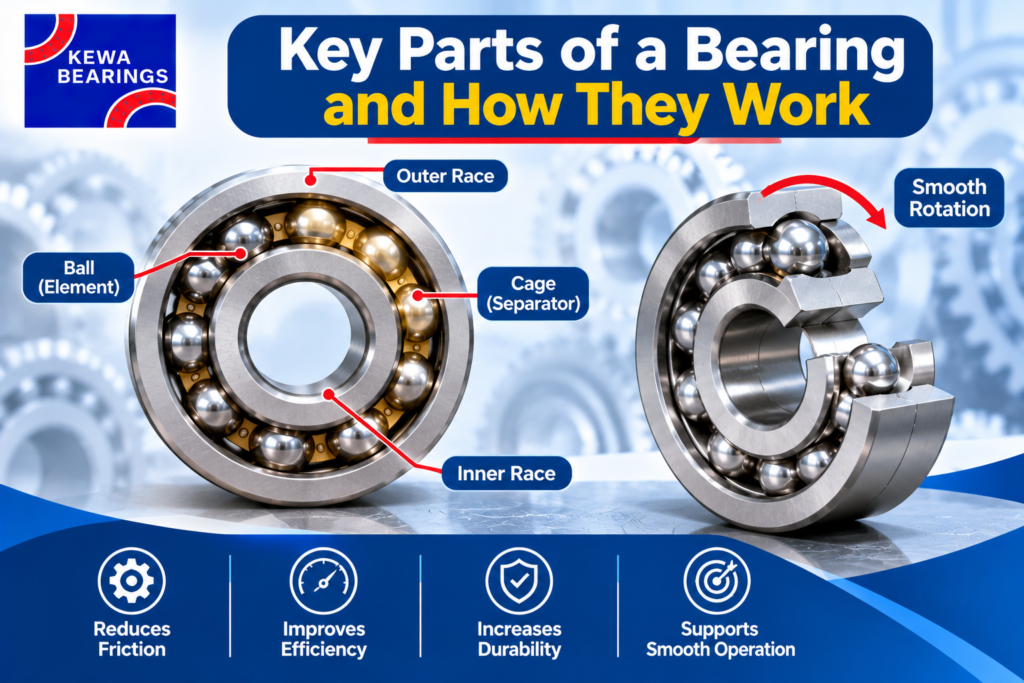
Most rolling-element bearings consist of four main components: inner race, outer race, rolling elements, and cage. Some bearing types also include seals and shields for additional protection.
Let’s understand how each component works.
1. Inner Race
The inner race is the ring located at the centre of a bearing. It is generally mounted on a rotating shaft and provides a smooth surface for the rolling elements.
Its primary functions include:
- Supporting the rotating shaft.
- Providing a rolling path for balls or rollers.
- Transferring loads from the shaft to the rolling elements.
The inner race usually rotates along with the shaft. Its surface finish, hardness, and dimensional accuracy are important for smooth operation.
In a well-planned bearing design, the inner race must have the correct dimensions and surface properties to support the required load without excessive wear.
2. Outer Race
The outer race is the outermost ring of a bearing. It is usually fitted inside a machine housing and provides a track along which the rolling elements move.
Its main functions include:
- Supporting and positioning the rolling elements.
- Transferring loads to the machine housing.
- Maintaining the alignment of internal components.
The outer race plays an important role in maintaining bearing stability. Its shape and construction depend on the bearing type and operating conditions.
The bearing design also considers the interaction between the inner and outer races to ensure proper load distribution and reliable operation.
3. Rolling Elements
Rolling elements sit between the inner and outer races, reducing friction through rolling movement. They are of two main types:
- Ball Elements: Spherical elements used in applications requiring high speeds and low friction.
- Roller Elements: Cylindrical, tapered, spherical, or needle-shaped elements suitable for handling heavier loads.
Their size, shape, and arrangement influence load capacity and overall bearing design, especially in demanding industrial applications.
4. Cage or Retainer
The cage, also known as a retainer, maintains the correct spacing between rolling elements. It prevents them from coming into direct contact with one another during operation.
Its important functions include:
- Keeping rolling elements evenly spaced.
- Guiding their movement.
- Reducing friction between rolling elements.
- Supporting smooth and stable rotation.
Cages can be manufactured using steel, brass, or engineering plastics. The material depends on the bearing type, operating speed, temperature, and application requirements.
A properly selected cage supports consistent movement and helps prevent unnecessary friction. Therefore, cage construction is another important aspect of bearing design.
5. Seals and Shields
Seals and shields are protective components used in many bearing types. Their primary purpose is to prevent dust, dirt, moisture, and other contaminants from entering the bearing.
Seals: These provide better protection against contaminants and help retain lubricant inside the bearing.
Shields: These offer protection against larger dust particles and debris while generally maintaining a non-contact arrangement with the rotating components.
They are particularly useful in applications where bearings operate in dusty, dirty, or moisture-prone environments.
The selection of suitable seals or shields depends on the working environment and the level of protection required.
How Do Different Bearing Parts Work Together?
All bearing components work together to ensure smooth mechanical movement. As the shaft rotates, the inner race moves with it, while rolling elements reduce friction and transfer loads to the outer race. The cage maintains proper spacing, and seals protect internal parts from contaminants.
An effective bearing design ensures smooth rotation, better load handling, and reduced vibration, heat, and wear.
Why Is Bearing Design Important?
The construction and arrangement of bearing components directly influence their performance, durability, and suitability for different applications. A suitable bearing design ensures that the bearing can handle the required operating conditions without unnecessary stress.
Here are some important benefits of proper bearing construction.
1. Reduced Friction
Properly designed raceways and rolling elements help minimise friction and energy loss during operation. This allows machinery to operate smoothly and efficiently.
2. Better Load Handling
The right combination of rolling elements and raceways allows bearings to handle different radial and axial loads. This is particularly important for heavy industrial machinery.
3. Improved Durability
High-quality materials, accurate dimensions, and suitable lubrication help reduce wear and extend service life. A reliable bearing design also helps minimise the chances of premature component failure.
4. Smooth Operation
Correct component alignment and spacing help minimise vibration and unwanted noise. This supports stable machine performance, even during continuous operation.
5. Greater Efficiency
Bearings with suitable construction help machines operate efficiently and reduce unnecessary maintenance requirements. Selecting the right bearing for an application can also help improve overall equipment performance.
Common Materials Used in Bearing Components
Bearing materials influence strength, durability, wear resistance, and performance. Commonly used materials include:
- Chrome Steel: Offers hardness and wear resistance.
- Stainless Steel: Provides corrosion resistance.
- Brass: Commonly used for durable bearing cages.
- Engineering Plastics: Lightweight and corrosion-resistant.
Material selection depends on load, speed, temperature, and operating conditions. These factors help determine a suitable bearing design for industrial applications.
Conclusion
Bearings consist of several precisely manufactured parts that work together to reduce friction, support loads, and ensure smooth movement. Understanding these components helps in selecting the right product for industrial applications. A reliable bearing design, quality materials, and proper maintenance improve machine efficiency and durability. Kewa Bearings offers bearing solutions to meet diverse industrial requirements.
Frequently Asked Questions (FAQs)
1. Can you tell me the name of four main parts of a bearing?
Inner race, outer race, rolling elements, and cage.
2. Which bearing component reduces friction?
Rolling elements reduce friction between the races.
3. What happens if a bearing cage breaks?
It causes friction, vibration, and possible bearing failure.
4. Why are bearing races hardened?
To improve wear resistance and durability.
5. Can bearings operate without seals?
Yes, but they need protection from contaminants.
6. What causes bearing overheating?
Poor lubrication, excessive loads, and misalignment.
7. Which bearing material is commonly used?
Chrome steel is widely used for its strength and hardness.
8. What is the purpose of a bearing cage?
It maintains spacing between rolling elements.
9. How does lubrication affect bearing performance?
It reduces friction, heat, and wear.
10. How can bearing life be improved?
Through proper installation, lubrication, and regular inspection.