
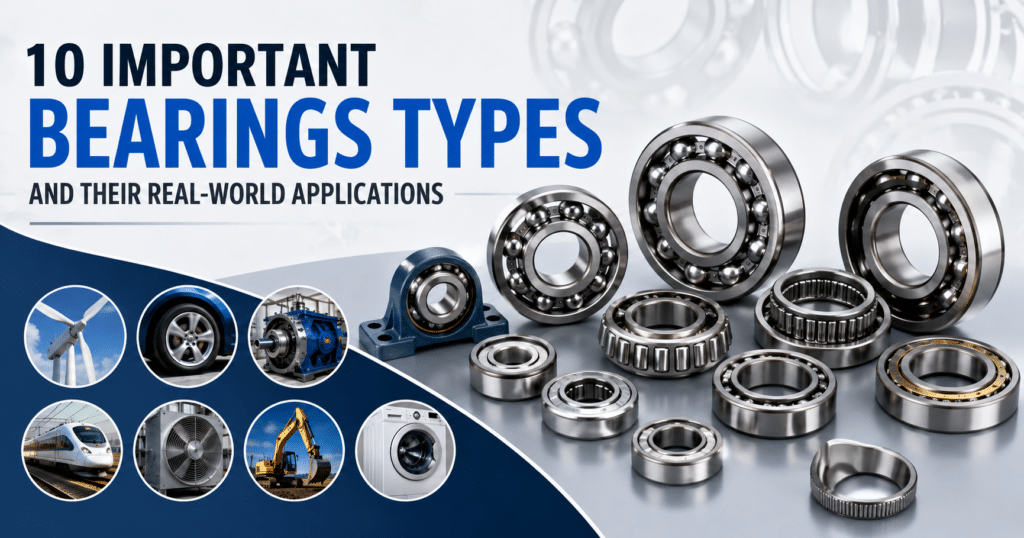
Bearings are basically key components in machines and equipment, and they help lower friction and hold things that move, together. Learning about various bearings types and applications matters a lot when you’re choosing the right bearing for industrial or commercial work, because one size never really fits everything. At Kewa Bearings, we provide solid high-quality bearing solutions made for strong performance and long-term durability, not just a short term fix.
1. Ball Bearings
Ball bearings are probably one of the most common kind of bearing. They work with rolling balls, so as to reduce friction a little, and they show up everywhere, such as in electric motors , fans, and even in home appliances. In a sense, it’s all about that constant rolling, not so much sliding.
2. Roller Bearings
Roller bearings use cylinders instead of balls, so they can take heavier loads more efficiently. You’ll see these bearings in conveyor systems and in a lot of industrial machines, where steady motion matters.
3. Deep Groove Ball Bearings
These bearings can handle both radial loads and axial loads too, so they’re versatile for different situations. That flexibility makes them a good fit for pumps, motors and even automotive use, in a more steady way than some other kinds.
4. Tapered Roller Bearings
Tapered roller bearings are made for managing combined loads, they’re commonly used in vehicle wheel hubs, also in gearboxes and some heavy equipment. In other words they help take on those combined forces, kinda smoothly.
5. Spherical Roller Bearings
These bearings can handle a certain level of shaft misalignment, and also they’re good with heavy loads, too. You’ll see them in mining work in construction stuff, and in equipment built for material handling, like conveyors.
6. Thrust Bearings
Thrust bearings are made to take axial loads, more or less. You’ll find them in a bunch of places like automotive transmissions, marine systems and industrial machinery too. Sometimes people call the load direction “push” and that is kinda the whole idea behind these parts.
7. Needle Roller Bearings
With their rather compact design, needle roller bearings give you a high load capability even when the available space is limited. You’ll see them used quite often inside gearboxes and in various automotive parts, yeah.
8. Pillow Block Bearings
These bearings are coming housed in a mounting unit, so the installation is easy enough, really. You see them a lot in agricultural gear, on conveyors, and in manufacturing setups too, where the whole system keeps moving along kind of smoothly.
9. Angular Contact Bearings
Angular contact bearings can take both radial, and axial forces at high speed. You tend to see them in machine tools, pumps and compressors, because they’re kind of good at handling those unaligned loads, even when things spin fast.
10. Linear Bearings
Linear bearings enable that smooth sliding along, more or less, a straight path. You can see them pretty often in automation setups, CNC machines, or robotics. In practice they make the linear travel feel kind of steady and controlled, not jittery.
Why Understanding Bearings Types and Applications Matters
Getting the right bearing alignment, or maybe the bearing number, really helps the machine run better. It cuts down maintenance costs, it even increases the overall service life, in a way that feels more solid. Sometimes it is just that small tuning and then things behave more steadily, less complains, less surprises. In practice, each industry ends up needing a distinct bearing design because of load level, rotation speed, operating conditions, and even the way alignment is handled. When you really know the bearing types, plus where they get used, then companies can choose more wisely and keep productivity moving.
At Kewa Bearings, we deliver dependable bearing solutions across many kinds of industrial tasks, so you get steady performance even when the environment is tough or not exactly friendly.
Conclusion
Bearings play a vital role in modern machinery. From ball bearings and roller bearings to linear and thrust bearings, each type serves a specific purpose. By understanding bearings types and applications, industries can choose the right bearing for optimal performance, efficiency, and long-term reliability.
FAQs
1. Which bearing type is most commonly used?
Ball bearings are among the most widely used bearings due to their versatility.
2. What bearing is best for heavy loads?
Roller bearings and spherical roller bearings are suitable for heavy-load applications.
3. Where are pillow block bearings used?
They are commonly used in conveyors, agricultural equipment, and manufacturing systems.
4. Can bearings reduce machine maintenance?
Yes, the right bearing helps reduce wear and maintenance requirements.
5. Why are linear bearings important?
They enable smooth and accurate linear motion in automation and CNC systems.