
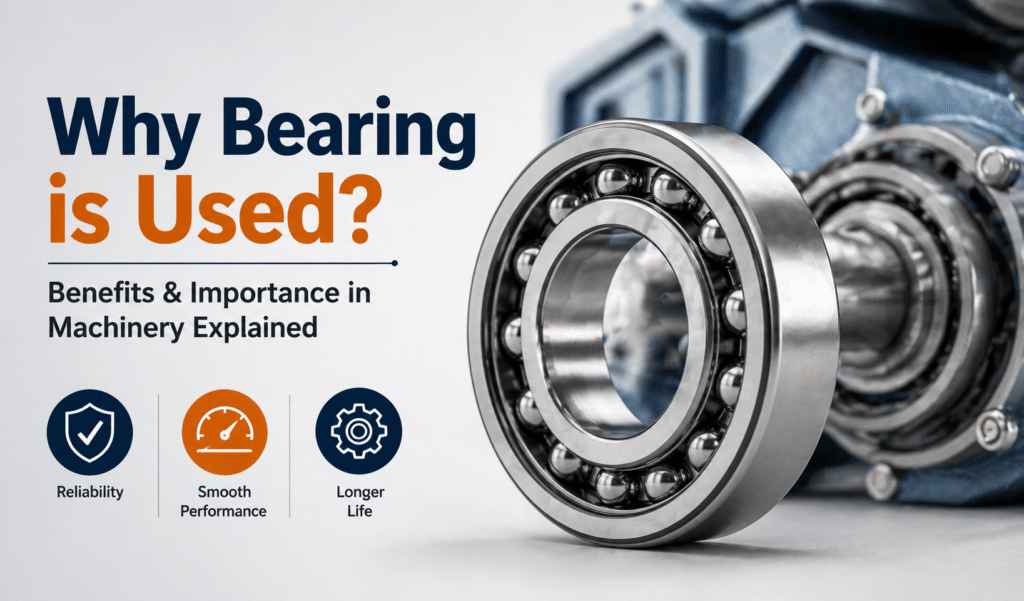
You cannot imagine modern equipment with jerks and inefficiency. One of the key elements that facilitates this is the bearing. In case you have been asking yourself why bearing is used, it is due to the fact that friction is minimized, loads are reduced, thereby increasing the working life of machines. In almost every single appliance from tiny household devices to huge industrial ones, bearings perform a vital function that is making sure that all is working well.
What is a Bearing?
Bearings serve as a mechanical construction, especially for the support of moving parts by reducing inter-part friction. Their primary purpose is twofold: they fully support the loads and demand motion, either linear or rotational. Bearings have become essential components of delicate machines and engines, pumps, vehicles, etc., for their smooth working.
Why Bearing is Used in Machinery
It’s easy to see why bearing is used when one considers how machines operate. Almost every piece of machinery consists of moving parts that touch other moving parts. A bearning-free mechanism is bound to experience a high degree of friction when operating causing rapid wear and tear. It would eventually result in the machine’s malfunctioning when left unchecked.
Bearings minimize friction in a bid to facilitate free movement. Besides, they help a machine or its parts to stay within the required orientation, which ensures that they do not break down frequently.
Key Benefits of Using Bearings
1. Reduces Friction
One of the main causes of why bearing is used is the need to minimize the friction between two parts that are in relative motion. And as a result, the lower the friction is, the less energy is wasted, the smoother the motion will be, and the higher the efficiency achieved.
2. Enhances Machine Efficiency
Bearings allow a machine to work smoothly with less resistance. Thereby, minimal resistance will enhance an independent bearing’s efficacy and performance by producing more output with less energy being input.
3. Supports Heavy Loads
Bearings are meant for working under different types of loads, with loads that include more radial and axial, which means they are remarkably versatile when it comes to many industries, for any circumstances that call for some extra strength and reliability.
4. Increases Equipment Lifespan
Bearings make machinery long-lasting. That is, fewer breakdowns and lower costs in maintenance are additional consequences.
5. Improves Safety
Machines using optimal bearings have fewer chances of failing out of the blue, reducing accidents and guaranteeing a healthier working atmosphere.
Importance of Bearings in Different Industries
Bearings play a strong role across a variety of industries due to their versatility. They serve to guarantee smooth wheel rotation and engine performance in the automotive sector while upholding support for massive machinery of demanding precision in the manufacturing sector. In agriculture, bearings help equipment operate efficiently in tough conditions.
Without bearings, machines would consume more energy, require frequent repairs, and deliver poor performance. This clearly highlights why bearing is used as a fundamental component in almost every mechanical system.
Choosing the Right Bearing
Several factors determine the choice of four-mounted roller-bearing devices and they bear the name of Kewa Bearings. Its single piece of roller-bearing device is different from any, which surpasses in every respect in many of the said scales required by world-standard bearing assemblies.
Conclusion
In conclusion, the reasons why bearing is used are important in order for any mechanic to know how to incorporate them. A bearing, therefore, supports the forces, reduces resistance, enhances performance and lengthens the longevity of apparatuses. Regardless of whether one regards the industrial equipment or thinks of all types of gears, they are required so that things work as they should. Superior grade of bearing means better than the rest, bears less weight of service and gives a discount in the economical aspect.
FAQs
Q1. What happens if a machine runs without a bearing?
Without a bearing, friction increases significantly, leading to overheating, rapid wear, and possible machine failure.
Q2. Are bearings only used in heavy machinery?
No, bearings are used in both small devices like fans and large industrial equipment.
Q3. How often should bearings be replaced?
It depends on usage, load, and maintenance. Regular inspection helps determine the right replacement time.
Q4. Can bearings improve energy efficiency?
Yes, by reducing friction, bearings help machines consume less energy and operate more efficiently.
Q5. What are common signs of bearing failure?
Noise, vibration, overheating, and reduced performance are common indicators of bearing issues.