
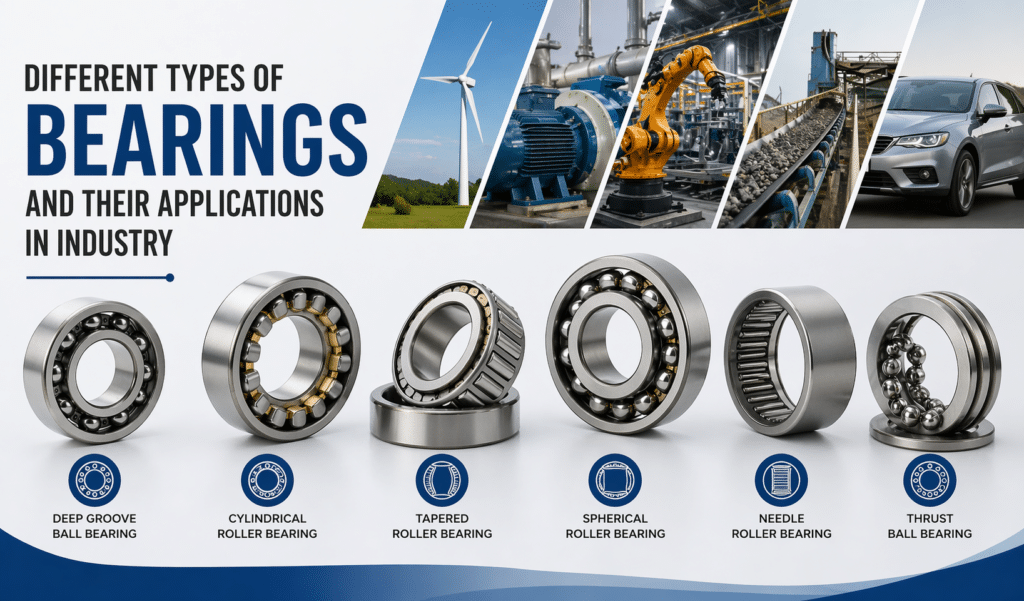
Bearings serve essential functions in modern machinery by enabling smooth operation and minimizing friction while their use increases operational efficiency. The right industrial component selection requires knowledge about different types of bearing and their applications. The correct bearing selection for equipment, ranging from heavy machinery to precision devices results in improved performance and durability and increased operational reliability.
Understanding Bearings and Their Importance
Bearings function as mechanical components which provide support for rotating components while reducing frictional resistance. The system enables load handling which preserves proper alignment and delivers uninterrupted operational performance. Different industries require specific bearing types which match their operational requirements of load capacity and rotational speed and actual working conditions.
Ball Bearings and Their Applications
Ball bearings are one of the most frequently used bearing types because they can perform in various applications. The system employs small steel balls to achieve two functions which enable it to minimize rotational friction while handling radial and light axial loads. The bearings find extensive application in electric motors and fans as well as automotive wheels and household appliances. The system achieves optimal performance in applications requiring efficient operation and uninterrupted rotation because it operates at high speeds with minimal friction.
Roller Bearings in Heavy-Duty Machinery
Roller bearings are built to support heavier weight capacities when compared to ball bearings. The system uses cylindrical rollers instead of balls to achieve better weight distribution. These bearings are widely used in conveyor systems and construction machinery and industrial gearboxes.
The system performs best when handling high radial loads which makes it vital for use in manufacturing and heavy engineering work.
Needle Bearings for Compact Designs
Needle bearings function as roller bearings which use long, slender rollers as their main element. Their compact design enables installation in tight spaces while maintaining their capability to handle heavy loads. The bearings find extensive application in automotive systems particularly in transmission components and in industrial equipment that requires space-efficient solutions. The system uses lightweight components which enable it to handle heavy loads in small mechanical systems.
Thrust Bearings for Axial Load Handling
Thrust bearings are specifically created to manage axial forces which operate in the direction of the shaft. The components have widespread applications in automotive gear systems, crane operations and vertical shaft mechanisms. The bearings provide stability and enable smooth operation in systems which experience axial force because they are essential components for heavy vertical operations.
Tapered Roller Bearings in Automotive Applications
Tapered roller bearings exist to support dual loading which includes both radial and axial forces. The system provides stability under extreme conditions because its special design enables it to sustain high weight loads. The equipment receives common application in automotive wheel hubs and gearboxes and heavy machinery. The strength and load-handling capacities of the product make it a perfect requisite for applications that are both difficult and demanding in terms of strength and reliability.
Spherical Bearings for Misalignment
Spherical bearings permit shaft to housing misalignment because of their design. The system functions effectively in mining equipment and agricultural machinery and construction vehicles because it handles both shaft deflection and angular misalignment. The system protects equipment from stress damage because of its ability to adapt to different operational situations.
Choosing the Right Bearing for Industrial Use
The process of selecting an appropriate bearing requires evaluation of multiple factors which include load type, speed, temperature and working environment. The selection of an appropriate bearing results in operational efficiency improvements while decreasing maintenance expenses and protecting against equipment breakdowns. Kewa Bearings provides multiple high-quality bearing options which fulfill various industrial needs. The selection process for bearings becomes simpler through precise engineering which ensures long-lasting performance in all use cases.
Conclusion
Industries require knowledge of types of bearing and their applications to make proper component choices for their machinery needs. The different bearing types exist to fulfill specific operational needs which include supporting heavy loads and enabling high-speed processes. The selection of an appropriate bearing type will enable companies to enhance their business performance by achieving two objectives which protect their equipment from harm while sustaining their operational activities over extended time periods.
FAQs
1. What are the most commonly used types of bearings in industry?
The two types have gained immense popularity in terms of applications, the first type, ball, and, the other type, roller bearings.
2. Which bearing is best for high-speed applications?
Ball bearings are ideal for high-speed operations because they generate less friction.
3. Where are thrust bearings mainly used?
Thrust bearings are used in applications involving axial loads, such as automotive systems and vertical machinery.
4. Why are tapered roller bearings used in vehicles?
They can handle both radial and axial loads, making them suitable for wheel hubs and gear systems.
5. How do I choose the right bearing for my application?
Consider factors like load type, speed, space, and operating environment to select the most suitable bearing.