
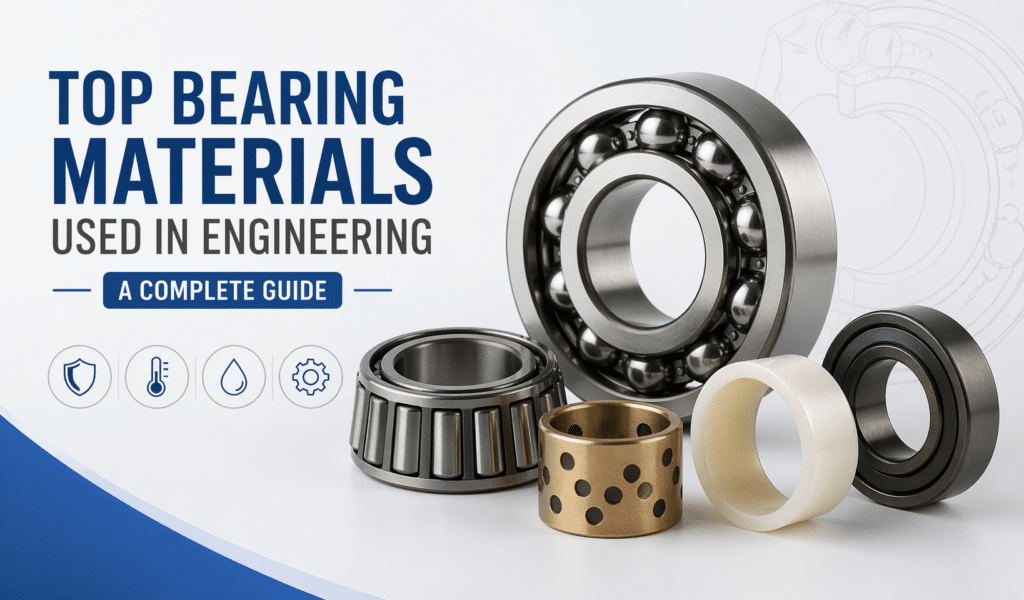
The performance and durability of machinery is in some way reliant on the quality of its components as in the case of almost all industries in mechanical engineering. Bearings are one of the main components whose primary function is to minimize friction and enhance smooth motion. Bearing materials or bearing efficiency is one of the vital studies in bearings. Many advances have been made in the design of bearings over the years mostly in improving performance and also the longevity of machines.
This guide discusses the various bearing materials that are most commonly used in engineering and the benefits that come with each material.
Why Bearing Materials Matter
A bearing works under different loads, speeds and environmental conditions; strength, wear resistance, corrosion resistance, heat resistance, and pressure resistance are the attributes required of the right material. The wrong selection could result in the machine breaking down too often, whole lot more maintenance and drying out revenue from the effluent.
Common Types of Bearing Materials
1. Steel Bearings
Considering its indestructible characteristics and resilience, nothing is used in bearing materials more than steel. Bearing in mind its case hardness and resistance properties chrome steel, however, is at the top of the list of the best available options. However, when it comes to food industries and seagoing environments, stainless steel rolling element bearings are highly recommended.
2. Ceramic Bearings
Ceramic materials such as silicon nitride possess desirable light weight characteristics and are resistant to corrosion and high temperature. These bearing materials are well suited for situations with high speed and high temperature and other hostile motile environments where traditional steel bearings would not function. In addition, these reduce friction hence saving significant amounts of energy.
3. Bronze Bearings
Bronze is a traditional yet highly reliable option among bearing materials. This is one of the most preferred faces for heavy constructions because it can hold a lot of debris and does not easily wear out. Bearings that are made of bronze are most commonly used in construction equipment and heavy-duty wear applications.
4. Plastic Bearings
Plastic bearings are being widely used these days, especially in engineering, as they are very light in weight and do not degrade with the use of certain chemicals. Such bearing materials are employed in applications where the use of the lubricants is either impracticable or unwanted, like the food and pharma.
5. Babbitt (White Metal) Bearings
Soft Babbitt alloy is used in many bearings as a metal layer that overlays the steel shell. It is very well tolerated and allows for embedded particles because it can absorb impacts or address small offsets. Such bearing materials are mainly used in slow-speed machines under high loads such as turbines, generators, etc.
6. Composite Bearings
It is the essence of composite materials to use materials with combined properties to provide a better performance. These materials called bearing materials comprise in most cases alternating metal and polymer layers for low friction and self-lubricating capacity as well as for increased strength and support. Because of such advantages, they are often applied in transport and air travel.
Factors to Consider When Choosing Bearing Materials
The selection of bearing materials is based on several considerations such as load bearing capacity, working speed, temperature and surrounding conditions. For example, ceramic bearings may be the right type for high-speed applications, while bronze housing or steel housing higher bearing types would be applicable for high-speed applications.
Factors such as moisture, chemicals, or temperature extremes also ought to be considered. One must utilize the best material to minimize any chance of failure and sufficiently support the operation of the bearing.
Conclusion
To understand bearing materials is significant if an engineer wishes to make the right decision. Each material features its advantages, while its choice, with regard to an application or situation, can greatly improve efficiency, reduce maintenance and increase service life.
FAQs
1. What are the most commonly used bearing materials?
Steel, ceramic, bronze, plastic, Babbitt, and composite materials are commonly used in bearings.
2. Which bearing material is best for high-speed applications?
Ceramic materials are ideal due to their low weight and high heat resistance.
3. Are plastic bearings durable?
Yes, plastic bearings are durable in low-load and corrosion-prone environments.
4. Why is steel widely used in bearings?
Steel offers high strength, durability, and excellent wear resistance.
5. How do I choose the right bearing material?
Consider factors like load, speed, temperature, and environmental conditions before selecting.