
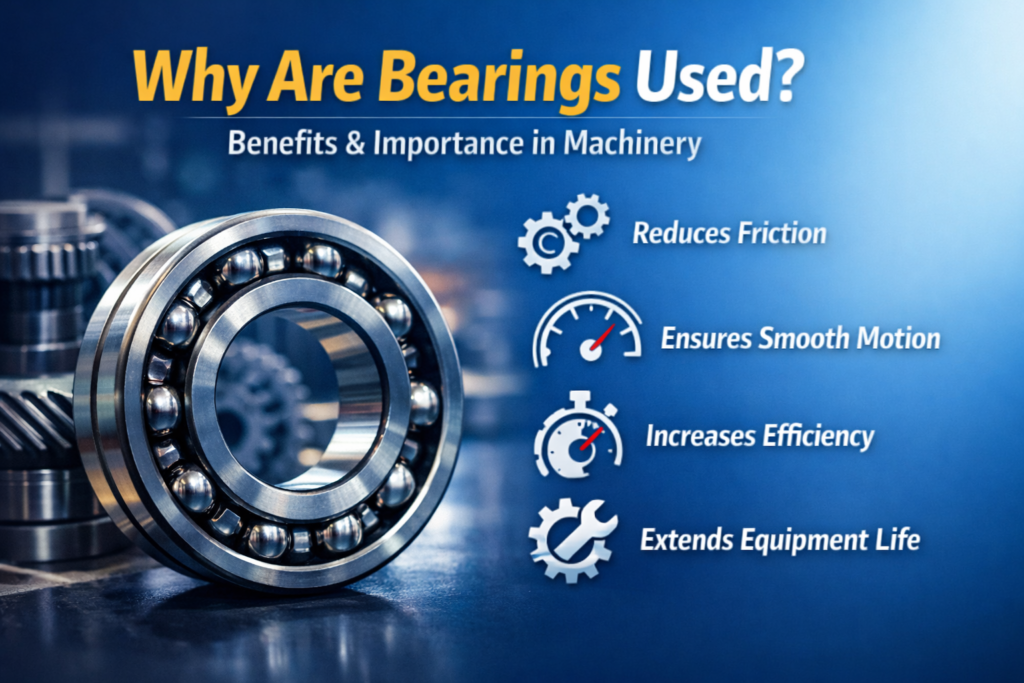
In mechanics and engineering, there is one unassuming item that contributes considerably to the efficiency of operation – the bearing. Be it huge mechanisms, cars, or ordinary appliances, it is impossible to imagine their workers’ productivity without bearings. If it ever crossed your mind why are bearings used then it is because they are designed with features that help minimize friction, carry loads and prolong the durability of the components in motion.
Understanding Why Are Bearings Used in Machinery
If you want to understand why are bearings used, it can be useful to go to the very essence of the subject and find out what a bearing is. A bearing is an element that is designed to hold components together and avoid or limit the friction between cooperating surfaces. Such surfaces which help the elements of two moving assemblies along one another may entail overheating, deterioration and consumption. The ‘bearing’ action allows the sliding surface or rolling surface to occur and reduces or eliminates the friction.
This seeming principle, owing to the difference in the structural components works wonders. Machines, for instance, would wear out immediately as they have excessive power consumption if they do not have bearings.
Key Benefits of Bearings in Machinery
One of the key reasons why are bearings used is to reduce friction, allowing machines to run smoothly and efficiently while consuming less energy. They also support both radial and axial loads, helping equipment handle pressure without any damage. Other than protection from wear, bearings extend machine life and can also trim down maintenance expenses. Equally important, they promote precision via stable movement; hence, the performance is more consistent and output quality is better.
Importance of Bearings Across Industries
The importance of why are bearings used is clear across industries. Bearings allow for a smoother movement and maximized fuel efficiency in cars, while supporting the high loads at high speeds in industrial machines, thereby enhancing their productivity and reducing downtimes. These bearing components even allow appliances to be highly successful and reliable, while providing a smooth and silent operation.
How Bearings Improve Machine Efficiency
Efficiency is one of the strongest answers to why are bearings used. Bearings cut down the friction, and in some ways, the machine takes less power to get some work done. Finally, we all equally will be able to save energy in the long run and cut on operational costs.
Another advantage is that they help regulate heat. When friction gets excessive, it generates heat damaging many machine parts. Thus bearings reduce this temperature, protecting machines to assure their safe and efficient operation.
Another advantage is ensuring a machine can handle high speeds. The bearings that are of excellent quality meant that the devices can actually run at favorable speeds without handling abnormal activities in the structure. This is crucial for industries where only speed and quantity matter.
Choosing the Right Bearings Matters
The study of why are bearings used is imperative; however, the selection of a type is also significant. Bearing types and sizes are needed for the specific application, as well as the working conditions such as thrust, roller and ball bearings. The use of an incorrect bearing can lead to wear and eventual breakage. Thus, only bearings from reliable companies such as Kewa Bearings should be chosen if one desires hassle-free operations.
Conclusion
It leads us to the next question: why are bearings used? Quite simply, bearings help in minimizing the friction, bearing the load, and optimizing the performance of the machinery, thus enabling a much smooth and more dependable operation. Bearings also help in the longevity of the equipment as well as reduce the wear. It is inexpensive and efficient to use the right bearings as they reduce energy consumption and maintenance levels, further justifying their use
in all machinery and domestic use.
FAQs
1. What is the result of bearings not being employed in machines?
Machines without bearings would have high friction, which would consequently lead to an increase in heat, quick wear and tear, and final collapse.
2. How do bearings help to reduce the maintenance costs?
Bearings greatly diminish the wear and tear on moving parts, thus reducing the need for frequent repairs and replacements.
3. Are bearings suitable for high-speed applications?
Yes, many bearings are specially crafted to handle high-speed functioning with stability.
4. How often bearings should be replaced?
The answer varies with use and under what conditions; better monitoring helps in discovering when the need arises for a replacement.
5. Can bearings save energy?
Well, yes. By reducing friction, bearings can reduce energy consumption in machines, permitting more effective operation.