
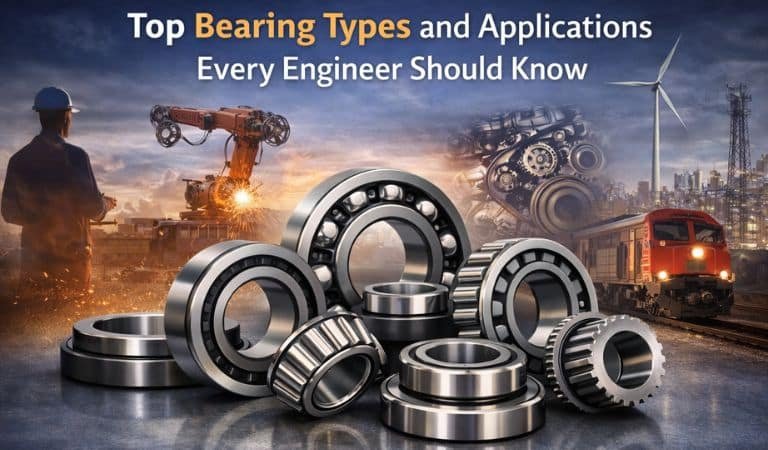
The present-day operation of mechanical systems depends on the unrecognized yet essential functions performed by bearings. The appropriate bearing selection enables electric motors and industrial machines to achieve smooth rotational movement with decreased friction and extended operational lifespan. Engineers from all fields require bearing types and applications knowledge because it enables them to choose components which boost machine performance. Kewa Bearings provides an extensive selection of precision-engineered bearings which customers can use to fulfill their industrial needs.
Understanding the Basics of Bearings
Bearings function as mechanical components which provide support to rotating shafts while they operate at low friction and carry their weight. The performance of any machine depends heavily on the bearing’s design, material, and suitability for operating conditions. The wrong choice results in overheating and vibration and energy loss and premature equipment breakdown. Engineers need to understand different bearing types and applications because this knowledge helps them make design decisions.
bearing types and applications
Ball Bearings and Their Applications
Ball bearings rank among the most frequently used bearing types because they provide both flexibility and affordable pricing. The system employs spherical rolling elements to minimize friction that occurs between its moving components. The bearings function optimally during high-speed operations that require both radial and axial load capacities at moderate levels. The system finds application in electric motors, household appliances, pumps, fans, and automotive components.
Roller Bearings for Heavy Loads
Roller bearings utilize cylindrical, tapered, and spherical rollers to support heavier loads than ball bearings can handle. The bearings operate at their maximum radial load capacity because they possess a larger contact area. Cylindrical roller bearings are used in gearboxes and compressors while tapered roller bearings suit wheel hubs and industrial transmissions. This makes roller bearings vital in many bearing types and applications.
Spherical Roller Bearings in Industrial Machinery
Spherical roller bearings are constructed to withstand both misalignment conditions and heavy load situations. The bearings maintain their operational efficiency through self-aligning capability which enables them to function properly during shaft deflection and mounting errors. The mining industry and cement production facilities and steel manufacturing plants and paper production facilities use these bearings because they need dependable equipment.
Needle Bearings for Compact Designs
Needle bearings use long, thin rollers which enable operation in tight areas that require high load capacity with minimal radial space. The small size of these objects enables them to handle substantial weight. These bearings find common application in automotive transmissions two-wheelers power tools and industrial pumps.
Thrust Bearings for Axial Loads
Thrust bearings are designed specifically to handle axial loads and prevent axial movement of shafts. They are available in ball and roller designs depending on load requirements. Thrust bearings are commonly found in machine tool spindles, marine propulsion systems, automotive gear assemblies, and heavy machinery used in industrial production.
Why Bearing Selection Matters
The selection process for suitable bearings needs assessment of factors beyond their capacity to carry loads. The performance of the system depends on five factors which include speed, temperature, lubrication system, alignment method and actual working conditions. Engineers can achieve better efficiency and lower maintenance costs and extended machine life and improved safety and energy savings through their knowledge of different bearing types and their specific uses. Kewa Bearings provides dependable certified solutions which serve all major industrial sectors.
Conclusion
For every engineer, knowledge of bearing design is a fundamental skill. Understanding bearing types and applications helps engineers make informed decisions, enhance machine reliability, and achieve long-term operational success with Kewa Bearings for long-term value and dependable industrial performance globally.
FAQs
How do bearing materials affect performance?
Bearing materials influence strength, wear resistance, corrosion protection, and overall service life.
Can one bearing type be used for all applications?
Each bearing type is designed for specific operating conditions, making correct selection essential.
Why is proper lubrication important for bearings?
Proper lubrication reduces friction, prevents overheating, and protects bearings from wear.
What bearing handles misalignment?
Spherical roller bearings handle misalignment effectively.
Why is bearing selection important?
It improves efficiency, safety, and machine lifespan.