
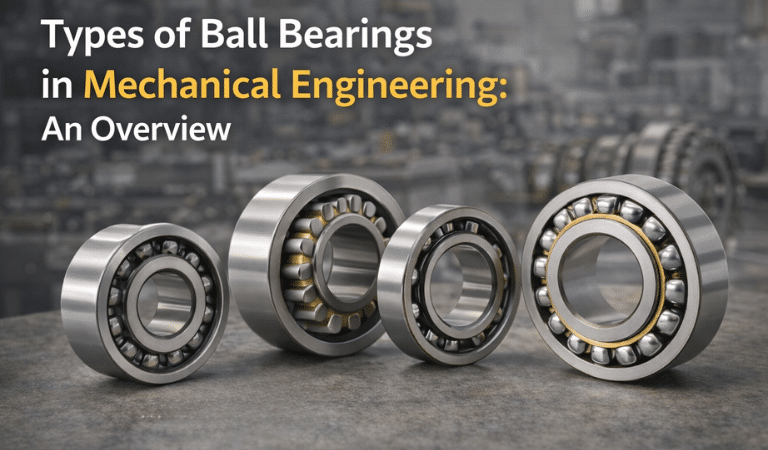
Ball bearings rank as one of the most essential things in mechanics. They range from household appliances to heavy industrial equipment. In such applications, ball bearings provide structural support and decrease the rate of wear. KEWA Bearing knows perfectly well how the right bearing influences the work of any equipment making it more durable and efficient. This post will explain in simple terms the types of ball bearings, how they work, and the most common places they are used.
What Are Ball Bearings and Why Are They Important?
Ball bearings are mechanical parts that reduce the friction in the operating parts. They are made of steel balls lodged in two metal rings, which are called races. This way, no matter what moves, the balls roll smoothly and enable that movement with no friction. This simple theory speeds up the machinery, provides quiet operation, and helps reduce wear and tear. In mechanical engineering, the ball bearings assume an important role in the increased efficiency and extension of the equipment life.
How Ball Bearings Work in Mechanical Systems
In a rotating system, friction always generates heat, causes an energy loss and even structural damage. Friction is reduced in ball bearings by replacing the sliding friction with rolling friction. The balls transfer the loads and so there is free movement of the parts. Various machines are subjected to various loads, speeds, and running conditions, therefore engineers have a choice of different types of ball bearings to use for a given application.
Deep Groove Ball Bearings
Deep groove ball bearings are the most commonly used type in mechanical engineering. They are designed to handle both radial and limited axial loads. These bearings are simple in design, easy to maintain, and suitable for high-speed operations. You find them very often in electric motors, pumps, fans, and household appliances. KEWA Bearing brings a line of good-quality deep groove ball bearings that are by far very reliable and efficient.
Angular Contact Ball Bearings
These bearings are made mainly for working in high-speed and motor-driven machines, like machine tools, precision equipment, and gearboxes, where they act as a mechanical device for supporting an axial thrust load. Due to the higher deformations resulting from the speed of the machine, a system of the appropriate pair is desired.
Self-Aligning Ball Bearings
Self-aligning ball bearings are specially designed to adjust misalignment between the shaft and housing. This feature makes them ideal for applications where alignment issues are common due to shaft deflection or mounting errors. They are widely used in agricultural machinery, conveyors, and textile machines. Among the different types of ball bearings, this type is valued for reducing maintenance problems caused by misalignment.
Thrust Ball Bearings
Thrust bearings are specifically engineered to withstand only axial loads in the absence of any radial load accommodation, which works great in instances where force is towards one direction. These kinds of bearings typically are used in rotating tables, feed screws, and automotive steering. Engineers in mechanical and civil installations generally select thrust ball bearings.
Miniature and Precision Ball Bearings
Miniature and precision ball bearings are small in size but high in performance. They are used in applications where space is limited, such as medical devices, robotics, instruments, and electronics. Despite their small size, these bearings offer high accuracy and smooth motion. KEWA Bearing supplies precision ball bearings that meet strict quality standards for sensitive mechanical applications.
Choosing the Right Ball Bearing for Your Application
Selecting the correct bearing depends on factors like load type, speed, operating temperature, and environment. Understanding the different types of ball bearings helps engineers make better decisions that improve machine life and performance. At KEWA Bearing, our experts help customers choose bearings that perfectly match their mechanical requirements.
Conclusion
For many industries, the necessity of properly functioning ball bearing, is self-explanatory. Ball bearings usually come with kinds styled for specific applications such as deep groove, angular contact designs since its thrust or self-aligning type. Awareness is the key to minimizing breakdowns and at the same time ensures continuous satisfaction of one’s customers. KEWA Bearing guarantees reliable, high-performance bearing designed to withstand professional use in keeping with the trends.
FAQs
Q.1 Which ball bearing is most commonly used in machines?
Deep groove ball bearings are the most widely used due to their simple design and versatility.
Q.2 Can ball bearings handle heavy loads?
Yes, certain ball bearings can handle moderate loads, but load capacity depends on bearing type and design.
Q. 3 What happens if the wrong bearing is used?
Using the wrong bearing can lead to overheating, noise, early failure, and machine damage.
Q. 4 Are ball bearings suitable for high-speed applications?
Yes, many ball bearings are designed specifically for high-speed rotation.
Q. 5 How often should ball bearings be replaced?
Replacement depends on usage, load, lubrication, and operating conditions.