
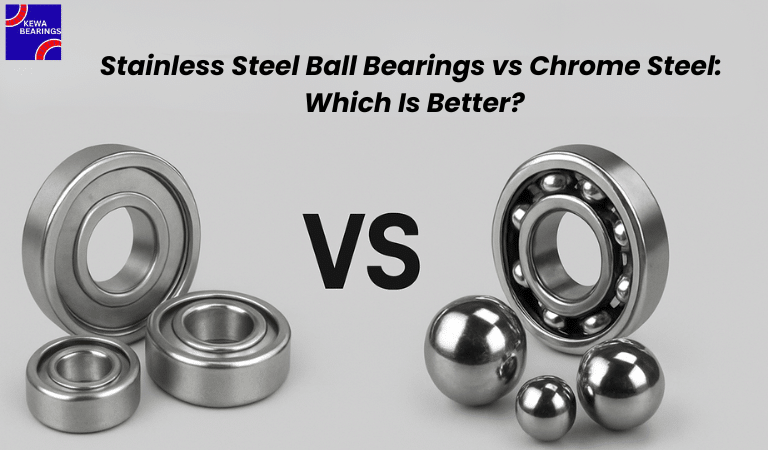
When it is machinery, vehicles or industrial applications under consideration, the selection of appropriate steel ball bearings goes a long way into improving performance, durability, and maintenance. Being considered perhaps among the most common kinds of materials used in bearings, stainless steel and chrome steel each has slightly different characteristics that make them apt for certain environments and requirements. To better guide you in deciding which type of bearing is appropriate for your use, let me compare the stainless steel ball bearing with that of chrome steel bearings.
Understanding Steel Ball Bearings
Spherical bearings are bearings that are the most precise kind, used to reduce friction between some moving parts. They consist of steel balls enclosed by an inner ring and an outer ring so that they can easily carry out rotational motion. The production of these bearings determines the strengths they possess: corrosion-resistant property and long life.
Stainless Steel Ball Bearings
From stainless steel ball bearings, we seek essentially rust resistance, corrosion resistance, and moisture resistance. Alloying chromium and nickel in the steel allows these metals to form a singular protective barrier against harsh environments.
These are bearings wetted down or getting wet with chemicals or subject to extreme weather commonly used in the food industry, marine tools, and medical instruments. A stainless steel bearing requires little maintenance and, in corrosive conditions, will last longer.
Advantages of Stainless Steel Ball Bearings:
- Excellent corrosion and rust resistance
- Durable in high-moisture and chemical environments
- Long service life with low maintenance
- Can handle both high and low temperatures effectively
Disadvantages:
- More expensive than chrome steel bearings
- Slightly lower load capacity and hardness
Chrome Steel Ball Bearings
Chrome steel bearings, usually made with AISI 52100 steel, are absolutely the choice of the strength, hardness, and smooth surface finish. In other cases where automotive, industrial, or mechanical applications require the utmost precision and holding of load, these are appropriate.
Chrome steel ball bearings will do great in clean and dry environments. From the moment they step past water or chemicals, there is all the more likelihood of rust, thus having to be lubricated and maintained fairly often.
Advantages of Chrome Steel Ball Bearings:
- High load capacity and strength
- Cost-effective and easily available
- Excellent performance under heavy loads
- Smooth and precise operation
Disadvantages:
- Susceptible to rusting and corrosion.
- They are not really suitable for atmospheric conditions where there might be humidity or lines of chemical vapors.
Key Differences Between Stainless Steel and Chrome Steel Bearings
Corrosion helps differentiate between the two types and strength. Stainless steel bearings were for longevity-based corrosive environments, while chrome steel bearing performance was high for loads and low for the cost.
| Property | Stainless Steel Bearings | Chrome Steel Bearings |
| Corrosion Resistance | Excellent | Poor |
| Load Capacity | Moderate | High |
| Hardness | Slightly lower | Higher |
| Durability in Moisture | Very Good | Low |
| Cost | Higher | Lower |
| Maintenance Need | Low | High |
Which One Should You Choose?
Different requirements exist for stainless-steel or chrome-steel ball bearings, depending on your particular application.
Due to atmospheres moist or laden with chemicals or in marine application, stainless-steel ball bearings must be used because of their corrosion resistance and longevity. Otherwise, if you are interested in handling heavy loads, precision, and cheap installation in dry conditions, chrome steel bearings would be ideal.
In brief, go for stainless steel in the name of endurance and chrome steel for high performance.
Conclusion
Both bearing types have their pros and cons. Choose according to the working conditions and performance. When working in a corrosive environment, stainless steel ball bearings are a must. On the contrary, chrome steel is the best choice when dealing with dry high-load applications due to the strength and cost advantage it offers.
FAQs
Q1. Do stainless steel ball bearings have greater strength than chrome steel bearings?
No; chrome steel bearings are harder and can carry more load.
Q2. Can stainless steel bearings be used in vehicle applications?
Yes, mostly in areas where moisture or chemicals are present.
Q3. Which steel ball-bearing type will give better service?
Chrome is better in dry conditions; stainless is your choice where corrosion sets in.
Q4. Are stainless steel bearings really worth their high prices?
Yes, if you have moisture or harsh environmental conditions upon your set.
Q5. How do I take care of steel ball bearings?
Keep them clean and lubricated with appropriate oils.